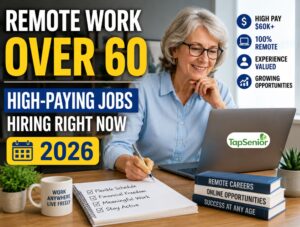
Remote Work Over 60 | High-Paying Jobs Hiring Right Now 2026. As the workforce continues to evolve, one trend has become impossible to ignore: remote work for seniors is no longer a niche opportunity. In 2026, thousands of companies are actively seeking experienced professionals who bring reliability, sound judgment, and decades of real-world knowledge to their teams. For adults over 60, this represents more than just a chance to earn extra income it offers the opportunity to remain engaged, financially secure, and professionally fulfilled while enjoying the flexibility of working from home.
Many older adults mistakenly believe that remote jobs are reserved for younger workers with advanced technical backgrounds. The reality is quite different. Employers are increasingly recognizing that qualities such as attention to detail, integrity, accountability, and excellent decision-making often matter far more than age. In industries where accuracy, confidentiality, and independent thinking are essential, experienced professionals frequently outperform less experienced applicants.
If you’re searching for high-paying remote jobs for seniors, you’re entering the market at an exciting time. Organizations across healthcare, finance, insurance, compliance, payroll, and consulting are expanding their remote workforce while offering competitive salaries, comprehensive training programs, and career advancement opportunities.
The best part is that many of these positions don’t require you to start over from scratch. Instead, they allow you to build upon skills you’ve developed throughout your career. Whether you’ve worked in administration, accounting, management, customer service, education, government, healthcare, or even operated your own business, your professional experience can translate into valuable qualifications for today’s remote positions.
This guide explores some of the most promising work from home jobs for seniors, explains why employers actively seek experienced candidates, and shows how your existing knowledge can become one of your greatest competitive advantages.
Why More Adults Over 60 Are Choosing Remote Work
Retirement no longer looks the same as it did twenty years ago.
Many people over 60 aren’t looking to completely stop working. Instead, they want flexibility, meaningful work, and additional income without sacrificing their personal lifestyle.
Remote work offers exactly that balance.
Instead of commuting through traffic every morning, professionals can work from a comfortable home office, manage their own schedules, and eliminate many of the physical demands associated with traditional employment.
Some seniors choose remote work to supplement retirement income.
Others continue working because they genuinely enjoy solving problems, collaborating with colleagues, and contributing their expertise.
Common reasons older adults pursue remote careers after retirement include:
- Greater flexibility
- Improved work-life balance
- Additional retirement income
- Reduced commuting expenses
- Better health and energy management
- Opportunities to continue learning
- The ability to stay socially and intellectually engaged
Remote employment also allows individuals to continue using decades of accumulated knowledge instead of letting those valuable skills go unused.
Why Employers Value Experienced Professionals
Contrary to common myths, many employers specifically appreciate mature professionals.
While technical skills can often be taught in a few weeks, qualities like professionalism, responsibility, communication, and sound judgment usually take decades to develop.
Experienced employees often demonstrate:
Attention to detail
Strong organizational skills
Professional communication
Excellent time management
Reliable decision-making
Confidentiality
Independent problem solving
These qualities are particularly valuable in remote positions where managers expect employees to work with minimal supervision.
Companies know they can teach software.
They cannot easily teach maturity.
That’s one reason many hiring managers actively recruit experienced workers for positions involving finance, compliance, insurance, payroll, healthcare administration, and business operations.

What Makes a Great Remote Job After 60?
Not every remote job is a good fit.
The best positions usually share several characteristics:
They rely more on judgment than physical labor.
They reward consistency rather than speed.
They emphasize communication, organization, and accuracy.
They provide structured training.
They offer long-term stability.
These jobs allow older professionals to leverage their experience instead of competing solely on technical expertise.
One of the strongest examples is becoming a Compliance Analyst, one of today’s fastest-growing remote careers.
Job #1: Compliance Analyst
Among today’s highest-paying remote opportunities, the role of Compliance Analyst stands out for professionals who enjoy organization, research, and careful attention to detail.
Although the title may sound highly specialized, much of the work revolves around something many experienced professionals have already done throughout their careers: ensuring that procedures are followed correctly.
Companies operate under numerous federal, state, and industry regulations.
A compliance analyst helps ensure the organization follows those rules consistently.
Rather than creating regulations, they verify that existing processes meet legal and organizational standards.
This work is particularly important in industries such as:
- Healthcare Compliance
- Financial Services Compliance
- Human Resources Compliance
- Insurance Compliance
- Government Contract Compliance
As regulations continue becoming more complex, organizations increasingly rely on skilled professionals who can carefully review documents and identify potential issues before they become expensive problems.
What Does a Compliance Analyst Actually Do?
Most daily responsibilities involve reviewing information rather than creating it.
Typical tasks include:
Reviewing company policies
Examining internal procedures
Checking operational documentation
Monitoring regulatory compliance
Identifying potential risks
Preparing compliance reports
Supporting internal audits
Working with different departments
Ensuring documentation meets legal requirements
This isn’t a customer-facing role.
Instead, much of the day involves focused, independent work requiring concentration and careful analysis.
For many professionals over 60, this environment feels far more comfortable than fast-paced customer service positions.
Why This Job Fits Experienced Professionals
Many older workers already possess the mindset required for compliance work.
Think about your previous career.
Did you ever:
Review contracts?
Approve paperwork?
Manage budgets?
Follow government regulations?
Supervise employees?
Conduct quality control?
Work in healthcare?
Handle confidential information?
Operate a business?
Serve on a nonprofit board?
Coordinate documentation?
If so, you’ve likely developed many transferable skills needed for remote compliance jobs.
Experience often teaches people how to recognize inconsistencies.
Small details that younger employees may overlook frequently stand out immediately to someone with decades of professional experience.
That instinct has tremendous value.

Salary Expectations in 2026
One reason compliance positions continue attracting experienced workers is compensation.
Depending on industry, location, and experience, many remote compliance professionals earn salaries ranging from approximately $70,000 to well over $120,000 annually.
Healthcare and financial compliance often offer particularly competitive compensation because mistakes can carry significant legal and financial consequences.
Even entry-level remote compliance positions frequently provide attractive salaries compared to many traditional retirement jobs.
In addition to competitive pay, employers often provide:
Health insurance
Retirement plans
Paid vacation
Remote work equipment
Professional training
Career advancement opportunities
Flexible scheduling
These benefits make compliance one of the most attractive remote jobs hiring now for experienced professionals.
Skills That Make You Successful
You don’t need to become a programmer or software engineer.
Instead, successful compliance analysts typically excel in areas such as:
- Critical thinking
- Risk assessment
- Policy interpretation
- Document review
- Written communication
- Problem solving
- Professional ethics
- Research skills
- Organization
- Time management
Technology certainly plays a role.
Most companies use document management systems, spreadsheets, databases, and collaboration software.
Fortunately, these tools are generally straightforward to learn, especially for individuals already comfortable using email, Microsoft Office, or cloud-based applications.
The Advantages of Working as a Compliance Analyst
There are several reasons this career appeals to professionals over 60.
First, much of the work is performed independently.
Managers typically assign responsibilities and expect employees to complete them without constant supervision.
Second, success depends more on quality than speed.
Being thorough matters more than rushing.
Third, your professional reputation grows over time.
As colleagues learn they can trust your judgment, you’ll often receive increasingly important assignments.
Finally, compliance work exists across numerous industries.
Healthcare organizations.
Insurance companies.
Banks.
Manufacturers.
Government contractors.
Universities.
Technology firms.
Virtually every regulated industry requires compliance professionals.
That diversity creates long-term career stability.

Challenges to Consider
Like every profession, compliance work isn’t perfect for everyone.
The job requires extended periods of concentration.
You’ll spend significant time reading policies, regulations, contracts, and reports.
Some documents can be highly technical.
If you enjoy analytical thinking, this can be rewarding.
However, individuals who prefer constant interaction with people may find the work somewhat isolated.
Eye strain can also become a concern since much of the work occurs on a computer screen.
Maintaining an ergonomic workspace, taking regular breaks, and following healthy work habits become especially important.
Industries Hiring Remote Compliance Analysts
Demand continues growing in several sectors.
Healthcare remains one of the strongest employers because patient privacy regulations continue expanding.
Financial institutions also require compliance professionals to manage increasingly complex regulations.
Other industries include:
- Healthcare Administration
- Insurance Companies
- Investment Firms
- Mortgage Companies
- Government Agencies
- Human Resources
- Pharmaceutical Companies
- Technology Companies
- Educational Institutions
This broad demand provides flexibility if you’d like to transition between industries later in your career.
How to Prepare for Your First Compliance Role
Many applicants assume they need years of direct compliance experience.
That’s often not true.
Instead, employers frequently prioritize transferable skills.
Begin by identifying examples from your previous career where you:
- Solved procedural problems.
- Reviewed documentation.
- Protected confidential information.
- Improved organizational processes.
- Ensured policies were followed.
- Reduced operational risks.
- Coordinated projects.
- Managed records.
These accomplishments demonstrate the exact type of thinking employers seek.
If you’d like to strengthen your qualifications even further, consider taking introductory online courses covering:
Regulatory compliance
Risk management
Corporate governance
Healthcare regulations
Business ethics
Internal auditing
Many of these programs can be completed online within several weeks and significantly strengthen your resume.
Resume Tips for Compliance Positions
When applying for remote compliance roles, avoid simply listing job titles.
Instead, emphasize measurable accomplishments and transferable skills.
Use professional language that reflects your experience.
For example, instead of saying:
“Reviewed paperwork.”
Describe the accomplishment more effectively:
“Reviewed operational documentation to ensure regulatory compliance while maintaining accuracy and confidentiality.”
Employers also appreciate candidates who highlight competencies such as:
- Risk Management
- Regulatory Compliance
- Internal Auditing
- Policy Enforcement
- Documentation Review
- Quality Assurance
- Data Integrity
- Process Improvement
These keywords help demonstrate your experience while making your resume more relevant to applicant tracking systems.
For professionals over 60, your career history is one of your greatest strengths. Rather than hiding decades of experience, focus on presenting the most relevant achievements that show your ability to solve problems, work independently, and maintain high standards of accuracy. Employers hiring for compliance positions are looking for dependable professionals who can be trusted with important responsibilities, and those qualities often come with years of practical experience.
Job #2: Payroll Specialist
Another outstanding remote career for adults over 60 is becoming a Payroll Specialist. While many people assume payroll is all about complicated mathematics, the reality is much different. Modern payroll software performs nearly all calculations automatically. The real responsibility belongs to the professional reviewing information, verifying accuracy, protecting confidential employee records, and ensuring every paycheck is processed correctly.
Companies simply cannot afford payroll mistakes. Employees expect to be paid accurately and on time, regardless of company size. Because of this, employers place tremendous value on professionals who are dependable, detail-oriented, and trustworthy.
For seniors who have spent decades balancing budgets, managing office operations, overseeing bookkeeping, or handling administrative work, payroll can be an incredibly natural transition into the world of remote work for seniors.
What Does a Payroll Specialist Do?
Every payroll cycle follows a structured process, and the Payroll Specialist ensures each step is completed correctly.
Typical responsibilities include:
Collecting employee timesheets
Reviewing attendance records
Verifying work hours
Checking tax withholding information
Confirming employee deductions
Reviewing overtime calculations
Ensuring payroll deadlines are met
Maintaining confidential salary information
Preparing payroll reports
Communicating with Human Resources and Accounting
Although payroll software automates calculations, someone must verify that all information entered into the system is correct. Accuracy is the foundation of the role.
Salary Expectations
Payroll remains one of the most stable business functions because every organization, regardless of industry, needs employees to be paid correctly.
In 2026, remote Payroll Specialists commonly earn between approximately $52,000 and $72,500 per year, while experienced professionals or certified specialists may earn considerably more.
Entry-level positions generally start around $47,000 annually, with excellent opportunities for salary growth after gaining experience or earning certifications such as the Fundamental Payroll Certification (FPC).
Why Seniors Often Excel in Payroll
Many of the qualities employers seek cannot be taught through a short training course.
Companies value professionals who:
- Protect Confidential Information
- Meet Strict Deadlines
- Maintain Data Accuracy
- Follow Established Procedures
- Communicate Professionally
- Work Independently
These characteristics often develop through decades of professional experience.
Someone who has managed office finances, operated a family business, supervised employees, or handled accounting responsibilities already understands the importance of precision and discretion.
Employers recognize that experience.
Rather than viewing older applicants as outdated, many hiring managers see them as dependable professionals who understand responsibility.
Skills That Transfer Well
Previous careers in many different industries provide relevant experience.
Examples include:
Administrative Assistant
Office Manager
Bookkeeper
Executive Assistant
School Administrator
Healthcare Administrator
Government Employee
Small Business Owner
Human Resources Coordinator
Accounting Clerk
Even years of managing household finances, coordinating volunteer organizations, or running nonprofit operations demonstrate valuable organizational abilities.
Payroll Software Is Easier Than Many Think
One concern many older job seekers have involves technology.
Fortunately, payroll systems are designed to simplify work rather than complicate it.
Many organizations provide complete training on platforms such as:
- ADP
- Workday
- Paychex
- QuickBooks Payroll
- UKG
- Oracle Payroll
Companies generally care far more about your willingness to learn than whether you’ve already mastered every software package.
Challenges of Payroll Work
Although payroll offers excellent stability, applicants should understand the responsibilities.
Payroll deadlines cannot move.
If payroll must be completed every Friday, that deadline remains fixed regardless of unexpected events.
The work also involves handling confidential salary information.
Professional ethics are absolutely essential.
Fortunately, these expectations align well with the strengths many experienced professionals already possess.
Job #3: Assistant Underwriter
The third career worth serious consideration is becoming an Assistant Underwriter.
Insurance companies constantly evaluate risk.
Before issuing insurance coverage, they must determine whether an applicant represents an acceptable level of financial risk.
Assistant Underwriters help gather information that supports those decisions.
This role combines analytical thinking, organization, research, and professional judgment.
Unlike physically demanding jobs, underwriting relies almost entirely on careful decision-making.
What Does an Assistant Underwriter Do?
Rather than selling insurance, Assistant Underwriters evaluate information.
Daily tasks may include:
Reviewing insurance applications
Analyzing supporting documentation
Verifying applicant information
Examining claims histories
Researching property details
Assessing financial risk
Preparing underwriting reports
Communicating with insurance agents
Supporting senior underwriters
Maintaining organized records
Much of the work follows structured procedures, making it ideal for professionals who enjoy logical thinking.
Salary Potential
Assistant Underwriters generally begin earning between $46,000 and $59,000 annually.
However, the long-term opportunity is particularly attractive.
After gaining several years of experience, many professionals advance into full Underwriter positions earning $64,000 to well above $100,000 annually.
Specialized underwriting fields—including commercial insurance, healthcare, cyber insurance, and financial services often pay even more.
For seniors interested in building a second career rather than simply earning part-time income, underwriting offers impressive growth potential.
Why Experience Matters
Insurance companies don’t simply need employees who understand software.
They need professionals capable of exercising sound judgment.
Every application presents unique circumstances.
Experienced professionals naturally recognize patterns because they’ve encountered countless real-life situations throughout their careers.
This ability to evaluate risk often develops through decades of experience rather than formal education alone.
That’s one reason mature professionals remain highly valuable in insurance.
Skills Employers Want
Successful underwriters typically possess:
- Risk Assessment
- Critical Thinking
- Analytical Skills
- Decision Making
- Professional Judgment
- Attention to Detail
- Communication Skills
- Problem Solving
- Documentation Review
- Time Management
Notice that many of these abilities come from experience rather than technical training.
Learning the Industry
New terminology can initially feel overwhelming.
Insurance includes specialized language covering policies, liability, claims, underwriting guidelines, and risk classifications.
Fortunately, reputable insurance companies usually provide structured onboarding programs lasting several weeks or months.
Most organizations expect new hires to learn while working.
The first ninety days require commitment, but many professionals quickly become comfortable with the systems.

Why Remote Work Benefits Seniors Beyond Income
Although earning additional income remains an important motivation, remote employment provides several other meaningful benefits.
Working from home helps maintain daily structure after retirement.
Professional responsibilities encourage continued learning and mental stimulation.
Many seniors report feeling more connected and confident while contributing their expertise.
Additional benefits include:
Greater independence
Improved financial security
Expanded professional networks
Continued intellectual engagement
Flexible scheduling
Reduced commuting costs
Better work-life balance
Opportunities to mentor younger colleagues
For many individuals, remote work becomes an enjoyable extension of retirement rather than a replacement for it.
Optimizing Your Resume for Applicant Tracking Systems
One of the biggest challenges job seekers face today involves Applicant Tracking Systems (ATS).
Before a recruiter reviews your resume, software often scans documents for relevant skills and keywords.
That doesn’t mean stuffing your resume with random buzzwords.
Instead, naturally incorporate industry terminology that accurately reflects your experience.
For Compliance positions, consider including phrases such as:
Regulatory Compliance
Policy Enforcement
Risk Mitigation
Internal Audit
Documentation Review
Process Improvement
For Payroll positions, useful keywords include:
Payroll Processing
Data Integrity
Confidentiality
Payroll Administration
Disbursement Accuracy
Employee Records Management
For Underwriting positions, valuable keywords include:
Risk Assessment
Liability Evaluation
Loss Prevention
Strategic Decision Support
Policy Analysis
Analytical Review
These keywords should appear naturally within descriptions of your actual accomplishments rather than as isolated lists.
Highlight Transferable Experience
Many seniors underestimate how valuable their previous careers truly are.
You may never have held the exact title of Compliance Analyst or Payroll Specialist.
That doesn’t mean you lack relevant experience.
Think about situations where you:
Reviewed contracts
Managed confidential information
Solved operational problems
Supervised employees
Created reports
Balanced budgets
Coordinated projects
Maintained accurate records
Followed government regulations
Implemented company procedures
These accomplishments demonstrate the exact competencies employers seek.
Instead of focusing on job titles, focus on results.
Best Practices for Finding Legitimate Remote Jobs
As remote work becomes increasingly popular, fraudulent job postings have also increased.
Protect yourself by following several important guidelines.
Look for employers with established websites and verifiable business information.
Research company reviews before applying.
Never pay application fees.
Never purchase equipment from unknown vendors requested by employers.
Be cautious if interviews occur only through text messages.
Avoid positions promising unrealistic income for minimal work.
Legitimate employers conduct professional hiring processes similar to traditional office positions.

Build Confidence with Continuous Learning
Technology continues evolving, but learning never stops.
Fortunately, many excellent online resources help older adults remain competitive.
Consider strengthening your skills in:
Microsoft Excel
Microsoft Word
Google Workspace
Business Communication
Project Management
Business Writing
Cybersecurity Awareness
Cloud Collaboration Tools
Even a few hours of learning each week can significantly improve your confidence during interviews.
Remember that employers often value adaptability more than perfection.
The Future of Remote Careers for Adults Over 60
The demand for experienced professionals is expected to remain strong throughout the coming years.
Healthcare organizations face increasing regulatory requirements.
Insurance companies continue expanding digital operations.
Financial institutions require stronger compliance controls.
Businesses of every size depend on accurate payroll systems.
These trends create sustainable opportunities for mature professionals willing to embrace remote work.
More importantly, employers are increasingly recognizing that experience remains one of the most valuable assets any employee can offer.
Patience.
Professional judgment.
Integrity.
Reliability.
Strong communication.
These qualities rarely disappear with age they often become even stronger.
Final Thoughts
The modern workplace is changing rapidly, and adults over 60 are uniquely positioned to benefit from those changes. Instead of viewing age as a limitation, many employers now recognize the tremendous value that experienced professionals bring to remote teams.
Whether you choose to pursue a Compliance Analyst, Payroll Specialist, or Assistant Underwriter position, each career offers the opportunity to earn competitive income while enjoying the flexibility of working from home. These roles reward qualities that many seniors have spent decades developing: attention to detail, accountability, professionalism, and thoughtful decision-making.
The key to success is presenting your experience in a way that today’s employers understand. Update your resume, learn the basic digital tools used in modern workplaces, and confidently highlight the transferable skills you’ve built throughout your career. You don’t need to reinvent yourself you simply need to demonstrate how your existing expertise fits today’s remote workforce.
As more organizations embrace flexible hiring in 2026 and beyond, high-paying remote jobs for seniors will continue expanding across healthcare, finance, insurance, payroll, and compliance. With preparation, persistence, and the willingness to learn, your next rewarding career may be only a few applications away.
Frequently Asked Questions
Is it really possible to start a remote career after age 60?
Absolutely. Many employers value experience, reliability, and professional judgment over age. Thousands of companies actively hire mature professionals for remote positions every year.
Do I need advanced computer skills?
Not necessarily. Most remote jobs require basic proficiency with email, video meetings, spreadsheets, and office software. Employers often provide training on their own systems.
Which remote job offers the highest earning potential?
Among the careers discussed, Compliance Analyst and experienced Insurance Underwriter positions typically offer the highest salary ranges, with many professionals earning well into six figures depending on industry and specialization.
Can I transition into these careers without direct experience?
Yes. Many employers look for transferable skills rather than identical job titles. Experience in administration, finance, healthcare, government, education, management, or business ownership often translates exceptionally well into these remote roles.
How can I increase my chances of getting hired?
Tailor your resume for each application, include relevant industry keywords, emphasize measurable accomplishments, continue learning modern workplace technology, and confidently present the decades of professional experience that set you apart from less experienced candidates.Remote Work Over 60
Bài viết liên quan: