
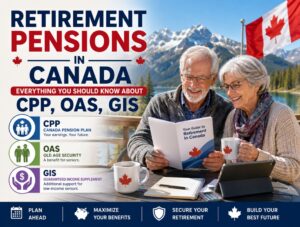
Retirement Pensions in Canada – Everything You Should Know About CPP, OAS, GIS. Planning for retirement is one of the most important financial decisions Canadians will ever make. While many people spend decades contributing to workplace pension plans, personal investments, RRSPs, TFSAs, and other savings accounts, a large portion of retirement income still comes from government-sponsored pension programs. Understanding how these programs work can help retirees maximize their benefits, reduce taxes, and enjoy greater financial security throughout their retirement years.
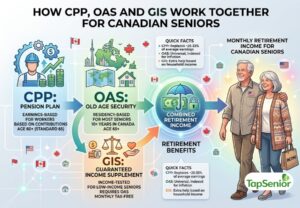
Canada offers three major retirement income programs that form the foundation of retirement planning: Canada Pension Plan (CPP), Old Age Security (OAS), and the Guaranteed Income Supplement (GIS). Each program serves a different purpose, has different eligibility requirements, and follows unique rules regarding benefit calculations, taxation, and payment timing.
Unfortunately, many Canadians wait until they are approaching retirement before learning how these pension programs actually work. By then, they may have already missed valuable opportunities to increase their lifetime income. Choosing when to start receiving CPP or OAS can permanently affect the amount of money received every month. Likewise, understanding GIS eligibility can make a significant difference for lower-income seniors.
Making informed decisions requires more than simply knowing the age you become eligible. It involves understanding contribution history, residency requirements, tax implications, life expectancy, employment plans, and how various retirement income sources interact with one another. A well-planned retirement strategy often means thousands or even tens of thousands of additional dollars over a lifetime.
This comprehensive guide explains everything Canadian seniors need to know about Canada retirement pensions, including how Canada Pension Plan, Old Age Security, and Guaranteed Income Supplement work together. Whether you are approaching retirement, already retired, or helping your parents prepare for retirement, understanding these programs can help you make smarter financial decisions.
Let’s begin with Canada’s largest retirement pension program: the Canada Pension Plan.
Understanding Canada’s Retirement Income System
Before exploring each pension individually, it’s important to understand how Canada’s retirement income system is structured.
The retirement income system is often described as having three pillars.
The first pillar consists of government benefits, including Canada Pension Plan, Old Age Security, and Guaranteed Income Supplement.
The second pillar includes employer-sponsored pension plans, whether defined benefit or defined contribution plans.
The third pillar consists of personal retirement savings such as RRSPs, TFSAs, investment portfolios, rental properties, and other assets accumulated throughout one’s working life.
Government pensions were never intended to replace a person’s full employment income. Instead, they provide a reliable financial foundation upon which Canadians build additional retirement savings.
For this reason, retirement planning should involve understanding all available income sources instead of relying on only one pension program.
What Is the Canada Pension Plan (CPP)?
The Canada Pension Plan is Canada’s mandatory public pension program designed to provide monthly retirement income for workers who contributed during their careers.
Unlike Old Age Security, CPP is directly tied to employment. Every time eligible Canadians earn employment income, they contribute to CPP.
Employees contribute through payroll deductions, while employers match those contributions. Self-employed individuals contribute both the employee and employer portions because they effectively serve as both.
The program is intended to replace part of your employment income during retirement rather than fully support your lifestyle.
Today’s enhanced CPP gradually replaces a larger percentage of pre-retirement earnings than it did in previous decades, making it an increasingly valuable source of retirement income.
Because contributions occur throughout a person’s working life, the amount received during retirement depends heavily on contribution history.
Why CPP Exists
The government introduced CPP to ensure Canadians have a dependable source of retirement income after leaving the workforce.
Without mandatory pension contributions, many workers might not save enough for retirement.
CPP helps reduce poverty among older adults while providing predictable monthly payments that continue for life.
Unlike personal investments, CPP payments continue regardless of stock market performance, economic recessions, or interest rate changes.
This reliability makes CPP one of the most valuable components of retirement planning.

Who Must Contribute to CPP?
Generally speaking, anyone earning employment income in Canada contributes to CPP.
This includes:
- Full-time employees
- Part-time employees
- Seasonal workers
- Self-employed individuals
- Independent contractors who qualify under CPP rules
Most Canadians contribute until age 65.
Individuals who continue working after age 65 may choose whether to continue making CPP contributions until age 70.
For self-employed Canadians, contributions are calculated when filing annual income taxes rather than deducted from a paycheck.
Although paying both portions can seem expensive, these additional contributions often lead to larger retirement benefits later.
How CPP Contributions Work
CPP contributions are based on pensionable earnings.
Each year, the federal government establishes annual contribution rates, income thresholds, and maximum pensionable earnings.
Only income within specified ranges requires CPP contributions.
Income below the basic exemption is excluded.
Once earnings exceed the annual maximum pensionable earnings threshold, no further CPP contributions are required until the following calendar year.
Many employees notice that their paychecks become slightly larger toward the end of the year after reaching the annual contribution maximum.
This is completely normal and reflects that required CPP deductions have stopped.
Because these contribution limits are updated annually, Canadians should always review the latest figures before making retirement projections.
CPP Enhancement
Recent reforms have gradually strengthened the Canada Pension Plan.
The CPP enhancement increases future retirement benefits by requiring slightly higher contributions during working years.
The goal is to replace approximately one-third of average employment earnings instead of roughly one-quarter under the original system.
Younger workers and those still employed during the enhancement period will benefit the most because they contribute under the enhanced formula for a longer period.
Canadians who retired before these changes generally do not receive additional benefits from the enhancement.
Who Can Receive CPP?
Eligibility for CPP is surprisingly straightforward.
You generally qualify if:
- You are at least 60 years old.
- You made at least one valid CPP contribution during your working life.
Even someone who worked in Canada for only a few years may qualify for CPP.
The monthly benefit may be relatively small compared with someone who contributed for decades, but eligibility still exists.
Another important point is that retirees do not necessarily need to remain in Canada to receive CPP payments.
Many Canadians retire overseas while continuing to collect their pension.
However, tax obligations may differ depending on residency status and tax treaties between Canada and the country of residence.
Professional tax advice is recommended for anyone planning to retire abroad.

Is CPP Financially Secure?
Many Canadians worry about the long-term sustainability of government pensions.
Fortunately, CPP operates differently from programs funded directly through annual government budgets.
The plan is managed by an independent investment organization responsible for investing contribution funds on behalf of contributors.
Its investment portfolio includes global stocks, bonds, infrastructure, private equity, real estate, and other long-term assets.
Independent actuarial reviews regularly evaluate the financial health of CPP, and current projections indicate that the program remains financially sustainable for many decades under existing contribution rates.
This long-term stability provides retirees with confidence that CPP will continue supporting future generations.
How Your CPP Retirement Benefit Is Calculated
No two Canadians receive exactly the same CPP payment.
Monthly benefits depend primarily on three factors.
1. Your Contribution History
The more you contributed throughout your working years, the higher your retirement pension is likely to be.
Workers who consistently earned higher incomes generally contributed more.
Those contributions translate into larger retirement benefits.
2. Years of Contributions
Someone who contributed for nearly four decades will usually receive significantly more than someone who only contributed for ten or fifteen years.
Individuals who immigrated later in life often have fewer contribution years, which may reduce their monthly pension.
Career breaks can also affect total contributions.
3. The Age You Begin Receiving CPP
This is one of the most important retirement decisions you’ll ever make.
Choosing to receive CPP earlier permanently reduces monthly payments.
Delaying CPP permanently increases monthly payments.
The increase or reduction lasts for the rest of your life.
Because annual inflation adjustments apply to your starting benefit, beginning with a larger pension often produces higher inflation-adjusted payments over time.
CPP Dropout Provisions
Fortunately, the government recognizes that not everyone enjoys a perfect employment history.
Certain provisions help prevent temporary career interruptions from significantly reducing retirement benefits.
General Dropout Provision
One helpful feature automatically excludes a percentage of your lowest earning years when calculating CPP benefits.
This protects workers who experienced periods of unemployment, lower wages, or career transitions.
Most Canadians never need to apply for this provision because it is automatically included.
Child-Rearing Provision
Parents who stayed home or reduced working hours while raising young children may qualify for additional protection.
Eligible caregivers can exclude certain low-income years associated with caring for children.
This provision helps parents avoid unfairly reduced retirement pensions because of family responsibilities.
Unlike the general dropout provision, this benefit usually requires an application.
Disability Provision
Workers who experienced prolonged disability may also have low-income periods removed from benefit calculations.
This helps ensure disability-related employment interruptions do not unfairly reduce retirement income.
These dropout provisions demonstrate that CPP recognizes the realities of modern careers rather than assuming continuous full-time employment throughout adulthood.
When Should You Start Receiving CPP?
One of the most frequently asked retirement questions is:
Should I start CPP at age 60, wait until 65, or delay until age 70?
There is no universal answer.
Each option has advantages depending on health, financial needs, employment plans, taxes, and life expectancy.
Starting CPP at Age 60
The earliest Canadians can generally begin receiving CPP is age 60.
Starting early provides income sooner.
This option may be attractive for individuals who:
- Retire early
- Have health concerns
- Need additional income
- Expect shorter life expectancy
- Have physically demanding careers
However, beginning at age 60 permanently reduces monthly benefits.
Because payments are lower for life, early retirement requires careful consideration.
Starting CPP at Age 65
Age 65 is considered the standard retirement age for CPP.
Benefit calculations use this age as the reference point.
Many Canadians choose this option because it aligns with traditional retirement planning and eligibility for other government retirement benefits.
Delaying CPP Until Age 70
Waiting until age 70 provides the largest monthly CPP payment available.
Each month of delay increases future retirement income.
Canadians with good health, longer expected life expectancy, substantial retirement savings, or continued employment often benefit from delaying CPP.
Although waiting requires using other income sources during the delay period, higher lifelong monthly payments may provide greater financial security later in retirement.
Questions to Ask Before Choosing Your CPP Start Date
Rather than focusing only on maximizing payments, retirees should consider their complete financial picture.
Important questions include:
Do I need retirement income immediately?
Will I continue working after age 60 or 65?
What other income sources do I have?
How healthy am I?
What is my family history regarding longevity?
Will I spend more during early retirement or later retirement?
Am I comfortable delaying guaranteed income?
Retirement planning is about balancing mathematics with personal priorities.
Sometimes maximizing lifetime income is appropriate.
Other times, enjoying retirement earlier may be the better choice.
CPP Is Taxable Income
Many retirees are surprised to learn that Canada Pension Plan benefits are taxable.
CPP payments are included in taxable income alongside employment income, private pensions, RRIF withdrawals, rental income, investment income, and other taxable sources.
This means your CPP decision should never be made in isolation.
Instead, it should fit within a broader retirement tax strategy.
Proper planning can reduce lifetime taxes while helping preserve eligibility for other retirement benefits discussed later in this guide.

Additional CPP Benefits Beyond Retirement
Most Canadians think only about retirement pensions when discussing CPP.
However, the program also provides several valuable additional benefits.
Survivor Pension
If a CPP contributor dies, their surviving spouse or common-law partner may qualify for monthly survivor benefits.
The amount depends on several factors, including age and other CPP benefits already being received.
This support can provide important financial stability following the loss of a spouse.
Disability Benefits
Workers who become severely and permanently disabled before retirement age may qualify for CPP disability benefits.
These monthly payments help replace employment income when individuals can no longer work because of qualifying medical conditions.
Once recipients reach retirement age, disability benefits generally transition into regular retirement CPP.
Children’s Benefits
Dependent children of disabled or deceased CPP contributors may also qualify for monthly assistance under certain conditions.
These benefits help families maintain financial stability during difficult circumstances.
Death Benefit
CPP also provides a one-time death benefit paid to the deceased contributor’s estate or eligible applicants.
Although relatively modest compared with other benefits, it helps offset some funeral and estate-related expenses.
Applying for CPP
One common misconception is that CPP begins automatically.
In reality, most Canadians must apply to receive their retirement pension.
Applications can typically be completed online through a government account or submitted using paper forms.
Applying online generally results in faster processing.
Retirees should apply well before the desired pension start date to avoid unnecessary delays.
Those who accidentally delay their application may still qualify for limited retroactive payments, depending on government rules.
Likewise, individuals who recently began receiving CPP but change their minds may, in certain situations, cancel their application within a specified timeframe and reapply later.
Understanding these rules before retirement helps avoid costly mistakes that could affect retirement income for decades.
Understanding Old Age Security (OAS)
While the Canada Pension Plan is based on employment contributions, Old Age Security (OAS) works very differently. OAS is Canada’s largest government-funded pension program for seniors and is designed to provide a basic level of retirement income regardless of whether someone spent their career working full-time, part-time, or even outside the workforce.
Unlike CPP, you do not earn OAS by contributing through payroll deductions. Instead, eligibility is primarily determined by your age and how long you have lived in Canada after turning 18.
This distinction is extremely important because many immigrants who have lived in Canada for many years may qualify for OAS even if they have relatively little CPP entitlement. Likewise, Canadians who spent years raising children or acting as caregivers may still receive significant OAS benefits despite having limited employment history.
For millions of seniors, Old Age Security benefits become a dependable source of monthly income that helps cover housing, groceries, transportation, healthcare expenses, and everyday living costs.
Who Is Eligible for OAS?
To qualify for OAS, you generally must:
- Be at least 65 years old.
- Be a Canadian citizen or legal resident when your application is approved.
- Have lived in Canada for at least 10 years after turning 18 if residing in Canada.
Individuals living outside Canada may still qualify if they accumulated sufficient years of Canadian residency before leaving the country.
Unlike CPP, employment history does not determine eligibility.
Someone who never worked because they cared for family members may still qualify for OAS if residency requirements are met.
This makes Old Age Security one of Canada’s most inclusive retirement programs.
How OAS Is Calculated
Your monthly OAS benefit depends almost entirely on your years of Canadian residency.
Individuals who have lived in Canada for 40 years or more after age 18 generally qualify for the maximum benefit.
Those with fewer than 40 qualifying years typically receive a proportional amount.
For example:
Someone who lived in Canada for 20 qualifying years would generally receive approximately half of the maximum OAS pension.
This proportional approach ensures that benefits reflect an individual’s long-term connection to Canada while still providing meaningful retirement support.
Delaying OAS
Many Canadians assume OAS automatically begins at age 65.
However, retirees may choose to delay receiving OAS until age 70.
Each month of delay permanently increases future monthly payments.
This option can be attractive for retirees who:
- Continue working after age 65.
- Have substantial retirement savings.
- Expect higher longevity.
- Want larger guaranteed income later in retirement.
Delaying OAS is not the right decision for everyone.
Individuals needing income immediately may benefit more from beginning OAS at age 65 rather than waiting.
The decision should always be considered alongside CPP, investment withdrawals, RRIF income, and personal tax planning.
OAS Is Taxable
Like CPP, Old Age Security payments are taxable.
Many retirees mistakenly believe government pensions are tax-free.
In reality, OAS payments are included in taxable income and can affect eligibility for other government benefits.
Understanding this relationship becomes especially important for retirees with significant investment income or workplace pensions.
Understanding the OAS Clawback
One of the most misunderstood aspects of Canadian retirement planning is the OAS Clawback, officially known as the OAS Pension Recovery Tax.
Unlike CPP, OAS is income-tested for higher-income seniors.
If annual taxable income exceeds the government’s threshold, part or all of the OAS benefit must be repaid.
The repayment is calculated automatically using information from your income tax return.
You do not write a separate cheque to the government.
Instead, future OAS payments are reduced accordingly.
Many retirees are surprised by the clawback because they fail to consider all taxable income sources.
The calculation includes income from:
- CPP
- Workplace pensions
- RRIF withdrawals
- Employment income
- Rental income
- Interest income
- Dividend income
- Capital gains
- Other taxable retirement income
The higher your taxable income becomes, the greater the reduction in your OAS benefit.
For affluent retirees, proper planning can significantly reduce the impact of the clawback.
Strategies to Reduce the OAS Clawback
Reducing taxable income often allows retirees to preserve more of their OAS payments.
Some common planning strategies include carefully managing retirement withdrawals.
For example, retirees may coordinate withdrawals from RRIFs, TFSAs, and taxable investment accounts to smooth taxable income over multiple years.
Since TFSA withdrawals are generally tax-free, they do not increase taxable income used in the clawback calculation.
Income splitting between spouses can also reduce total household taxes while preserving OAS eligibility.
Rather than making withdrawal decisions year by year without a plan, developing a long-term retirement income strategy often produces significantly better financial outcomes.
Guaranteed Income Supplement (GIS)
For lower-income seniors, the Guaranteed Income Supplement (GIS) provides another valuable layer of financial support.
Unlike CPP and OAS, GIS is completely tax-free.
It is specifically designed to help seniors with limited retirement income maintain a reasonable standard of living.
GIS works alongside OAS.
In other words, receiving OAS is generally a requirement before receiving GIS.
Because GIS targets low-income seniors, eligibility depends largely on annual income.
Individuals with substantial retirement savings or investment income usually do not qualify.
However, for those who do qualify, GIS can dramatically improve monthly retirement income.
Who Qualifies for GIS?
Generally, applicants must:
- Be at least 65 years old.
- Receive Old Age Security.
- Live in Canada.
- Meet annual income requirements.
Unlike OAS, GIS is intended specifically for seniors living in Canada.
Individuals residing permanently outside Canada generally cannot receive GIS benefits.
Income thresholds are reviewed regularly, meaning eligibility can change as financial circumstances change.
Each year, the government reassesses eligibility using income tax information.
Why GIS Matters
For many seniors, GIS represents the difference between financial hardship and financial stability.
Housing costs, grocery prices, medications, transportation, utilities, and healthcare expenses continue rising each year.
Without GIS, many lower-income retirees would struggle to meet essential living expenses.
The tax-free nature of GIS further increases its value because recipients keep every dollar they receive.
GIS and Other Retirement Income
One important consideration is that many types of retirement income affect GIS eligibility.
CPP benefits, employment income, RRIF withdrawals, rental income, and investment earnings may reduce GIS.
However, OAS payments themselves generally are not counted when determining GIS eligibility.
This creates important planning opportunities for retirees seeking to maximize lifetime government benefits.
Professional retirement planning often focuses on balancing multiple income sources to preserve GIS whenever possible.
Allowance Program
Canada also provides an additional tax-free benefit known simply as the Allowance.
This program supports certain lower-income individuals between ages 60 and 64 whose spouse or common-law partner qualifies for GIS.
The Allowance helps bridge the income gap until the younger spouse reaches age 65 and becomes eligible for OAS.
Like GIS, eligibility depends largely on household income.
Applications should generally be submitted several months before eligibility begins to avoid payment delays.
Allowance for the Survivor
The government also offers financial support for certain widowed Canadians through the Allowance for the Survivor.
Eligible applicants generally include individuals who:
- Are between 60 and 64 years old.
- Live in Canada.
- Have not remarried or entered another common-law relationship.
- Meet annual income requirements.
This benefit helps provide temporary financial assistance during an especially difficult period before regular retirement benefits begin.

Choosing Between CPP and OAS
One of the biggest retirement planning questions is whether retirees should begin CPP, OAS, or both as soon as they become eligible.
The answer depends on each person’s financial situation.
Someone continuing full-time employment may benefit from delaying both pensions.
Another retiree with limited savings may need immediate income.
Others may choose to begin OAS while delaying CPP because delayed CPP generally receives larger lifetime increases.
There is no single strategy that works for everyone.
Instead, decisions should consider health, taxes, family history, investment assets, spending needs, employment plans, and life expectancy.
Retirement Income Planning Matters
Government pensions should never be viewed independently.
Instead, retirees should build a comprehensive retirement income strategy.
A complete retirement plan often coordinates:
- Canada Pension Plan
- Old Age Security
- Guaranteed Income Supplement
- Workplace pensions
- RRSP withdrawals
- RRIF withdrawals
- TFSA withdrawals
- Investment income
- Rental income
- Employment income
The order in which income is received can significantly influence taxes and government benefits.
Even relatively small adjustments may generate thousands of additional dollars over retirement.
Common Retirement Pension Mistakes
Many retirees unintentionally reduce their lifetime retirement income.
Some of the most common mistakes include:
Starting CPP Too Early
Although receiving income immediately may feel attractive, permanently reduced monthly benefits may not be ideal for healthy individuals expecting long retirements.
Ignoring Tax Planning
Taxes continue throughout retirement.
Failing to coordinate pension income with investments may increase taxes unnecessarily.
Forgetting About OAS Clawback
Higher-income retirees often underestimate how taxable income affects OAS.
Without planning, valuable benefits may be lost.
Waiting Too Long to Apply
Some Canadians mistakenly assume benefits begin automatically.
Always verify application requirements and payment status.
Depending Entirely on Government Pensions
Government pensions provide valuable financial security, but they were never intended to replace full employment income.
Most retirees benefit from combining pensions with personal savings and investments.
Practical Retirement Planning Tips
Preparing for retirement becomes much easier when planning starts early.
Consider these best practices:
Review your Canada Pension Plan contribution record regularly.
Estimate future CPP and OAS benefits before retirement.
Understand how investment withdrawals affect taxes.
Maximize TFSA savings whenever possible.
Review RRSP and RRIF withdrawal strategies.
Plan for healthcare costs during retirement.
Discuss retirement goals with your spouse.
Review beneficiary designations.
Meet with a qualified financial advisor before making irreversible pension decisions.
Good retirement planning is not about finding one perfect answer.
It is about building a flexible strategy that supports your lifestyle throughout retirement.
Frequently Asked Questions
Can I receive both CPP and OAS?
Yes. Most eligible Canadians receive both benefits, provided they meet each program’s requirements.
Is CPP enough for retirement?
For most Canadians, no. CPP provides an important income foundation, but additional savings are usually necessary for a comfortable retirement.
Is OAS based on employment?
No. OAS is primarily based on age and Canadian residency rather than employment history.
Is GIS taxable?
No. Guaranteed Income Supplement payments are generally tax-free.
Can I receive CPP while living outside Canada?
Yes. Many retirees continue receiving CPP while living abroad, although tax rules may differ depending on residency and international tax agreements.
Should everyone delay CPP until age 70?
Not necessarily. The best decision depends on personal finances, health, retirement goals, taxes, and expected longevity.
Final Thoughts
Canada’s retirement system provides an excellent financial foundation through Canada Pension Plan, Old Age Security, and the Guaranteed Income Supplement. Understanding how each program works and how they interact can help retirees make informed decisions that increase lifetime income while minimizing taxes and preserving valuable government benefits.
The most successful retirement plans do not rely on guesswork. Instead, they combine government pensions with personal savings, tax-efficient withdrawal strategies, and thoughtful long-term planning. Whether you are five years away from retirement or already receiving pension benefits, taking the time to understand your options today can make a meaningful difference in your financial future.
Retirement is about more than receiving monthly pension payments. It is about creating the confidence to enjoy life, spend time with loved ones, pursue hobbies, travel when possible, and maintain financial independence throughout your senior years.
By learning how Canada Pension Plan, Old Age Security, and Guaranteed Income Supplement work together, you will be better prepared to make retirement decisions that support both your lifestyle and your long-term financial well-being.
Bài viết liên quan: