
3 Easy Memory Games for Seniors. Many older adults worry about memory changes as they age. In fact, concerns about forgetting names, misplacing everyday items, or struggling to recall appointments are among the most common health questions seniors discuss with family members and healthcare professionals. While occasional forgetfulness is a normal part of aging, it does not necessarily mean that significant memory loss is inevitable. Many Canadians continue to learn new skills, solve complex problems, volunteer in their communities, and remain mentally sharp well into their 70s, 80s, and beyond.
Research has consistently shown that the brain remains capable of adapting throughout life. This ability, often referred to as neuroplasticity, means that the brain can continue forming new neural connections when challenged regularly. Just as muscles become stronger through exercise, the brain benefits from consistent mental stimulation. Daily activities that encourage thinking, remembering, and problem-solving can help maintain cognitive function and support overall brain health.
One of the easiest ways to keep the mind active is through memory games for seniors. Unlike complicated puzzles or advanced brain-training programs, simple memory games require little preparation and can often be enjoyed anywhere. Whether played alone, with family members, or with friends at a retirement residence or community centre, these activities encourage concentration, attention, and recall while providing opportunities for laughter and social interaction.
In Canada, maintaining cognitive wellness has become an increasingly important part of healthy aging. Organizations that support older adults frequently recommend combining physical activity, healthy eating, meaningful social engagement, and lifelong learning to reduce the risk of cognitive decline. Memory games fit naturally into this lifestyle because they are enjoyable, inexpensive, and adaptable for seniors with different abilities.
This guide explores three easy memory games that older adults can incorporate into their daily routines. More importantly, it explains why these activities work, how they support long-term brain health, and practical ways to make them part of everyday life. Whether you are looking to strengthen your own memory or help a loved one stay mentally active, these simple exercises can become valuable tools for maintaining confidence, independence, and cognitive wellness.
Why Memory Changes as We Age
Many people believe that memory loss is an unavoidable consequence of getting older. While certain aspects of memory may change naturally over time, aging itself is not the primary cause of significant cognitive decline.
As we grow older, the brain processes information a little more slowly. It may take longer to learn unfamiliar technology or remember a person’s name immediately after meeting them. However, these normal changes are very different from diseases that affect memory.
Several factors influence memory throughout life, including:
- Physical health
- Sleep quality
- Nutrition
- Stress levels
- Medication use
- Social engagement
- Physical activity
- Mental stimulation
A healthy lifestyle often has a greater impact on memory than chronological age alone.
Many older adults actually become better at certain types of thinking as they age. Years of experience contribute to stronger judgment, problem-solving abilities, vocabulary, and emotional intelligence. This explains why many successful business leaders, professors, physicians, judges, and community leaders continue making valuable contributions well beyond traditional retirement age.
Rather than focusing solely on what may decline, it is equally important to recognize the strengths that often improve with age.
Can Seniors Really Improve Their Memory?
The encouraging answer is yes.
While no activity can completely prevent every cause of memory loss, many studies suggest that regularly challenging the brain helps maintain cognitive function and may slow age-related decline.
The brain responds positively when it is asked to solve problems, learn new information, or retrieve stored memories.
Activities that stimulate the brain include:
- Reading books
- Learning another language
- Playing musical instruments
- Solving crossword puzzles
- Completing jigsaw puzzles
- Social conversations
- Card games
- Strategy games
- Learning new hobbies
- Memory exercises
These activities encourage different parts of the brain to work together.
Each time a person recalls information, new neural pathways become stronger.
This process becomes even more effective when combined with physical exercise, since regular movement improves blood flow to the brain.
Walking, swimming, gardening, tai chi, and light strength training all contribute to healthier brain function.
Nutrition also plays a significant role.
Canadian dietary guidelines encourage older adults to eat a variety of vegetables, fruits, whole grains, lean proteins, nuts, seeds, and healthy fats.
Staying hydrated is equally important because even mild dehydration can temporarily affect concentration and memory.
The combination of healthy living and brain exercises for seniors creates an excellent foundation for lifelong cognitive wellness.
The Benefits of Daily Memory Training
Consistency matters more than difficulty.
Playing a simple memory game every day is often more beneficial than attempting an extremely challenging activity once a month.
Daily mental exercise offers numerous advantages.
Improves Attention
Memory depends heavily on attention.
If the brain never fully focuses on information in the first place, it becomes much harder to remember later.
Memory games strengthen concentration by encouraging players to pay close attention to details.
Strengthens Recall
Many memory activities require recalling information after short or long periods.
This repeated practice helps improve retrieval skills.
Rather than storing information passively, the brain learns to access it more efficiently.
Builds Confidence
Occasional forgetfulness can make seniors worry unnecessarily.
Successfully completing memory exercises reminds older adults that their brains remain capable of learning and improving.
Greater confidence often leads to increased independence.
Encourages Social Interaction
Many memory games are designed for groups.
Playing with family members, grandchildren, neighbours, or fellow residents creates enjoyable opportunities for conversation and laughter.
Social engagement itself is associated with better cognitive health.
Supports Emotional Wellbeing
Fun activities reduce stress.
Lower stress levels help the brain process and retrieve memories more effectively.
Enjoyable games also contribute to a more positive outlook on aging.

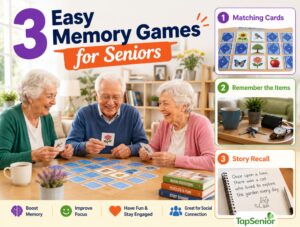
Game #1: The Matching Cards Game
One of the simplest and most effective memory activities for older adults is the Matching Cards Game.
This classic game has entertained children for generations, but it remains equally valuable for seniors because it exercises several important cognitive skills simultaneously.
Players must:
- Remember card locations
- Pay attention to visual details
- Develop strategies
- Recall previous turns
- Maintain concentration
Unlike many brain-training programs, this game requires only a standard deck of playing cards.
How to Set Up the Game
Begin by selecting a smaller number of cards rather than using an entire deck.
For beginners, remove:
- All diamonds
- All clubs
- All face cards
This leaves twenty cards consisting of hearts and spades from Ace through Ten.
Shuffle the cards thoroughly.
Place every card face down on a table.
Spread them evenly so each card is clearly visible.
Players then take turns flipping over two cards.
If the cards match, they remain removed from the table.
If they do not match, they are turned face down again.
The objective is to remember where each card is located and remove every matching pair using the fewest possible turns.
Why This Game Works
The Matching Cards Game strengthens several different types of memory.
Visual memory helps players remember card locations.
Working memory keeps track of information during each turn.
Attention skills improve because players must carefully observe every card revealed by themselves and others.
Problem-solving abilities also develop as players adjust their strategies throughout the game.
Unlike passive entertainment such as television, this activity requires active thinking from beginning to end.
Making the Game Easier
Not every senior has the same cognitive abilities.
Fortunately, this activity can be adapted.
For beginners:
- Use only eight cards.
- Increase card size.
- Choose cards with simple images.
- Play without time limits.
- Offer gentle reminders when needed.
The goal is enjoyment rather than competition.
Positive experiences encourage continued participation.
Making the Game More Challenging
As confidence grows, players can gradually increase the difficulty.
Ideas include:
- Using more cards.
- Timing each round.
- Mixing multiple suits.
- Introducing themed picture cards.
- Playing silently to increase concentration.
These adjustments keep the activity engaging over time.
Tips to Get the Most Out of Matching Games
Like any form of exercise, consistency is more important than intensity.
Playing for fifteen to twenty minutes several times each week often provides better long-term benefits than marathon sessions.
Consider these practical suggestions.
Play in a Quiet Environment
Background television or loud conversations may reduce concentration.
Choose a calm, well-lit area whenever possible.
Encourage Conversation
When playing with others, discuss strategies.
Talking about the game reinforces memory while adding a valuable social element.
Celebrate Progress
Avoid focusing solely on winning.
Instead, celebrate improvements such as remembering more card locations or finishing the game faster than before.
Positive reinforcement increases motivation.
Rotate Different Versions
Using different picture cards, seasonal themes, or family photographs introduces variety.
This challenges the brain in new ways while preventing boredom.
Combine with Healthy Habits
Memory games work best alongside healthy daily routines.
Seniors who stay physically active, maintain regular sleep schedules, eat balanced meals, and remain socially connected often experience greater benefits from cognitive activities.
The Matching Cards Game may appear simple, but it provides an excellent foundation for lifelong brain health. By encouraging observation, concentration, recall, and strategic thinking, this enjoyable activity demonstrates that keeping the mind active does not require expensive equipment or complicated technology. Sometimes the most effective exercises are also the easiest to incorporate into everyday life.
In the next section, we’ll explore two additional activities the Remember Later Game and the Word Association Game along with practical advice for creating a daily brain-training routine, using digital memory apps available in Canada, and maintaining long-term cognitive wellness through enjoyable mental challenges.
Game #2: The Remember Later Game
One of the easiest ways to strengthen long-term memory doesn’t require cards, puzzles, or even a table. The Remember Later Game can be played almost anywhere and takes only a few seconds to begin.
The concept is simple. During the day, intentionally choose one piece of information that you want to remember later. It could be a number, a phrase, a person’s name, or a small task. Then, challenge yourself to recall that information the following day without writing it down.
For example, while making breakfast, you might tell yourself:
“I need to remember that my granddaughter’s piano recital is next Saturday.”
The next morning, ask yourself:
“What was I supposed to remember yesterday?”
Because the brain knows the information will be needed later, it pays closer attention when the memory is first created. This process strengthens both memory storage and memory retrieval.
Unlike passive remembering, this game requires intentional mental effort.
Over time, regularly practicing delayed recall helps improve everyday memory skills that seniors use for appointments, shopping lists, conversations, and daily routines.
Why Delayed Recall Is Important
Many everyday memory challenges involve delayed recall rather than immediate recall.
For example:
- Remembering to take medication after lunch.
- Remembering where the car was parked.
- Remembering a new neighbour’s name.
- Remembering an appointment next week.
- Remembering to call a family member.
The Remember Later Game closely mimics these real-life situations.
Instead of memorizing random facts, seniors practice remembering meaningful information that relates to everyday life.
This makes the exercise both practical and enjoyable.
Different Ways to Play
The beauty of this game is its flexibility.
Try remembering:
- A favourite quote.
- A grocery item.
- A birthday.
- A new recipe ingredient.
- A song title.
- A phone number.
- A family story.
- A historical fact.
- A destination for tomorrow’s outing.
Each day can feature something completely different.
The variety keeps the brain engaged because it cannot rely on repetitive patterns.
Playing with Family Members
The Remember Later Game becomes even more enjoyable when family members participate.
Grandchildren can challenge grandparents with fun questions.
Adult children can create friendly memory competitions during visits.
For example:
“I’ll tell you three animals today. Tomorrow, let’s see if you remember all three.”
These interactions strengthen both memory and family relationships.
Many seniors say that meaningful conversations are just as valuable as the memory exercise itself.

Game #3: The Word Association Game
The third activity is ideal for seniors who enjoy social interaction.
The Word Association Game combines language skills, memory, creativity, and quick thinking.
Unlike crossword puzzles, this game does not require paper or special equipment.
It can be played anywhere.
All participants need is conversation.
How to Play
Choose a category.
Examples include:
- Fruits
- Canadian cities
- Animals
- Flowers
- Occupations
- Sports
- Movies
- Birds
- Vegetables
- Countries
One player begins with a word.
For example:
Apple.
The next player must say another word beginning with the last letter of the previous word.
Apple
Egg
Grape
Eggplant
Tomato
Orange
The game continues until someone cannot think of another word.
Then everyone chooses a new category and starts again.
Why It Helps the Brain
This activity exercises multiple cognitive skills simultaneously.
Players must:
- Retrieve vocabulary.
- Remember previous words.
- Follow game rules.
- Maintain attention.
- Think quickly.
- Switch between concepts.
Language centres throughout the brain become highly active during this exercise.
Because conversation happens naturally, many participants forget they are actually completing a valuable cognitive workout.
Making It Easier
Some seniors may find rapid responses difficult.
Instead of rushing, allow everyone plenty of thinking time.
You can also simplify the game by:
- Choosing familiar categories.
- Ignoring time limits.
- Offering hints.
- Working together instead of competing.
The objective is keeping the brain active—not creating unnecessary pressure.
Increasing the Challenge
Once everyone becomes comfortable, introduce additional rules.
Examples include:
- No repeating words.
- Use only Canadian provinces.
- Name only native Canadian wildlife.
- Include only healthy foods.
- Limit responses to five seconds.
Changing the rules encourages flexible thinking and keeps the activity interesting.

Why Social Memory Games Are Especially Valuable
While solo brain exercises are beneficial, group activities provide additional advantages.
Older adults who participate in regular social interactions often report greater emotional wellbeing and increased confidence.
Playing games with others encourages:
- Communication
- Teamwork
- Laughter
- Emotional connection
- Friendly competition
- Storytelling
Many retirement residences and senior centres across Canada organize regular game afternoons for exactly these reasons.
The conversations that happen during the games are often just as valuable as the games themselves.
Sharing stories stimulates autobiographical memory while strengthening social bonds.
Digital Memory Games and Brain Training Apps in Canada
Technology has made cognitive exercise more accessible than ever.
Today, many older Canadians use tablets, smartphones, and computers to stay mentally active.
Numerous brain training apps for seniors offer games designed to challenge attention, memory, problem-solving, and processing speed.
Popular features often include:
- Daily brain challenges.
- Memory matching activities.
- Number puzzles.
- Word games.
- Pattern recognition.
- Visual recall exercises.
- Progress tracking.
Digital games provide immediate feedback, making it easy to monitor improvement over time.
However, experts generally recommend viewing these apps as one part of a balanced cognitive wellness routine rather than the only solution.
The healthiest brains benefit from a combination of activities that include reading, learning, social engagement, physical exercise, outdoor recreation, and meaningful hobbies.
Technology should complement real-life experiences not replace them.

Creating a Daily Brain Exercise Routine
Consistency is one of the most important factors in maintaining cognitive health.
Fortunately, keeping the brain active does not require hours of work each day.
Even twenty to thirty minutes of intentional mental activity can make a meaningful difference over time.
A balanced daily routine might include:
Morning:
- Read the newspaper.
- Complete the Remember Later Game.
- Solve a crossword puzzle.
Afternoon:
- Go for a walk.
- Play the Matching Cards Game.
- Learn a few words in another language.
Evening:
- Play the Word Association Game with family.
- Read a book.
- Reflect on the day’s events.
Combining several different activities challenges different areas of the brain.
Variety also prevents boredom and encourages long-term participation.
Lifestyle Habits That Support Better Memory
Memory games work best when combined with healthy daily habits.
Experts across Canada encourage older adults to focus on overall wellness rather than relying on any single activity.
Stay Physically Active
Regular movement increases blood circulation throughout the body, including the brain.
Activities such as:
- Walking
- Swimming
- Cycling
- Tai Chi
- Yoga
- Strength training
all contribute to healthy cognitive aging.
Eat a Balanced Diet
Nutritious foods support brain function.
Choose meals rich in:
- Colourful vegetables
- Fruits
- Whole grains
- Fish
- Lean proteins
- Nuts
- Healthy oils
Limiting highly processed foods and excessive sugar may also support long-term health.
Prioritize Sleep
Sleep plays an essential role in memory consolidation.
During sleep, the brain organizes and stores information learned throughout the day.
Most older adults benefit from maintaining consistent sleep schedules and creating relaxing bedtime routines.
Stay Socially Connected
Loneliness can negatively affect both emotional wellbeing and cognitive health.
Regular conversations with family, neighbours, friends, or community groups provide valuable mental stimulation.
Volunteering, attending local events, joining book clubs, or participating in recreational programs can all contribute to healthier aging.
Continue Learning
The brain enjoys novelty.
Learning a musical instrument, trying photography, taking online courses, gardening, cooking new recipes, or exploring Canadian history all encourage continued brain development.
Lifelong learning remains one of the most rewarding forms of mental exercise.
Frequently Asked Questions
Do memory games prevent dementia?
Memory games alone cannot prevent dementia. However, they may help maintain cognitive function, encourage mental engagement, and support overall brain health when combined with physical activity, healthy eating, quality sleep, and regular medical care.
How often should seniors play memory games?
Most experts recommend engaging in mentally stimulating activities every day. Even fifteen to thirty minutes of brain exercises for seniors can provide meaningful cognitive benefits over time.
Are memory games suitable for seniors with mild cognitive impairment?
In many cases, yes. Simple games can help maintain engagement and confidence. Activities should be adapted to each individual’s abilities, and families should consult healthcare professionals if they have specific concerns.
Can family members participate?
Absolutely. Many memory games become even more enjoyable when played with children, grandchildren, friends, or caregivers. Social interaction adds another important layer of cognitive stimulation.
Are digital brain-training apps better than traditional games?
Both have benefits. Digital apps offer convenience and variety, while traditional games encourage face-to-face communication and social connection. A combination of both approaches often provides the greatest overall benefit.
Conclusion
Growing older does not mean accepting declining memory as an unavoidable part of life. Although certain changes in thinking and recall are normal, the brain continues to respond remarkably well to regular mental stimulation throughout the aging process.
Simple activities like the Matching Cards Game, the Remember Later Game, and the Word Association Game demonstrate that maintaining cognitive health does not require expensive equipment or complicated programs. These enjoyable exercises encourage attention, recall, language skills, and problem-solving while creating opportunities for meaningful social interaction.
The greatest results come from consistency. Spending a few minutes each day challenging the mind, staying physically active, eating nutritious meals, sleeping well, and maintaining strong social connections can all contribute to healthier cognitive aging.
For seniors across Canada, these habits support not only memory but also confidence, independence, and overall quality of life. Whether you are living independently, with family, or in a retirement community, making memory games for seniors, brain exercises for seniors, cognitive health for older adults, healthy aging, and mental fitness for seniors part of your daily routine is a positive investment in your future.
At TapSeniors, we believe healthy aging involves caring for both the body and the mind. Explore our growing collection of expert resources, practical wellness guides, and senior-focused services designed to help older Canadians stay active, independent, and engaged every day. Small daily habits can lead to lasting improvements, and it is never too late to begin strengthening your brain one enjoyable game at a time.
Bài viết liên quan: