
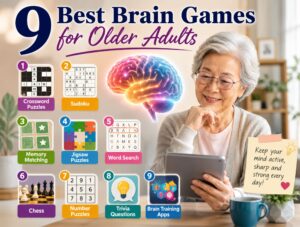
9 Best Brain Games for Older Adults. As we grow older, maintaining physical health often becomes a top priority, but keeping the mind active is just as important. The brain, much like the body, thrives on regular exercise. While occasional forgetfulness is a natural part of aging, engaging in mentally stimulating activities can help support memory, concentration, problem-solving, and overall cognitive wellness. One of the simplest and most enjoyable ways to achieve this is by incorporating brain games for older adults into your daily routine. These activities are designed to challenge different parts of the brain while providing entertainment and a sense of accomplishment. Whether it’s solving a crossword puzzle over breakfast, completing a Sudoku during the afternoon, or playing chess with a friend in the evening, every mental challenge contributes to keeping the brain engaged. Brain games are also incredibly accessible. Some require only a pencil and paper, while others are available through books, websites, or mobile devices. Best of all, they can be enjoyed alone or with family members, making them a wonderful opportunity to stay socially connected. Although no single activity can prevent age-related cognitive decline, combining brain exercises for seniors with regular physical activity, healthy eating, quality sleep, and meaningful social interaction creates a strong foundation for healthy aging. In this comprehensive guide, we’ll explore the 9 best brain games for older adults, explain how each one benefits cognitive health, and share practical tips for making brain training an enjoyable part of everyday life.
Why Brain Games Matter for Older Adults
The human brain is remarkably adaptable. Throughout life, it continues to build new neural connections through a process known as neuroplasticity. This ability allows people to learn new skills, adapt to changing situations, and strengthen cognitive abilities regardless of age.
As people grow older, some mental functions naturally become slower. Processing information may take longer, names may occasionally be forgotten, and multitasking can become more challenging. However, these changes do not mean that learning has to stop.
Research continues to suggest that engaging in regular mental activities may help support cognitive function while promoting confidence and independence. Brain games encourage the mind to stay active by challenging different cognitive abilities rather than relying on the same thought patterns every day.
Regular participation in mental activities for seniors may contribute to improvements in:
- Memory recall
- Attention span
- Logical thinking
- Language skills
- Decision-making
- Visual processing
- Problem-solving
- Concentration
Brain games also provide emotional benefits. Completing a difficult puzzle or winning a challenging game often creates a sense of achievement that boosts confidence and motivation.
Many older adults also find these activities relaxing. Spending time focused on an enjoyable challenge can reduce boredom while encouraging mindfulness and positive mental engagement.
It’s important to remember that brain games work best as one part of a healthy lifestyle. They should be combined with physical exercise, nutritious meals, social interaction, stress management, and adequate sleep to support overall well-being.
How to Choose the Right Brain Games
Not every game is suitable for every individual. Choosing activities that match personal interests and ability levels helps maintain motivation over time.
One of the most important factors is enjoyment. Someone who loves reading will likely appreciate word-based games, while another person may prefer solving logic puzzles or strategy games.
Difficulty also matters.
Games should feel challenging enough to require concentration but not so difficult that they become frustrating. Starting with beginner-friendly versions and gradually increasing complexity allows the brain to continue developing without causing discouragement.
Variety is another essential element.
Different games stimulate different cognitive abilities. Crossword puzzles focus on language and vocabulary, Sudoku develops logical reasoning, while jigsaw puzzles encourage spatial awareness and visual perception.
Rotating among several types of cognitive exercises for seniors creates a more balanced mental workout than repeating the same activity every day.
Social opportunities should also be considered. Many brain games become even more enjoyable when shared with family members, friends, or community groups. Conversation, teamwork, and friendly competition provide additional mental stimulation while strengthening relationships.
1. Crossword Puzzles
Crossword puzzles have remained one of the world’s favorite brain games for generations. They combine vocabulary, memory, reasoning, and problem-solving into an activity that is both relaxing and intellectually rewarding.
Every clue encourages players to search their long-term memory, identify patterns, evaluate possible answers, and connect words logically across the puzzle.
This process activates multiple regions of the brain simultaneously.
Cognitive Benefits
Regularly completing crossword puzzles may help improve:
- Vocabulary
- Language comprehension
- Long-term memory
- Concentration
- Pattern recognition
- Problem-solving
- Verbal reasoning
Many older adults enjoy making crossword puzzles part of their morning routine because they provide an enjoyable mental challenge without requiring extensive preparation.
Crosswords also encourage lifelong learning by introducing unfamiliar words, historical references, and interesting facts.
Tips for Success
Begin with puzzles designed for beginners or older adults.
Avoid becoming discouraged if every clue cannot be solved immediately.
Use dictionaries or online references when necessary, as learning new words is part of the experience.
Most importantly, focus on enjoying the process rather than completing every puzzle perfectly.
Crossword puzzles are widely available in newspapers, puzzle books, websites, and mobile applications.
2. Sudoku
Sudoku has become one of the most popular logic games worldwide because it provides a satisfying mental challenge without requiring advanced mathematical knowledge.
Although the puzzle uses numbers, success depends entirely on reasoning and pattern recognition rather than arithmetic.
Players fill a nine-by-nine grid so that each row, column, and smaller section contains every number from one to nine exactly once.
Each move requires careful thinking and attention to detail.
Brain Health Benefits
Sudoku encourages the development of:
- Logical reasoning
- Working memory
- Concentration
- Pattern recognition
- Decision-making
- Mental flexibility
Because every puzzle is unique, Sudoku continually presents new challenges that encourage the brain to adapt and think creatively.
Many seniors enjoy the calm, focused nature of Sudoku because it provides a satisfying sense of accomplishment after each completed puzzle.

Helpful Strategies
Start with easy puzzles before progressing to moderate or difficult levels.
Look for rows or columns with the greatest number of completed squares first.
Avoid guessing whenever possible.
If progress slows, take a short break and return with fresh eyes.
With regular practice, many players notice improvements in both speed and confidence.
3. Memory Matching Games
Memory Matching Games are among the most enjoyable memory games for seniors because they are simple to learn while providing valuable cognitive exercise.
Players flip cards over two at a time, attempting to remember the location of matching images.
Although the rules are straightforward, success depends on attention, visual memory, and recall.
The difficulty can easily be adjusted by increasing or decreasing the number of cards.
Benefits for Cognitive Health
Memory matching activities help strengthen:
- Short-term memory
- Visual memory
- Concentration
- Attention
- Recall speed
- Pattern recognition
Because the game is easy to understand, it is suitable for older adults with varying cognitive abilities.
Many families also enjoy playing together, allowing grandparents and grandchildren to participate in the same activity while creating meaningful memories.
Fun Variations
Memory games don’t always require cards.
Other enjoyable options include matching family photographs, remembering grocery lists, identifying sounds, matching objects, or using digital memory applications.
The goal remains the same: encouraging the brain to store and retrieve information efficiently.
4. Jigsaw Puzzles
Jigsaw puzzles provide an excellent combination of relaxation and mental stimulation.
Unlike fast-paced games, they encourage patience, careful observation, and sustained concentration.
Players analyze colors, shapes, textures, and patterns while determining where each piece belongs.
This process activates several cognitive functions simultaneously.
Cognitive Benefits
Completing jigsaw puzzles may help improve:
- Visual perception
- Spatial reasoning
- Problem-solving
- Planning skills
- Concentration
- Patience
- Attention to detail
Working toward a finished puzzle also creates a rewarding sense of accomplishment that encourages continued participation.
Choosing the Right Puzzle
Older adults should begin with puzzles that feature larger pieces and clear, colorful images.
Scenes depicting nature, animals, landscapes, or familiar places often make assembly easier.
As confidence grows, gradually increase the number of pieces or select puzzles with greater detail to continue challenging the brain.
Jigsaw puzzles also provide excellent opportunities for family members to work together toward a shared goal.
5. Word Search
Word Search puzzles remain one of the simplest yet most effective brain training activities for seniors.
Players search a grid of letters to locate hidden words arranged horizontally, vertically, diagonally, or backward.
While the rules are easy to understand, successful completion requires focus, visual scanning, and sustained attention.
Word Search puzzles are suitable for nearly every skill level and can easily be completed in short sessions throughout the day.
Cognitive Benefits
Regularly solving Word Search puzzles may help strengthen:
- Visual attention
- Concentration
- Vocabulary
- Pattern recognition
- Processing speed
- Language skills
Because the activity is relaxing and easy to start, many seniors include Word Search puzzles in their daily routine as part of a balanced cognitive wellness program.
Ways to Increase the Challenge
As skills improve, consider trying:
- Larger letter grids
- Smaller print
- Timed challenges
- Themed vocabulary lists
- Foreign language Word Search puzzles
Increasing the difficulty gradually helps maintain motivation while providing fresh mental stimulation.
By combining Crossword Puzzles, Sudoku, Memory Matching Games, Jigsaw Puzzles, and Word Search, older adults engage multiple areas of the brain, including memory, language, visual perception, reasoning, and concentration. This balanced approach lays a strong foundation for lifelong cognitive wellness and prepares the way for the next four brain games that further develop strategic thinking, analytical reasoning, and lifelong learning.

6. Chess
Chess has been recognized as one of the greatest strategy games in the world for hundreds of years. Every move requires players to think several steps ahead, evaluate different possibilities, anticipate an opponent’s strategy, and make thoughtful decisions. Unlike games that depend on luck, chess rewards planning, patience, logic, and careful observation.
For older adults, chess is much more than an entertaining board game. It provides an excellent opportunity to keep the brain engaged while encouraging social interaction with friends, family members, or fellow chess enthusiasts. Every match presents a new challenge, making it an activity that remains interesting regardless of experience level.
Cognitive Benefits
Playing chess regularly may help improve:
- Strategic thinking
- Long-term planning
- Memory recall
- Concentration
- Decision-making
- Problem-solving
- Visual perception
One of chess’s greatest strengths is that every game is different. Players continuously adapt their strategies, encouraging the brain to develop flexibility while strengthening reasoning skills.
Tips for Beginners
If you’ve never played chess before, don’t worry. Learning can be both enjoyable and rewarding.
Begin by understanding how each piece moves before studying advanced tactics. Practice with family members, friends, or beginner-friendly computer programs that explain mistakes and suggest better moves. Short games are often less overwhelming and allow new players to build confidence gradually.
The objective isn’t to become a competitive player. Instead, chess offers a fun way to challenge the brain while developing valuable thinking skills that can benefit everyday life.
7. Number Puzzles
Although Sudoku is the most well-known number puzzle, there are many other number-based games that provide excellent cognitive exercise. These activities challenge logical thinking, sequencing, pattern recognition, and analytical reasoning without requiring advanced mathematical knowledge.
Popular examples include magic squares, Kakuro, number sequences, logic grids, and fill-in number puzzles. Each presents unique challenges that encourage the brain to recognize relationships between numbers and solve increasingly complex problems.
Brain Health Benefits
Number puzzles help strengthen:
- Logical reasoning
- Working memory
- Concentration
- Pattern recognition
- Attention to detail
- Analytical thinking
Many older adults also find that practicing number puzzles helps maintain confidence when performing everyday tasks involving numbers, such as budgeting, shopping, paying bills, or managing medications.
Making Number Puzzles Enjoyable
Choose puzzles that match your current ability level. Beginning with easier challenges allows you to develop confidence before progressing to more advanced problems.
Remember that consistency is far more valuable than difficulty. Solving number puzzles for just twenty minutes several times each week provides meaningful mental stimulation while remaining enjoyable.
8. Trivia Questions
Trivia games are a fantastic way to exercise long-term memory while having fun. Every question encourages the brain to search stored information, strengthening memory retrieval and recall.
Trivia topics can include history, geography, music, sports, literature, science, famous people, classic television shows, current events, or even favorite hobbies. This variety keeps learning fresh and exciting while encouraging lifelong curiosity.
Why Seniors Enjoy Trivia
Trivia games often become social events rather than solitary activities. Families can play together during holidays, senior centers frequently organize trivia competitions, and friends can enjoy friendly challenges over coffee.
This combination of mental exercise and meaningful social interaction provides benefits that extend well beyond memory training.
Cognitive Benefits
Trivia games may improve:
- Long-term memory
- Recall speed
- Language skills
- General knowledge
- Attention
- Confidence
Discussing answers often leads to storytelling, shared memories, and enjoyable conversations that further stimulate the brain.
Ways to Keep Trivia Interesting
Rotate different themes throughout the week. One day might focus on classic movies from the 1960s, while another explores geography, famous inventions, animals, or world history.
Changing topics encourages continuous learning and helps prevent boredom.

9. Brain Training Apps
Technology has made brain training for older adults easier and more accessible than ever before. Modern brain-training applications offer hundreds of short activities that target multiple cognitive abilities, making it convenient to exercise the mind almost anywhere.
Many apps include activities that challenge:
- Memory
- Attention
- Language
- Processing speed
- Logical reasoning
- Visual perception
- Problem-solving
- Mental flexibility
Several applications automatically adjust the difficulty level according to performance, ensuring users continue to experience appropriate mental challenges as they improve.
Benefits of Brain Training Apps
Brain-training apps fit easily into everyday routines. Older adults can complete a quick session while relaxing at home, waiting for a doctor’s appointment, or traveling.
Many apps also record progress over time, allowing users to monitor improvements and stay motivated.
Choosing the Best App
Look for applications that offer:
- Large, easy-to-read text
- Clear instructions
- Simple navigation
- Adjustable difficulty
- Multiple game categories
- Short daily sessions
While digital games are helpful, they should complement rather than replace real-world mental activities such as reading, socializing, learning new hobbies, or completing traditional puzzles.
Creating a Weekly Brain Training Routine
Just as muscles become stronger through regular exercise, the brain benefits from consistent mental stimulation. Rather than playing only one game every day, rotating different activities challenges multiple cognitive skills throughout the week.
A balanced schedule might look like this:
Monday: Crossword Puzzles to strengthen vocabulary and language.
Tuesday: Sudoku or Number Puzzles to improve logical reasoning.
Wednesday: Memory Matching Games to develop short-term memory and attention.
Thursday: Jigsaw Puzzles to enhance visual and spatial thinking.
Friday: Chess to practice planning and strategy.
Saturday: Trivia Questions with family or friends to encourage memory recall and social interaction.
Sunday: Brain Training Apps for a combination of different cognitive exercises.
This balanced approach keeps the brain engaged while making each day’s activities feel fresh and enjoyable.

Additional Habits That Support Brain Health
Brain games are most effective when combined with healthy lifestyle habits that support overall cognitive wellness.
Regular physical activity improves blood flow to the brain and has been associated with better memory, mood, and overall health. Walking, swimming, stretching, tai chi, and strength exercises are all excellent choices for older adults.
Eating a nutritious diet filled with fruits, vegetables, whole grains, fish, nuts, and healthy fats provides nutrients that support brain function.
Quality sleep is equally important because it allows the brain to consolidate memories and prepare for learning the next day.
Maintaining strong social connections through conversations, volunteering, community activities, and spending time with loved ones also provides valuable mental stimulation.
Finally, never stop learning. Reading books, taking online classes, learning a musical instrument, cooking new recipes, gardening, or exploring creative hobbies all help keep the brain active throughout life.
Common Mistakes to Avoid
Many people expect immediate improvements after only a few days of playing brain games. In reality, cognitive fitness develops gradually through consistent practice.
Another common mistake is relying on only one favorite game. Different games challenge different areas of the brain, making variety much more beneficial than repetition.
It’s also important not to overlook physical health. Exercise, nutrition, hydration, stress management, and quality sleep all contribute significantly to maintaining healthy brain function.
Most importantly, don’t become discouraged if a puzzle feels difficult. Challenging activities are often the ones that provide the greatest opportunities for learning and growth.

Frequently Asked Questions
Are brain games proven to prevent dementia?
Brain games cannot guarantee the prevention of dementia. However, many health experts believe mentally stimulating activities can support cognitive health when combined with regular exercise, healthy eating, quality sleep, and social engagement.
How often should older adults play brain games?
Most experts recommend spending about 20 to 30 minutes on mentally stimulating activities on most days of the week. Consistency is generally more beneficial than occasional long sessions.
Which brain game is best for improving memory?
Memory Matching Games, Trivia Questions, Crossword Puzzles, and Brain Training Apps are all excellent choices because they encourage recalling information and strengthening memory pathways.
Are digital brain games better than traditional puzzles?
Both offer valuable benefits. Traditional games such as chess, crossword puzzles, Sudoku, and jigsaw puzzles encourage focused thinking, while digital apps provide convenience, personalized challenges, and progress tracking. Combining both approaches creates a well-rounded brain training routine.
Conclusion
Keeping the brain active is one of the most rewarding investments older adults can make in their long-term well-being. Whether you enjoy Crossword Puzzles, Sudoku, Memory Matching Games, Jigsaw Puzzles, Word Search, Chess, Number Puzzles, Trivia Questions, or modern Brain Training Apps, each activity exercises different cognitive skills that contribute to lifelong learning and mental sharpness.
The greatest benefits come from consistency rather than intensity. Spending just 20 to 30 minutes each day engaging in enjoyable mental activities can help support memory, concentration, reasoning, and confidence. Rotating different games throughout the week provides a more complete cognitive workout while keeping the experience enjoyable.
At TapSeniors, we believe healthy aging involves caring for both the body and the mind. Along with regular physical activity, nutritious meals, quality sleep, and meaningful social connections, brain games can become an enjoyable part of a balanced lifestyle that promotes independence and overall well-being.
Explore more healthy aging tips, activities for older adults, memory care resources, and senior wellness guides on TapSeniors to discover practical ways to stay active, connected, and mentally strong every day. It’s never too late to learn something new, challenge your mind, and enjoy the lifelong benefits of staying mentally engaged.
Bài viết liên quan: