
How has Canada’s health care changed?. For decades, Canada’s healthcare system has been recognized around the world as a symbol of universal access and public responsibility. Often referred to as “Medicare,” the system was built on the belief that every Canadian should receive medically necessary healthcare regardless of income. This philosophy has shaped Canadian society and remains one of the country’s defining characteristics.
Yet despite its international reputation, many Canadians today experience a very different reality than previous generations. Long wait times for specialist appointments, overcrowded emergency departments, shortages of family physicians, delayed surgeries, and increasing pressure on hospitals have become common concerns. While Canadians continue to value universal healthcare, many also wonder why accessing care has become more difficult.
Understanding today’s healthcare challenges requires looking back at how the system developed. Canada’s Medicare system did not emerge overnight. It evolved through decades of political decisions, economic changes, demographic shifts, and medical advancements. What began as an ambitious effort to provide equitable healthcare has gradually encountered new pressures that policymakers in the 1960s and 1970s could hardly have imagined.
This article explores the history of Canada’s healthcare system, the key policy decisions that shaped Medicare, why healthcare demand has increased dramatically over time, and the challenges facing Canadian seniors and their caregivers today. Rather than assigning blame, understanding this evolution helps Canadians better appreciate both the strengths and limitations of the current system while encouraging informed discussions about future improvements.

The Vision Behind Canadian Medicare
The idea behind Canadian Medicare was simple but revolutionary.
Healthcare should be available based on medical need rather than a person’s financial situation.
Before universal healthcare became available across Canada, many families relied on employer-sponsored insurance, private insurance plans, or personal savings to pay medical bills. While many Canadians could afford medical care, others struggled to pay for necessary treatment, particularly those with chronic illnesses or limited incomes.
Doctors frequently treated patients who could not immediately pay for services. In many communities, physicians provided care first and worried about payment later. Although this demonstrated the compassion of healthcare professionals, it also created financial uncertainty for both patients and providers.
Universal medical insurance promised a solution.
Instead of individuals carrying the financial burden alone, healthcare costs would be shared collectively through public funding. Every Canadian would contribute through taxes, ensuring that anyone who became ill could receive care without facing catastrophic medical expenses.
This principle remains one of the defining features of Canada’s universal healthcare system today.
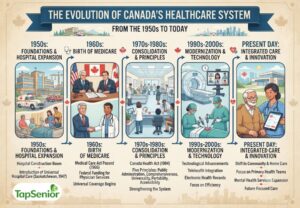
The Early Years: Building Canada’s Healthcare Infrastructure
The foundations of modern Canadian healthcare were established long before Medicare officially covered every province.
Following World War II, Canada’s population expanded rapidly. Communities grew, life expectancy increased, and governments recognized the need for stronger public infrastructure.
In 1948, the federal government introduced health grants that encouraged provinces to build hospitals.
Rather than operating hospitals directly, the federal government used financial incentives to help provinces expand healthcare infrastructure.
This investment sparked an era of remarkable hospital construction.
Small towns, rural communities, and growing cities all gained access to hospitals that previously did not exist. Across many provinces, local hospitals became symbols of community development and public investment.
During this period, healthcare demand remained relatively manageable.
The average Canadian was much younger than today’s population.
Medical technology was far less advanced.
Doctors could treat fewer diseases than modern medicine can today.
As a result, hospitals generally had more capacity than demand required.
For many Canadians who lived during this era, healthcare seemed highly accessible, contributing to the lasting reputation of Canadian Medicare.
The Introduction of Hospital Insurance
Another major milestone arrived in 1957 with the Hospital Insurance and Diagnostic Services Act.
This legislation significantly expanded federal financial support.
- Instead of only helping provinces build hospitals, the federal government also agreed to share the cost of hospital services.
- Under the arrangement, the federal and provincial governments generally shared eligible hospital costs.
- This financial partnership encouraged provinces to expand hospital-based care.
- More diagnostic services became available.
- Laboratory testing improved.
- Medical imaging expanded.
- Hospital admissions increased.
Canadians gained access to a broader range of publicly funded healthcare services than ever before.
However, one important area remained outside the system.
Physician services themselves were not yet universally insured.
Hospitals received funding for facilities, nursing care, diagnostic testing, and other services, but physician billing operated differently.
The next major reform would change that.
The Medical Care Act and the Birth of Nationwide Medicare
In 1966, Canada introduced another landmark reform through the Medical Care Act.
This legislation expanded public insurance to physician services, completing what most Canadians now recognize as Medicare.
The federal government again offered significant financial support to provinces that agreed to participate.
However, participation required provinces to follow several guiding principles.
These included:
- Public administration
- Universality
- Comprehensive coverage
- Portability
These principles established the foundation of Canadian Medicare.
Every eligible resident would receive medically necessary physician and hospital services through a publicly administered insurance plan.
Private insurance companies could continue operating in many areas of healthcare, but medically necessary physician and hospital services became the responsibility of provincial public insurance programs.
Each province gradually implemented its own version of Medicare while following national standards.
By the early 1970s, every province had joined the system.
Canada had successfully created one of the world’s most comprehensive publicly funded healthcare systems.
Why Canadians Considered Medicare a Global Success
The early 1970s are often remembered as the “golden years” of Canadian Medicare.
Several factors contributed to this success.
First, Canada’s population remained relatively young.
A younger population naturally requires fewer healthcare services.
Second, chronic diseases were less common because people generally lived shorter lives.
Third, medical technology had not yet advanced to today’s level.
Modern treatments such as organ transplantation, advanced cancer therapies, minimally invasive surgery, complex cardiovascular procedures, and sophisticated imaging were either unavailable or still developing.
Healthcare demand remained relatively modest.
At the same time, Canada had invested heavily in hospitals and healthcare infrastructure throughout previous decades.
The combination of abundant hospital capacity and comparatively lower demand created a healthcare environment that many considered exceptional.
Patients generally experienced shorter wait times.
Hospitals had greater flexibility.
Healthcare professionals could devote more resources to each patient.
International observers frequently praised Canada’s healthcare model during this period.
Canada’s Single-Payer Model
One defining characteristic of Medicare is its single-payer healthcare system.
A single-payer model means that the government acts as the primary insurer for medically necessary physician and hospital services.
Patients generally do not pay directly at the point of care.
Instead, healthcare is financed collectively through taxation.
Supporters argue that this approach offers several advantages.
Administrative costs may be lower because providers work with fewer insurance systems.
Patients avoid large medical bills during serious illness.
Healthcare access is based primarily on medical need rather than insurance status.
The simplicity of presenting a provincial health card instead of managing multiple insurance claims has long been considered one of Medicare’s greatest strengths.
For many Canadians, this remains an important source of national pride.

How Healthcare Demand Changed Over Time
Although the structure of Medicare remained largely unchanged, Canadian society changed dramatically.
Perhaps the biggest transformation has been demographics.
During the 1960s, Canada’s average age was approximately 25 years.
Today, the population is significantly older.
Millions of Canadians are now over age 65.
Life expectancy has increased substantially.
While longer lives represent tremendous progress, they also increase healthcare demand.
Older adults naturally require more healthcare services than younger populations.
Seniors are more likely to develop chronic conditions such as:
Heart disease
Diabetes
Arthritis
Osteoporosis
Cancer
Dementia
Vision loss
Hearing impairment
Kidney disease
Many seniors manage multiple chronic illnesses simultaneously.
This requires ongoing physician visits, specialist consultations, medications, diagnostic testing, rehabilitation, and long-term monitoring.
Healthcare systems originally designed for younger populations now face much greater demand.
Medical Advances Created New Opportunities and New Costs
Medicine has transformed enormously over the past fifty years.
Conditions once considered untreatable can now often be managed successfully.
Cardiologists routinely perform life-saving procedures.
Joint replacements restore mobility.
Cancer survival rates continue improving.
Organ transplantation saves thousands of lives.
Advanced imaging detects disease earlier.
New medications help patients live longer with chronic illnesses.
These advances represent remarkable achievements.
However, every new treatment also requires highly trained professionals, specialized equipment, modern facilities, and substantial financial investment.
Healthcare systems now provide services that simply did not exist when Medicare was originally established.
As medical possibilities expanded, healthcare spending naturally increased.
Demand grew faster than many healthcare systems anticipated.
The Decline in Hospital Capacity
One frequently discussed indicator of healthcare capacity involves hospital beds.
During the early decades of Medicare, Canada maintained a relatively high number of acute care hospital beds per capita.
Over time, however, healthcare policy shifted.
Hospitals emphasized shorter admissions.
Some facilities closed.
Others reduced inpatient capacity.
Healthcare increasingly moved toward outpatient treatment and community-based services.
While these changes reflected advances in medical practice, they also reduced flexibility during periods of high demand.
Seasonal respiratory illnesses, influenza outbreaks, and unexpected public health emergencies can quickly strain available hospital resources.
When hospitals operate near maximum capacity, patients may experience longer emergency department waits, postponed surgeries, or delayed admissions.
Although healthcare quality remains high, limited capacity contributes to many access challenges experienced today.

Why Wait Times Have Become a Major Concern
One of the most common frustrations among Canadians involves waiting.
Waiting for a family physician.
Waiting for diagnostic imaging.
Waiting for specialist consultations.
Waiting for elective surgery.
Waiting for rehabilitation.
Several factors contribute to these delays.
An aging population increases demand.
Healthcare professionals face workforce shortages in some regions.
Medical technology enables more people to receive treatment than ever before.
Specialists often manage growing numbers of complex patients.
At the same time, many healthcare resources remain finite.
Operating rooms have limited schedules.
Hospital beds are limited.
Healthcare professionals can only see a certain number of patients each day.
As demand exceeds available capacity, waiting lists inevitably grow.
This challenge has become one of the defining healthcare policy issues across Canada.
Canada’s Aging Population Will Continue Shaping Healthcare
Population aging is not a temporary trend.
It represents one of the most significant demographic transformations in Canadian history.
The Baby Boomer generation continues entering retirement.
People are living longer than previous generations.
Many older adults remain active well into their seventies and eighties, yet healthcare needs generally increase with advancing age.
This reality places additional pressure on hospitals, family physicians, specialists, rehabilitation programs, and long-term care services.
It also highlights the growing importance of family caregivers, home care services, preventive healthcare, healthy aging, and senior wellness programs.
Helping older adults remain healthy and independent for as long as possible may reduce hospitalizations while improving quality of life.
As Canada’s healthcare system entered the late 1970s, policymakers faced a reality very different from the one that existed when Medicare was first introduced. The rapid expansion of hospitals and publicly funded medical services had successfully created universal access, but the financial demands of maintaining such a system continued to grow.
Healthcare spending increased every year as Canada’s population expanded, medical technology advanced, and people began living much longer than previous generations. Governments across the country recognized that while universal healthcare remained a national priority, its funding model would eventually require adjustments.
The decades that followed brought important policy changes, ongoing debates about healthcare funding, and growing concerns about access to care. Understanding these developments helps explain many of the challenges Canadians experience today.

A Turning Point in Healthcare Funding
During the early years of Medicare, the federal government shared healthcare costs with the provinces through generous funding arrangements. This approach encouraged provinces to expand services while ensuring Canadians across the country had access to similar levels of care.
However, by the late 1970s, governments faced increasing financial pressures.
Healthcare expenditures were growing much faster than anticipated.
In response, funding arrangements gradually changed. Instead of reimbursing provinces for a fixed share of eligible healthcare spending, the federal government introduced a different financing approach that placed greater responsibility on provincial governments for managing healthcare budgets.
This transition marked an important shift.
Provincial governments now had greater responsibility for balancing healthcare spending alongside education, infrastructure, social services, and many other public priorities.
While universal healthcare remained in place, managing limited resources became increasingly challenging.
The Canada Health Act
Another major milestone came with the introduction of the Canada Health Act in 1984.
Rather than creating an entirely new healthcare system, the legislation strengthened the principles that already guided Medicare.
The Act reinforced several core values:
Public administration
Universality
Accessibility
Comprehensiveness
Portability
Together, these principles continue to define Canadian Medicare today.
The goal was to ensure that medically necessary hospital and physician services remained available to all Canadians regardless of income or province of residence.
The Canada Health Act also discouraged extra billing and user charges for insured medical services, helping preserve equal access across the country.
Even today, these principles remain central to public discussions about healthcare policy.
Why Demand Has Increased So Dramatically
Although the structure of Medicare has remained relatively stable, Canadian society has changed dramatically.
One of the most significant factors is aging.
Canadians are living longer than ever before.
Longer life expectancy represents an extraordinary public health achievement, but it also creates greater demand for healthcare services.
Older adults often require ongoing care for chronic illnesses rather than short-term treatment for isolated medical problems.
Common conditions include:
Heart disease
Diabetes
Arthritis
Dementia
Stroke recovery
Cancer
Chronic kidney disease
Respiratory disorders
Many seniors live with multiple conditions simultaneously.
Managing these complex health needs requires coordinated care involving family physicians, specialists, pharmacists, therapists, nurses, home care providers, and family caregivers.
This level of care was far less common when Medicare was originally developed.
Modern Medicine Is More Advanced Than Ever
Healthcare today bears little resemblance to that of the early 1970s.
Medical technology has transformed nearly every aspect of patient care.
Today, physicians routinely perform procedures that once seemed impossible.
Patients benefit from:
Advanced MRI and CT imaging
Minimally invasive surgery
Cardiac catheterization
Joint replacement surgery
Organ transplantation
Targeted cancer therapies
Artificial joints
Modern intensive care units
Sophisticated laboratory testing
These innovations save lives every day.
However, they also require specialized facilities, highly trained healthcare professionals, expensive equipment, and significant long-term investment.
As medicine becomes more advanced, healthcare systems naturally become more complex and costly to operate.
Hospital Capacity and System Pressure
Another frequently discussed issue is hospital capacity.
Healthcare experts often measure available resources using the number of acute care hospital beds relative to the population.
Over several decades, Canada has experienced a reduction in hospital bed availability compared with earlier periods.
At the same time, healthcare demand has steadily increased.
The result is familiar to many Canadians:
Busy emergency departments.
Delayed admissions.
Longer surgical wait lists.
Patients remaining in emergency rooms while waiting for inpatient beds.
Hospitals operating near full capacity.
Although healthcare professionals continue working tirelessly, limited capacity means the system has less flexibility during periods of increased demand such as influenza season or other public health emergencies.
The Challenge of Specialist Wait Times
For many Canadians, obtaining specialist care has become one of the most frustrating aspects of the healthcare system.
Patients may wait weeks or even months before seeing specialists in areas such as:
Cardiology
Neurology
Orthopedics
Dermatology
Rheumatology
Ophthalmology
Pain management
These delays often create anxiety for patients and caregivers alike.
It is important to recognize that specialist wait times result from multiple interacting factors.
Growing demand.
Limited specialist availability.
Increasingly complex medical cases.
An aging population.
Diagnostic bottlenecks.
Regional workforce shortages.
Improving access requires coordinated solutions rather than any single policy change.
The Growing Role of Family Caregivers
One of the biggest changes in Canadian healthcare has occurred outside hospitals.
Families now play a much larger role in supporting older adults.
Many seniors receive care primarily at home rather than in healthcare institutions.
As a result, family caregivers have become essential partners in healthcare delivery.
Caregivers frequently assist with:
Medication management
Transportation to appointments
Meal preparation
Monitoring symptoms
Coordinating specialist visits
Communicating with healthcare providers
Managing medical paperwork
Providing emotional support
Supporting rehabilitation
Helping with daily activities
Without these caregivers, hospitals and long-term care facilities would face even greater demand.
Supporting caregivers is becoming increasingly important as Canada’s population continues to age.
Aging at Home Has Become a National Priority
Most older adults prefer remaining in their own homes for as long as possible.
Aging in familiar surroundings often improves emotional well-being while maintaining independence and community connections.
For this reason, governments and healthcare organizations increasingly support aging in place whenever appropriate.
Successful aging at home often depends on several complementary services:
Home care services
Senior transportation
Meal delivery programs
Occupational therapy
Community nursing
Caregiver support
When these services work together, seniors may avoid unnecessary hospital admissions while enjoying better quality of life.
Preventive Care Matters More Than Ever
Another lesson from Canada’s healthcare evolution is the growing importance of prevention.
Healthcare systems perform best when people remain healthy for as long as possible.
Preventive strategies include:
Regular exercise
Healthy nutrition
Vaccinations
Blood pressure monitoring
Diabetes management
Cancer screening
Fall prevention
Mental health support
Social engagement
Preventing illness is often more effective and less costly than treating advanced disease.
For seniors especially, maintaining mobility and independence can significantly reduce future healthcare needs.
Healthcare Equity Remains an Important Goal
Universal healthcare was founded on the principle that everyone should receive medically necessary care regardless of financial circumstances.
This goal continues to guide Canadian healthcare policy.
However, researchers continue studying differences in healthcare access across regions, communities, and socioeconomic groups.
Factors such as geography, physician availability, transportation, language barriers, housing stability, and social support can all influence how quickly individuals receive care.
Recognizing these differences helps policymakers identify opportunities for improvement.
Healthcare equity remains an ongoing objective rather than a completed achievement.
The Discussion Around Public and Private Care
Healthcare reform frequently generates passionate public discussion.
Some experts advocate strengthening the existing public system through increased investment and workforce expansion.
Others believe carefully regulated private participation could help increase capacity in selected areas while maintaining universal access.
Examples already exist where publicly funded and privately funded services operate alongside one another in specific healthcare sectors.
Supporters argue that mixed approaches may increase overall system capacity.
Critics caution that reforms must preserve fairness and equal access.
Regardless of perspective, most Canadians agree on one principle:
High-quality healthcare should remain available to everyone who needs it.

Technology Is Changing Healthcare Delivery
Digital innovation is gradually reshaping Canadian healthcare.
Today, many patients benefit from:
Virtual appointments
Electronic medical records
Online prescription renewals
Remote patient monitoring
Digital diagnostic imaging
Secure health portals
Artificial intelligence is also beginning to assist healthcare professionals with diagnostic support, workflow optimization, and medical research.
Although technology cannot replace healthcare professionals, it may improve efficiency while reducing administrative burdens.
Continued investment in digital healthcare will likely play an increasingly important role over the coming decades.
Building a More Sustainable Healthcare System
Improving Canada’s healthcare system requires balancing several priorities simultaneously.
Governments must consider:
Population growth
Healthcare workforce planning
Hospital infrastructure
Medical education
Long-term care
Home care expansion
Mental health services
Preventive healthcare
Digital innovation
Financial sustainability
No single policy can solve every challenge.
Meaningful progress will likely involve many gradual improvements working together over time.
What Seniors and Families Can Do Today
Although healthcare policy continues to evolve, families can take practical steps to improve healthcare experiences.
Older adults should maintain regular relationships with primary care providers whenever possible.
Keeping organized medical records helps during specialist visits and hospital admissions.
Families should encourage healthy lifestyles long before serious illness develops.
Caregivers can prepare medication lists, monitor symptoms, and accompany seniors to important appointments.
Planning ahead often reduces unnecessary stress during medical emergencies.
Community resources can also provide valuable support.
Programs offering senior transportation services, caregiver support, home care assistance, and healthy aging programs frequently help older adults remain independent longer.
Being informed and proactive allows families to navigate the healthcare system more effectively.
Looking Toward the Future
Canada’s healthcare system has undergone remarkable transformation since its earliest days.
What began as a bold vision for universal healthcare successfully provided millions of Canadians with access to medically necessary care regardless of personal income.
That achievement remains one of Canada’s defining public institutions.
At the same time, healthcare today operates in a vastly different environment than it did fifty years ago.
The population is older.
People live longer.
Medicine has become dramatically more advanced.
Healthcare expectations have increased.
Demand continues to rise.
These realities require thoughtful planning, ongoing investment, innovation, and collaboration among governments, healthcare professionals, researchers, caregivers, and communities.
Future reforms will likely focus not only on treating illness but also on preventing disease, expanding community care, supporting caregivers, improving healthcare technology, and helping seniors maintain independence for as long as possible.
Final Thoughts
Canada’s healthcare journey is one of continuous evolution rather than a finished story.
The original vision of Medicare sought to ensure that every Canadian could receive necessary medical care without financial hardship. That principle continues to enjoy broad public support and remains central to Canadian identity.
However, changing demographics, medical innovation, workforce challenges, and increasing demand have created pressures that require new solutions.
Understanding the history of Canadian Medicare, appreciating the achievements of Canada’s universal healthcare system, and recognizing today’s challenges provide valuable context for future discussions about healthcare reform.
For seniors and their families, staying informed is one of the most effective ways to navigate an increasingly complex healthcare environment. By combining preventive healthcare, healthy aging, home care services, family caregiver support, and strong partnerships with healthcare professionals, Canadians can continue working toward a healthcare system that remains accessible, sustainable, and responsive for generations to come.
Bài viết liên quan: