
Canada’s Healthcare System Explained!. Healthcare is one of the topics that sparks the most discussion whenever people compare Canada with other countries, especially the United States. Some people describe Canada’s healthcare system as one of the world’s greatest public services, while others criticize it for long wait times or misunderstand how it actually works. The truth, as with most complex systems, lies somewhere in the middle.
Canada’s healthcare system is often praised because every eligible resident has access to medically necessary healthcare regardless of income. At the same time, Canadians also understand that no healthcare system is perfect. There are ongoing debates about wait times, physician shortages, healthcare funding, and expanding coverage for services such as prescription medications and dental care.
For seniors, families caring for aging parents, newcomers to Canada, and anyone planning retirement, understanding how the Canadian healthcare system works is incredibly valuable. Knowing what is covered, what is not, and how services are delivered can help people make informed healthcare decisions while avoiding unnecessary surprises.
Unlike many countries where private insurance plays the dominant role, Canada relies primarily on a publicly funded system known as Medicare. However, this does not mean healthcare is entirely free or that every medical expense is automatically covered. Instead, Canada combines public funding with private healthcare providers and supplemental insurance to create a system designed to provide universal access to medically necessary care.
In this guide, we’ll explain how Canada’s healthcare system really works, clear up some common myths, discuss its strengths and challenges, and help you better understand why it remains one of the most talked-about healthcare models in the world.
Throughout this article, we’ll also highlight important concepts related to Canadian healthcare, Medicare in Canada, healthcare for seniors, universal healthcare, and public health insurance, making it easier for readers to explore these topics further.
Understanding Canada’s Universal Healthcare System
One of the biggest misconceptions about Canada’s healthcare system is that the federal government directly runs every hospital and clinic across the country.
That isn’t how the system operates.
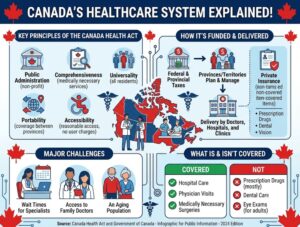
Canada has a publicly funded healthcare system, but healthcare administration is primarily handled by each province and territory.
This means healthcare is organized locally while following national principles established by the federal government.
Every province manages its own:
- Hospitals
- Physician payment systems
- Healthcare budgets
- Medical programs
- Health insurance plans
- Long-term planning
Although each province administers healthcare somewhat differently, all Canadians are entitled to receive medically necessary healthcare regardless of their income.
This universal approach reflects one of Canada’s core healthcare values: medical care should be based on need rather than financial ability.
For millions of Canadians, this provides peace of mind throughout every stage of life.
What Is Medicare in Canada?
Many people hear the word Medicare and immediately think about the American program designed mainly for adults aged 65 and older.
Canada uses the same word, but it means something entirely different.
In Canada, Medicare refers to the country’s publicly funded healthcare insurance system that covers virtually every eligible resident, not just seniors.
Once someone becomes eligible for provincial health coverage, they receive access to medically necessary healthcare services without paying directly at the point of care.
That means when visiting a family doctor, emergency department, or hospital for covered services, patients generally do not receive a bill afterward.
Instead, healthcare providers bill the provincial government.
This single-payer approach simplifies payment while helping ensure equal access for everyone.
Who Pays for Canada’s Healthcare?
Although healthcare appears “free” when Canadians visit a doctor, it certainly isn’t free to operate.
The system is funded primarily through taxes.
Federal and provincial governments both contribute funding, although provinces are responsible for administering healthcare delivery.
Tax revenue supports:
- Hospital operations
- Physician payments
- Emergency care
- Diagnostic testing
- Surgical procedures
- Maternity care
- Public health programs
Government funding covers roughly seventy percent of overall healthcare spending in Canada, while the remaining portion comes from private spending, including supplemental insurance and direct payments for services not covered under provincial plans.
Rather than paying large medical bills during illness, Canadians contribute collectively through taxation throughout their working lives.
This spreads healthcare costs across the population.

How Provincial Healthcare Plans Work
Every province and territory operates its own public health insurance program.
Examples include:
Ontario Health Insurance Plan (OHIP)
Medical Services Plan (British Columbia)
Alberta Health Care Insurance Plan
RAMQ in Quebec
Although the names differ, their purpose remains similar.
Residents apply for provincial health insurance after meeting residency requirements.
Once approved, they receive access to covered healthcare services within their province.
Canadians moving between provinces generally transfer their coverage after establishing residency in their new province.
Visitors traveling within Canada continue receiving medically necessary emergency care through agreements between provinces.
This provincial flexibility allows local governments to address regional healthcare needs while maintaining nationwide principles of universal access.
What Medical Services Are Covered?
One of the greatest strengths of Canada’s healthcare system is broad coverage for medically necessary services.
While coverage varies slightly by province, most plans include:
Visits to family physicians.
Appointments with specialists.
Emergency room treatment.
Hospital admissions.
Surgeries.
Diagnostic imaging.
Laboratory testing.
Maternity care.
Many medically necessary treatments.
Patients typically present their provincial health card when receiving care.
They do not need to negotiate prices, review complicated billing statements, or worry about surprise medical invoices for covered services.
This financial protection provides enormous security, especially for older adults living on fixed retirement incomes.
Hospital Care Without Financial Barriers
Hospital care represents one of the most valuable components of Canada’s healthcare model.
If someone requires hospitalization because of illness, injury, or surgery, medically necessary hospital services are generally covered.
This includes:
Hospital rooms.
Nursing care.
Operating rooms.
Emergency treatment.
Necessary medications administered during hospitalization.
Diagnostic testing.
Post-surgical monitoring.
Rather than evaluating whether patients can afford treatment, hospitals focus on providing appropriate medical care.
Most hospitals operate under fixed annual budgets funded publicly rather than generating profits from individual patients.
This budgeting approach helps control national healthcare spending while maintaining broad public access.

Family Doctors: The Foundation of Canadian Healthcare
Family physicians play an essential role within Canada’s healthcare system.
Unlike hospitals, most family doctors operate private medical practices.
However, they are paid by provincial governments through public insurance.
Many physicians receive compensation using fee-for-service models, meaning they bill provincial insurance plans for each covered patient visit or procedure.
This creates an interesting balance.
Healthcare funding remains public.
Healthcare delivery often remains private.
Doctors continue operating independent practices while patients receive publicly funded care.
This structure differs from fully government-operated healthcare systems.
Instead, Canada combines public financing with private medical practice.
Why Primary Care Matters
Family physicians often become lifelong healthcare partners.
They:
Monitor chronic illnesses.
Provide preventive care.
Manage medications.
Order diagnostic tests.
Coordinate specialist referrals.
Support mental health.
Deliver vaccinations.
Offer health education.
Especially for seniors, having a trusted family physician improves continuity of care.
Rather than repeating medical histories with multiple providers, patients build long-term relationships that improve healthcare quality.
Specialist Care in Canada
Unlike some countries where patients schedule appointments directly with specialists, Canada generally follows a referral system.
Patients usually begin by visiting their family physician.
If specialized care is necessary, the family doctor submits a referral.
This process helps prioritize patients based on medical need while reducing unnecessary specialist visits.
Specialists may include:
Cardiologists.
Orthopedic surgeons.
Neurologists.
Oncologists.
Dermatologists.
Gastroenterologists.
Pulmonologists.
Endocrinologists.
Because referrals are medically prioritized, urgent cases receive faster attention than routine consultations.
Although this process sometimes creates waiting periods for non-emergency appointments, it also helps ensure healthcare resources are directed toward patients with the greatest need.

Emergency Care Is Always Available
Medical emergencies receive immediate attention regardless of income.
Anyone experiencing serious illness or injury can visit an emergency department.
Emergency physicians evaluate patients according to medical urgency rather than arrival order.
Life-threatening conditions receive immediate treatment.
Less urgent problems may wait longer depending on hospital demand.
This triage system exists not only in Canada but in healthcare systems around the world.
It ensures resources remain available for patients facing the greatest medical risks.
Maternity and Reproductive Healthcare
Canada’s public healthcare system also covers many maternity-related services.
Expectant mothers generally receive access to:
Prenatal care.
Routine checkups.
Hospital delivery.
Obstetrical services.
Necessary medical interventions.
Postpartum care.
Some fertility-related treatments may also receive public funding depending on provincial policies and medical circumstances.
This broad coverage helps reduce financial barriers during one of life’s most important stages.
Why Canadians Rarely Worry About Medical Bankruptcy
One major advantage frequently discussed regarding Canadian healthcare is financial protection.
In countries where medical expenses are billed directly to patients, unexpected illness can sometimes create overwhelming debt.
Canada largely avoids this situation for medically necessary hospital and physician services.
Patients generally focus on recovery rather than negotiating hospital invoices.
This creates emotional security alongside financial stability.
For seniors living on retirement income, this protection becomes especially valuable.
Managing chronic diseases becomes less financially stressful when physician visits and hospital care remain publicly funded.
Equal Access Regardless of Income
Perhaps the defining principle of Canada’s healthcare philosophy is equality of access.
Whether someone earns a modest income or substantial wealth, medically necessary healthcare is intended to remain available.
A wealthy executive and a retired senior living on a pension both receive access to the same publicly funded physician services.
This principle strengthens public confidence in the healthcare system while promoting fairness throughout society.
Of course, challenges remain.
Healthcare demand continues increasing as Canada’s population ages.
Medical technology becomes more expensive.
Physician shortages affect certain regions.
Yet the commitment to universal access remains one of the country’s defining healthcare values.
In the next section, we’ll explore what isn’t covered by public healthcare, why many Canadians purchase private insurance, the truth about wait times, common myths surrounding Canada’s healthcare system, comparisons with the United States, and practical advice for seniors navigating the healthcare system. These topics will provide a more complete understanding of how Canada’s Healthcare System functions in everyday life.
What Isn’t Covered by Canada’s Public Healthcare?
One of the biggest myths about Canadian healthcare is that every medical service is completely free.
In reality, provincial healthcare plans primarily cover medically necessary physician and hospital services. Many everyday healthcare expenses fall outside public coverage.
Depending on the province or territory, services that are often not fully covered include:
Prescription medications taken outside hospitals.
Routine dental care.
Eyeglasses and routine eye examinations for many adults.
Hearing aids.
Ambulance transportation in some provinces.
Private hospital rooms.
Cosmetic procedures.
Many physiotherapy services.
Massage therapy.
Chiropractic care.
Psychological counseling provided outside hospital settings.
Because of these gaps, many Canadians rely on private health insurance to help pay for additional healthcare needs.
Fortunately, some services become more accessible for older adults through provincial senior benefit programs.
Prescription Drug Coverage
Unlike hospital medications, prescription drugs obtained from pharmacies are not universally covered across Canada.
Instead, each province operates its own drug benefit programs.
Many seniors qualify for reduced-cost or subsidized prescription medications after reaching a certain age.
For example, provincial programs often provide assistance for retirees living on fixed incomes or individuals with chronic medical conditions.
Some employers also continue offering retiree health benefits that include prescription drug coverage.
Others purchase private insurance plans to reduce medication expenses.
As Canada’s population continues aging, expanding prescription drug coverage remains an important national discussion.
Dental and Vision Care
Good oral health becomes increasingly important with age, yet routine dental services have traditionally fallen outside Canada’s public healthcare system.
Most adults pay privately for:
Dental cleanings.
Fillings.
Crowns.
Dentures.
Root canals.
Routine examinations.
Similarly, regular vision care and eyeglasses often require private payment, although certain groups—including children and seniors in some provinces—may receive partial coverage.
Recent federal initiatives have begun expanding access to publicly funded dental care for eligible Canadians, particularly seniors with lower incomes. These programs continue evolving and may significantly improve access in the coming years.
Why Many Canadians Have Private Insurance
Because public healthcare does not cover every service, millions of Canadians carry supplemental private insurance.
Private insurance commonly covers:
Prescription medications.
Dental care.
Vision care.
Medical equipment.
Paramedical services.
Travel health insurance.
Semi-private or private hospital rooms.
Many employees receive these benefits through workplace insurance plans.
Retirees sometimes continue participating in employer-sponsored plans or purchase individual policies after retirement.
Private insurance complements public healthcare rather than replacing it.
Canadians continue relying on the public system for physician visits and hospital care while using supplemental insurance for additional healthcare expenses.
Understanding Wait Times
Perhaps no aspect of Canada’s healthcare system receives more attention than wait times.
It is true that Canadians sometimes wait longer than patients in certain other countries for non-emergency procedures.
However, understanding why requires examining how healthcare resources are allocated.
Canada prioritizes care according to medical urgency.
Someone experiencing a heart attack receives immediate treatment.
A patient requiring emergency surgery enters the operating room quickly.
Meanwhile, someone needing a non-urgent knee replacement or routine specialist consultation may wait several weeks or months.
This prioritization helps ensure patients facing the greatest health risks receive care first.
Although wait times can certainly be frustrating, they are generally associated with elective or non-life-threatening conditions rather than emergency care.
Governments across Canada continue investing in healthcare workforce expansion, diagnostic capacity, and digital health technologies to improve access.
Why Healthcare Demand Continues Growing
Several factors contribute to increasing pressure on Canada’s healthcare system.
The first is population aging.
Canadians are living longer than ever before.
Older adults naturally require more frequent healthcare services, chronic disease management, surgeries, and long-term care.
Secondly, medical technology continues advancing.
New treatments improve survival rates but often require significant investment.
Third, many communities experience shortages of physicians, nurses, and other healthcare professionals.
Rural and remote regions may face particular challenges recruiting healthcare workers.
Finally, healthcare costs continue rising because of inflation, expensive medical equipment, and increasing demand for specialized services.
These pressures require ongoing planning and investment from governments at every level.
Long-Term Care for Seniors
As people age, some eventually require assistance beyond traditional medical care.
Long-term care facilities provide support for seniors who can no longer live independently because of physical or cognitive challenges.
Services may include:
24-hour nursing.
Medication management.
Assistance with bathing and dressing.
Meals.
Recreational activities.
Rehabilitation.
Memory care.
Funding models differ among provinces.
Medical care within long-term care facilities is generally publicly funded, while residents may contribute toward accommodation costs depending on income and provincial regulations.
Because Canada’s senior population continues growing rapidly, expanding access to quality senior healthcare and long-term care remains a national priority.
Home Care Services
Many older adults prefer remaining in their own homes for as long as possible.
Home care services help make this possible.
Depending on medical needs and provincial programs, eligible seniors may receive:
Nursing visits.
Personal care assistance.
Physical therapy.
Occupational therapy.
Medication monitoring.
Palliative care.
Support for family caregivers.
Receiving care at home often improves quality of life while reducing hospital admissions.
Many healthcare experts believe expanding home care will become increasingly important in the future.

Preventive Healthcare
One of the strengths of Canada’s healthcare philosophy is its emphasis on prevention.
Preventive services help identify health problems early before they become more serious.
Examples include:
Vaccinations.
Cancer screening.
Blood pressure monitoring.
Diabetes screening.
Prenatal care.
Routine physical examinations when medically appropriate.
Health education.
Smoking cessation programs.
Preventive care not only improves health outcomes but also reduces long-term healthcare costs.
Healthy lifestyles remain one of the most effective ways Canadians can support both their own well-being and the healthcare system as a whole.
Digital Healthcare and Virtual Medicine
Healthcare delivery has changed significantly over the past decade.
Virtual appointments have become increasingly common.
Many family physicians now offer telephone or video consultations for appropriate medical concerns.
Patients may receive:
Prescription renewals.
Follow-up appointments.
Chronic disease monitoring.
Mental health consultations.
Medical advice.
Without traveling long distances.
Virtual care has proven especially valuable for seniors with mobility limitations and residents living in remote communities.
Technology continues improving access while reducing unnecessary clinic visits.
Canada’s Healthcare System Compared with the United States
Comparisons between Canada and the United States frequently appear in healthcare discussions.
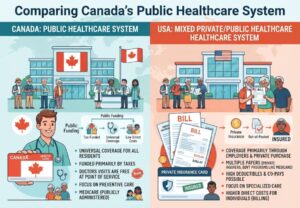
Although both countries provide high-quality medical expertise, their financing systems differ considerably.
Canada primarily funds medically necessary healthcare through taxation.
The United States relies more heavily on employer-sponsored insurance, government programs, and private insurance markets.
Some key differences include:
Canadians generally do not receive bills for covered physician or hospital services.
Americans may experience shorter waits for certain elective procedures.
Canadians typically face fewer concerns about medical bankruptcy for insured services.
Americans often have greater access to private healthcare options.
Neither system is perfect.
Each reflects different national priorities and policy choices.
Understanding these differences helps explain why healthcare debates remain active in both countries.
Common Myths About Canadian Healthcare
Several misconceptions continue circulating about Canada’s healthcare system.
Myth 1: Everything is completely free.
Reality: Many services, including dental care, vision care, and prescription medications, may require private payment or supplemental insurance.
Myth 2: Everyone waits months for every appointment.
Reality: Emergency care is provided promptly, while wait times mainly affect non-urgent specialist consultations and elective procedures.
Myth 3: Doctors work directly for the government.
Reality: Most physicians operate independent practices while billing provincial insurance plans for covered services.
Myth 4: Private healthcare doesn’t exist.
Reality: Canada has a significant private healthcare sector providing services not covered under provincial insurance, including dental, vision, physiotherapy, and many diagnostic services.
Understanding these facts creates a more balanced view of the Canadian healthcare system.
Tips for Seniors Navigating Canada’s Healthcare System
Healthcare becomes increasingly important with age.
Older adults can maximize their healthcare experience by following several practical strategies.
Maintain an up-to-date list of medications.
Develop a strong relationship with your family physician.
Attend recommended health screenings.
Stay physically active.
Keep copies of important medical records.
Understand your provincial drug benefit program.
Consider supplemental insurance if needed.
Ask questions during appointments.
Take advantage of preventive healthcare services.
Stay informed about provincial healthcare updates.
Being proactive often leads to better health outcomes and greater peace of mind.
The Future of Canadian Healthcare
Canada’s healthcare system continues evolving.
Governments, healthcare professionals, researchers, and communities are working together to address future challenges.
Current priorities include:
Reducing surgical wait times.
Recruiting more healthcare workers.
Expanding mental health services.
Improving access in rural communities.
Increasing home care.
Strengthening long-term care.
Expanding digital healthcare.
Supporting healthy aging.
Modernizing healthcare infrastructure.
As medical science advances and Canada’s population ages, innovation will remain essential to maintaining a strong universal healthcare system.
Frequently Asked Questions
Is healthcare free in Canada?
Medically necessary physician and hospital services are publicly funded through taxes for eligible residents. However, services such as dental care, prescription medications outside hospitals, and vision care may require private payment or supplemental insurance.
Do seniors receive additional healthcare benefits?
Many provinces offer additional programs for seniors, including prescription drug assistance, home care services, and various community support programs.
Can visitors receive free healthcare in Canada?
Visitors are generally not covered under provincial health insurance and should purchase travel medical insurance before arriving in Canada.
Why do Canadians buy private insurance?
Private insurance helps pay for healthcare services not fully covered by provincial health plans, including dental care, prescription drugs, vision care, and paramedical services.
Is Canada’s healthcare system considered successful?
Most experts recognize Canada’s healthcare system for providing universal access to medically necessary care while acknowledging ongoing challenges related to wait times, workforce shortages, and increasing healthcare demand.
Final Thoughts
Canada’s healthcare system is built on a simple yet powerful principle: access to medically necessary healthcare should depend on a person’s medical needs rather than their ability to pay. That commitment has shaped one of the world’s best-known examples of universal healthcare, providing millions of Canadians with financial protection and peace of mind when they need medical care most.
At the same time, understanding the system’s limitations is just as important as recognizing its strengths. Public coverage does not include every healthcare expense, and challenges such as wait times, workforce shortages, and the growing needs of an aging population continue to drive ongoing reforms. Canadians often rely on a combination of public healthcare and private insurance to meet their complete healthcare needs.
For older adults and their families, becoming familiar with Canadian healthcare, Medicare in Canada, healthcare for seniors, and public health insurance can make navigating medical services far less stressful. Knowing what is covered, planning for additional healthcare expenses, and taking advantage of preventive care programs all contribute to healthier and more confident aging.
While no healthcare system is perfect, Canada’s approach continues to demonstrate how a publicly funded model can provide broad access to essential medical care while evolving to meet the changing needs of its people. Understanding how the system works empowers individuals to make informed healthcare decisions and appreciate the balance between universal access, personal responsibility, and ongoing improvements that define healthcare in Canada today.
Bài viết liên quan: