
Healthcare In Decline? The Cost Of Canadian Vs. American Healthcare EXPLAINED. Healthcare has become one of the most debated topics in North America. Whether you live in Canada or the United States, you’ve likely heard strong opinions about which country offers a better healthcare system. Canadians often praise their public healthcare system, while Americans frequently point to shorter wait times, greater provider choice, and medical innovation. The reality, however, is far more complicated than the headlines suggest.
Many people believe healthcare in Canada is completely free, while others assume that healthcare in the United States is entirely private and only available to wealthy individuals. Neither statement is entirely accurate. Both countries rely on a mixture of public funding, private spending, insurance programs, and government regulations. Understanding how these systems actually work is essential before deciding which model is more effective.
For seniors, retirees, caregivers, and families, this topic becomes even more important. As people age, healthcare expenses naturally increase. Doctor visits become more frequent, prescription medications become essential, and specialized treatments may be required. Understanding how each country’s healthcare financing works can help seniors make informed decisions about retirement, relocation, travel, and long-term care planning.
This article explores the real costs behind the Canadian and American healthcare systems. Instead of repeating common myths, we’ll examine how healthcare is funded, what services are covered, what patients still pay out of pocket, and why healthcare expenses continue to rise on both sides of the border. The discussion is based on the concepts explained throughout the referenced YouTube transcript while expanding them into a broader, reader-friendly analysis.
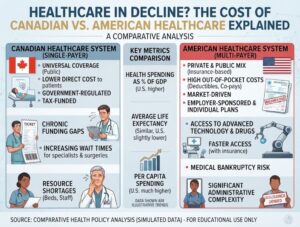
Why Comparing Canadian and American Healthcare Is So Difficult
Comparing healthcare systems is not as simple as comparing the price of a doctor’s visit or an emergency room bill.
Healthcare involves thousands of moving parts, including government funding, taxation, insurance policies, pharmaceutical pricing, physician compensation, hospital administration, preventive care, and population health.
Someone living in Ontario may have a completely different healthcare experience than someone living in British Columbia. Likewise, healthcare access in California differs significantly from Florida, Texas, or New York.
This complexity explains why debates often become emotional rather than factual.
One person may focus on waiting several months for surgery in Canada.
Another may focus on receiving a $50,000 hospital bill in America.
Both experiences can be true simultaneously.
Instead of asking which system is “better,” a more useful question is:
Which healthcare model works better for different types of patients?
The answer depends on income, age, employment, medical history, insurance coverage, and healthcare needs.
The Biggest Myth About Canadian Healthcare
Perhaps the most common misconception around the world is that healthcare in Canada is completely free.
This isn’t true.
A more accurate description is that Canada operates a publicly funded healthcare system.
That means healthcare services are largely paid through taxes rather than directly at the point of care.
Patients usually do not receive a bill after visiting their family physician or staying in a hospital for medically necessary treatment.
However, Canadians have already contributed to those services through income taxes and other government revenues.
In other words, healthcare isn’t free.
The payment simply happens before medical care is needed rather than afterward.
This distinction is extremely important because many international observers mistakenly believe Canadians receive unlimited healthcare without paying anything.
In reality, every taxpayer contributes toward funding the healthcare system whether they use it frequently or not.

Understanding Canada’s Medicare System
Canada’s healthcare system is commonly referred to as Medicare, although many people outside Canada confuse this with the American Medicare program.
Canadian Medicare is actually an umbrella term.
Rather than operating one nationwide healthcare system, Canada has thirteen publicly funded provincial and territorial healthcare plans.
Each province administers its own healthcare insurance.
For example:
Ontario operates OHIP (Ontario Health Insurance Plan).
British Columbia operates the Medical Services Plan (MSP).
Other provinces maintain similar systems under different names.
Although these programs are managed independently, they all must comply with the principles established under the Canada Health Act.
These principles include:
- Public administration
- Comprehensiveness
- Universality
- Portability
- Accessibility
These five principles ensure Canadians have access to medically necessary healthcare regardless of where they live within the country, while still allowing provinces some flexibility in administration.
Who Qualifies for Public Healthcare in Canada?
Another misconception is that anyone arriving in Canada immediately receives free healthcare.
Again, that’s not accurate.
Eligibility depends on residency status and provincial regulations.
Using Ontario as an example, individuals generally must establish Ontario as their primary residence, meet minimum physical presence requirements, and belong to one of several qualifying categories, such as Canadian citizens, permanent residents, eligible work permit holders, protected persons, or certain other approved residents.
Because healthcare is funded through provincial tax revenue, governments require residents to demonstrate genuine long-term ties before receiving full public coverage.
For newcomers, this often means carefully planning healthcare coverage during the transition period.
Travel insurance or temporary private insurance may be necessary until provincial eligibility begins.
What Does OHIP Actually Cover?
Many Canadians are surprised to learn that even after qualifying for OHIP, not every healthcare service is automatically covered.
Generally speaking, OHIP covers:
- Visits to family physicians
- Hospital admissions
- Emergency medical care
- Laboratory testing
- Many medically necessary surgeries
- Certain hospital-based dental procedures
- Limited optometry services
- Some ambulance services
These services represent the core foundation of Canada’s publicly funded healthcare model.
When Canadians visit their physician for routine medical concerns, they usually do not receive a bill.
Likewise, medically necessary hospitalization is generally covered.
This significantly reduces the financial uncertainty associated with unexpected illnesses.
Families do not typically worry about receiving a five-figure invoice after emergency surgery, something that can occur in countries relying more heavily on private billing.
However, this coverage does not extend to every aspect of healthcare.

What Isn’t Covered?
This is where many people misunderstand the Canadian healthcare system.
A surprising number of health-related services remain outside provincial insurance.
Examples include:
Routine dental care
Most prescription medications outside hospitals
Physiotherapy
Massage therapy
Chiropractic care
Many vision services
Some specialized treatments
These services often require private health insurance, employer benefits, or direct out-of-pocket payment.
As a result, many Canadians still purchase supplemental insurance through employers or private providers.
While hospital care may be publicly funded, maintaining overall health frequently involves additional personal expenses.
This is especially relevant for older adults who require ongoing rehabilitation, mobility treatments, or multiple medications.
Prescription Drugs: An Overlooked Cost
Prescription medications are perhaps one of the biggest surprises for people unfamiliar with Canadian healthcare.
Many assume medications are included under universal healthcare.
They are not.
If a patient receives medication while admitted to a hospital, those drugs are generally covered.
Once discharged, however, patients usually become responsible for paying for prescription medications unless they qualify for special programs or have private insurance.
Ontario offers drug benefits for certain age groups, including younger individuals and seniors, but working-age adults often depend on employer-sponsored insurance or personal coverage.
Without insurance, prescription costs can become significant.
Newer medications used to treat diabetes, cardiovascular disease, autoimmune disorders, or certain cancers can cost hundreds—or even thousands—of dollars each month.
This explains why employer-sponsored drug coverage remains highly valuable in Canada despite universal physician and hospital care.
Why Family Doctors Play Such an Important Role
Another defining characteristic of Canadian healthcare is the emphasis on primary care.
Family physicians serve as the central coordinators of patient care.
Unlike some healthcare systems where patients can directly schedule appointments with specialists, Canadian patients often require referrals from their primary care physician.
This referral system helps prioritize medical resources and ensures specialists focus on patients who genuinely require advanced evaluation.
Similarly, laboratory testing generally cannot be ordered solely at a patient’s request.
Blood work and diagnostic testing usually require authorization from an appropriate healthcare provider.
Although some patients view these referral requirements as inconvenient, they are intended to improve coordination, reduce unnecessary testing, and control healthcare costs across the publicly funded system.

How Canadians Actually Pay for Healthcare
Perhaps the most interesting aspect of Canada’s healthcare system is how funding occurs behind the scenes.
Instead of paying individual medical bills, Canadians contribute through taxation.
Healthcare represents one of the largest government expenditures each year.
According to figures discussed in the source material, Canada’s healthcare spending exceeded $330 billion annually, averaging nearly $9,000 per resident.
These numbers demonstrate an important reality.
Even individuals who rarely visit a doctor still contribute toward maintaining hospitals, emergency departments, long-term care facilities, medical education, and public health services.
Healthcare operates much like other public services.
Everyone contributes.
Everyone benefits when needed.
This approach spreads financial risk across the population rather than concentrating expenses on individuals experiencing illness.
Taxes and Healthcare Funding
Because Canada’s healthcare system is funded largely through taxation, higher-income households generally contribute more.
This progressive funding model allows lower-income Canadians to receive healthcare despite contributing relatively less financially.
Examples discussed in the source transcript illustrate how healthcare contributions increase alongside household income through Canada’s tax structure.
Critics argue this creates a heavier tax burden for higher earners.
Supporters counter that the system ensures healthcare remains available regardless of financial circumstances.
This philosophical difference represents one of the biggest distinctions between Canadian and American healthcare policy.
Rather than viewing healthcare primarily as an individual purchase, Canada treats medically necessary care as a publicly funded social service.
For many seniors, this model provides significant financial security.
Unexpected surgeries, cancer treatments, intensive care admissions, or emergency hospitalizations generally do not result in catastrophic medical debt.
However, this security comes with trade-offs, including higher taxation and limitations on services not included under provincial insurance.
Understanding the American Healthcare System
If Canada’s healthcare system is often misunderstood as being “free,” the American healthcare system is frequently misunderstood as being entirely private.
That assumption is just as inaccurate.
The United States actually operates a hybrid healthcare system, combining both government-funded healthcare programs and private health insurance. Millions of Americans receive healthcare coverage through public programs, while millions of others rely on employer-sponsored insurance or individual insurance plans. Others, unfortunately, remain uninsured and face significant financial risks if serious illness occurs.
Rather than having one universal healthcare system, the United States has multiple healthcare pathways depending on a person’s age, employment status, disability, military service, household income, and state of residence. This layered approach creates flexibility but also adds complexity for patients trying to understand their coverage options.

Medicaid: Healthcare for Lower-Income Americans
One of the largest public healthcare programs in the United States is Medicaid.
Unlike Canada’s provincial healthcare plans that generally cover all eligible residents, Medicaid is specifically designed for individuals and families who meet income and eligibility requirements.
Although Medicaid receives support from both federal and state governments, each state administers its own program.
That means eligibility rules, covered services, and enrollment procedures vary across the country.
Generally, applicants must belong to certain qualifying groups, such as:
Low-income families
Pregnant women
Children
Individuals with disabilities
Older adults with limited income
Applicants must also fall below specific household income thresholds established by their state.
Because every state administers Medicaid differently, two individuals with identical financial situations may qualify in one state but not another.
This decentralized approach gives states flexibility but also contributes to significant differences in healthcare access across the nation.
Medicare in the United States
Although Canada uses the term Medicare to describe its universal public healthcare framework, American Medicare refers to something very different.
In the United States, Medicare is a federal insurance program primarily serving:
Adults aged 65 and older
Certain younger individuals living with qualifying disabilities
Eligibility generally depends on age, work history, Social Security eligibility, residency status, or specific medical conditions.
Unlike Canada’s universal hospital and physician coverage, Medicare itself contains multiple components with different rules regarding hospital care, physician services, prescription drugs, and optional supplemental insurance.
Many seniors purchase additional coverage to help reduce deductibles and out-of-pocket expenses.
Another important distinction is that not every healthcare provider accepts every Medicare reimbursement arrangement.
In some cases, patients may need to locate physicians who participate in Medicare or pay additional costs depending on the services provided.
What Is the Affordable Care Act?
Another major component of American healthcare is the Affordable Care Act (ACA), commonly known as Obamacare.
One of its most important goals was improving access to health insurance.
Before the Affordable Care Act, individuals diagnosed with chronic illnesses often struggled to obtain affordable insurance coverage.
Insurance companies could charge significantly higher premiums or deny coverage based on pre-existing medical conditions.
The Affordable Care Act introduced regulations preventing insurers from increasing premiums simply because someone became ill after obtaining coverage.
This protection represented a major shift in healthcare policy.
Instead of allowing insurers to selectively favor healthier customers, the law expanded consumer protections and attempted to make private insurance more accessible.
Supporters argue that these reforms expanded healthcare access for millions of Americans.
Critics point to the increased government spending and higher insurance costs associated with implementing the legislation.
Regardless of political viewpoints, the Affordable Care Act remains one of the most influential healthcare reforms in modern American history.
What Happens Without Health Insurance?
One of the greatest financial risks in the United States is being uninsured.
Without public coverage or private insurance, patients generally pay directly for medical services.
This fee-for-service model means every doctor’s visit, emergency room treatment, diagnostic test, surgery, and hospitalization generates individual charges.
Even relatively minor emergencies can result in bills totaling thousands of dollars.
Major surgeries or extended hospital stays can become financially devastating.
Although uninsured healthcare also carries costs in Canada for individuals who do not qualify for provincial insurance, medical expenses in the United States are generally much higher.
For this reason, maintaining some form of health insurance is considered essential for most Americans.
Unexpected illnesses rarely provide advance warning.
Without insurance, even a single medical emergency may create years of financial hardship.
Understanding Private Health Insurance
Employer-sponsored insurance remains the most common form of healthcare coverage for working Americans.
Unlike Canada’s tax-funded system, American private insurance typically requires several different types of payments.
These include:
Premiums
Deductibles
Copayments
Coinsurance
Out-of-pocket maximums
Understanding these terms helps explain why healthcare expenses often appear confusing.
Premiums
A premium is the amount paid simply to maintain health insurance coverage.
This payment is required regardless of whether medical care is actually used.
Many employers contribute a substantial portion of these premiums, reducing the employee’s financial burden.
However, families still commonly contribute several thousand dollars annually toward their insurance coverage.
Deductibles
The deductible represents the amount patients must pay themselves before insurance begins covering eligible medical expenses.
For example, if a plan has a $4,000 deductible, patients generally pay the first $4,000 of covered medical expenses before insurance contributes significantly.
Higher deductibles usually result in lower monthly premiums.
Lower deductibles generally require higher monthly premium payments.
Copays and Coinsurance
After meeting the deductible, patients often continue sharing healthcare costs with their insurance company.
This arrangement is commonly known as coinsurance.
For instance, insurance may cover 80% of medical expenses while the patient remains responsible for the remaining 20%.
This cost-sharing continues until reaching the policy’s annual spending limit.
Out-of-Pocket Maximum
Once patients spend enough through deductibles, copays, and coinsurance to reach their annual out-of-pocket maximum, insurance companies typically cover nearly all additional eligible medical expenses for the remainder of the year.
This feature protects patients from unlimited financial liability following catastrophic illnesses or major surgeries.
Although the terminology may seem complicated, these mechanisms are designed to balance affordability, patient responsibility, and insurance risk.
A Practical Example
Imagine a family with private insurance requiring:
A yearly premium of $6,000
A deductible of $4,000
A 20% coinsurance rate
An $8,000 annual out-of-pocket maximum
If a medical procedure costs $100,000, the family would first pay their deductible.
Afterward, they would continue paying their share through coinsurance until reaching the out-of-pocket limit.
Beyond that point, the insurance company would generally assume responsibility for the remaining eligible costs.
Although the total hospital bill reaches six figures, the family’s direct medical responsibility would stop once the policy’s spending cap is reached.
This example demonstrates why simply comparing hospital prices between Canada and the United States rarely tells the complete story.
Insurance design plays a major role in determining what patients actually pay.

Prescription Drug Prices
Prescription medications represent another major difference between the two countries.
Research discussed in the source material suggests many prescription drugs cost considerably more in the United States than in Canada.
Several factors contribute to this difference, including:
Different pharmaceutical pricing policies
Negotiation practices
Distribution systems
Supply chain structures
Market competition
However, lower prices do not always guarantee greater availability.
Canada has occasionally experienced shortages involving certain medications, demonstrating that affordability and supply reliability do not always move together.
Both countries continue searching for better solutions to improve medication access while controlling costs.
Which System Costs More?
Looking only at total national healthcare spending, the United States spends substantially more than Canada.
The American healthcare system accounts for trillions of dollars in annual spending, reflecting both higher medical prices and greater utilization of advanced technologies and specialized treatments.
Canada also spends hundreds of billions annually, funded largely through taxation.
Yet individual experiences vary dramatically.
A healthy young professional may rarely require healthcare and therefore perceive higher Canadian taxes as unnecessary.
Meanwhile, an older adult living with multiple chronic illnesses may appreciate Canada’s reduced financial barriers to ongoing treatment.
Cost alone cannot determine which system is superior.
The more important question is how efficiently healthcare spending translates into accessible, high-quality care.
Which Healthcare System Benefits Seniors More?
For older adults, both systems offer meaningful advantages.
Canada’s model provides peace of mind by ensuring medically necessary physician and hospital services are generally available without large bills at the time of treatment.
This can significantly reduce financial anxiety during retirement.
However, seniors may still encounter expenses related to dental care, vision services, rehabilitation, home care, or medications not fully covered under provincial programs.
In the United States, Medicare provides broad coverage for millions of seniors, but beneficiaries often purchase supplemental insurance to reduce out-of-pocket costs.
Access to specialists may sometimes be faster, and patients often enjoy greater flexibility when selecting providers and treatment facilities.
The ideal system therefore depends on individual priorities.
Someone seeking maximum financial predictability may favor Canada’s publicly funded approach.
Someone prioritizing provider choice and rapid access to specialized services may prefer aspects of the American model.
Neither approach completely eliminates healthcare challenges.
Lessons Families Should Remember
Whether living in Canada or the United States, several important lessons apply.
First, health insurance matters.
Even countries with extensive public healthcare systems still leave gaps requiring private coverage.
Second, understanding your benefits is essential.
Many people assume services are covered only to discover unexpected expenses later.
Third, preventive healthcare remains one of the best financial investments.
Regular checkups, healthy lifestyles, vaccinations, and early treatment often reduce long-term medical costs while improving quality of life.
Finally, families should recognize that healthcare decisions involve more than money alone.
Availability, convenience, physician relationships, quality of care, patient satisfaction, and long-term health outcomes all influence the overall value of any healthcare system.
Final Thoughts
The debate surrounding Canadian and American healthcare will likely continue for many years.
Both systems reflect different philosophies about balancing personal responsibility, government involvement, taxation, private insurance, and universal access.
Canada emphasizes publicly funded healthcare, seeking to ensure medically necessary care remains available regardless of income.
The United States emphasizes a mixed public-private healthcare model, offering broader consumer choice while relying more heavily on insurance markets and employer-sponsored coverage.
Neither system is perfect.
Canada continues working to address physician shortages, wait times, and expanding healthcare demands driven by an aging population.
The United States continues searching for ways to improve affordability while preserving innovation and patient choice.
Perhaps the most valuable takeaway is that healthcare should never be evaluated using a single statistic or personal story.
Meaningful comparisons require examining healthcare costs, insurance coverage, government funding, patient access, prescription drug pricing, long-term sustainability, and the experiences of the people who rely on these systems every day.
For seniors, caregivers, and families planning for the future, understanding these differences is more than an academic exercise. It is an essential part of preparing for retirement, managing chronic conditions, and making informed decisions about where and how to receive healthcare throughout life’s later years.
Bài viết liên quan: