
The New $6000 Senior Tax Deduction Explained. For millions of older Americans, taxes remain one of the biggest financial concerns during retirement. Every year, retirees carefully plan withdrawals from retirement accounts, estimate Required Minimum Distributions (RMDs), evaluate Social Security benefits, and look for opportunities to legally reduce their taxable income. Beginning with the 2025 tax year, a significant temporary tax benefit is available for qualifying seniors: a new $6,000 Senior Tax Deduction.
Although many headlines describe it as a “$6,000 tax break,” the reality is more nuanced. The deduction works alongside the existing standard deduction and the additional deduction already available to taxpayers age 65 and older. It also includes income limits that gradually reduce the benefit for higher-income retirees.
Understanding how this deduction works can help retirees make smarter financial decisions. In some cases, careful planning around retirement account withdrawals or Roth conversions may allow eligible seniors to preserve the full deduction while reducing their overall tax liability.
This guide explains everything you need to know about the new deduction, including who qualifies, how income phase-outs work, examples of how the deduction is calculated, and planning strategies that retirees should consider between 2025 and 2028.
Whether you are already retired, preparing to retire soon, or helping aging parents manage their finances, understanding these new rules can make a meaningful difference.
What Is the New $6,000 Senior Tax Deduction?
Starting with the 2025 tax year, eligible taxpayers who are 65 years of age or older may claim an additional tax deduction of up to $6,000 per qualifying individual.
Unlike a tax credit, which directly reduces taxes owed, a tax deduction reduces taxable income. Lower taxable income generally means a smaller tax bill.
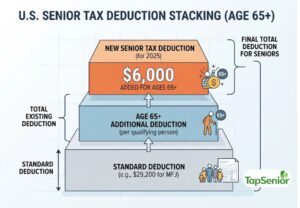
This deduction is available in addition to the standard deduction that taxpayers already receive. It also comes on top of the existing age-based additional standard deduction that has long been available to seniors.
As a result, many retirees may see a noticeable reduction in taxable income during the years this provision remains in effect.
However, eligibility depends on income. Once modified adjusted gross income (Modified AGI) exceeds certain thresholds, the deduction gradually decreases until it disappears entirely.

Why Was This New Deduction Introduced?
The new deduction was designed to provide additional tax relief for older Americans during retirement.
Many retirees rely on fixed incomes from Social Security, pensions, retirement savings, and investment accounts. Rising healthcare expenses, inflation, prescription medication costs, and long-term care needs have made managing retirement income increasingly challenging.
During discussions surrounding federal tax legislation, policymakers explored several approaches to reduce the tax burden on seniors. One widely discussed proposal involved eliminating federal taxes on Social Security benefits.
Rather than completely removing Social Security taxation, lawmakers introduced an alternative approach by creating this temporary additional deduction for taxpayers aged 65 and older.
The result is a tax benefit that applies broadly to many retirees regardless of whether they receive Social Security, provided they satisfy the eligibility requirements.
How Long Will the Deduction Be Available?
One important feature of this deduction is that it is temporary.
Under current law, the deduction applies to:
- Tax Year 2025
- Tax Year 2026
- Tax Year 2027
- Tax Year 2028
Unless Congress extends the provision or passes new legislation, the deduction is scheduled to expire after the 2028 tax year.
Because the deduction has a limited lifespan, retirees may wish to consider multi-year tax planning instead of making decisions one year at a time.
Planning across several tax years can sometimes help maximize available deductions while minimizing taxes over the course of retirement.
Understanding the Standard Deduction
To understand the new deduction, it is important first to understand the standard deduction.
Every taxpayer generally chooses between:
- Taking the standard deduction
- Itemizing deductions
Most retirees choose the standard deduction because it is simpler and often provides the larger benefit.
The new senior deduction does not replace the standard deduction.
Instead, it is added on top of it.
This distinction is important because some taxpayers mistakenly assume they must itemize deductions to receive the new benefit.
That is not the case.
Eligible seniors can still use the standard deduction while also claiming the additional senior deduction if they meet the requirements.
Existing Additional Deduction for Age 65 and Older
Even before the new legislation, older taxpayers already enjoyed an enhanced deduction.
For the 2025 tax year, taxpayers age 65 and older generally qualify for an additional standard deduction beyond the regular standard deduction.
For example:
- Single taxpayers age 65 or older receive an additional age-based deduction.
- Married couples receive an additional deduction for each spouse who meets the age requirement.
The new $6,000 deduction is separate from this long-standing age-based deduction.
This means qualifying seniors may benefit from:
- Regular Standard Deduction
- Existing Age 65 Additional Deduction
- New Temporary $6,000 Senior Deduction
These benefits work together, potentially reducing taxable income substantially for many retirees.
Who Qualifies for the New Deduction?
Eligibility primarily depends on two factors:
1. Age Requirement
A taxpayer generally must be at least 65 years old during the applicable tax year.
For married couples filing jointly, eligibility is determined separately for each spouse.
If only one spouse is at least 65, only one additional $6,000 deduction may apply.
If both spouses are age 65 or older, both may qualify.
2. Income Requirement
Meeting the age requirement alone is not enough.
The deduction also depends on Modified Adjusted Gross Income (Modified AGI).
Higher-income retirees will gradually lose part or eventually all of the deduction through a phase-out mechanism.
This income limitation ensures the deduction primarily benefits low- and middle-income retirees.
Deduction Amount by Filing Status
The maximum available deduction depends on filing status.
Single Filers
A qualifying taxpayer who files as single may receive:
Up to $6,000
provided income remains below the phase-out threshold.
Married Filing Jointly
For married couples filing jointly:
- One spouse age 65 or older = Up to $6,000
- Both spouses age 65 or older = Up to $12,000
This makes the deduction particularly valuable for retired couples who both satisfy the age requirement.
Because each qualifying spouse receives a separate deduction, married households may reduce taxable income by a significant amount before considering any other deductions already available under current tax law.
Understanding the Income Phase-Out
The deduction is not available equally to every senior.
Instead, eligibility decreases as income rises.
The government uses Modified Adjusted Gross Income (Modified AGI) to determine whether taxpayers qualify for the full deduction, a partial deduction, or no deduction at all.
For many retirees, Modified AGI includes income from sources such as:
- Traditional IRA withdrawals
- Pension income
- Taxable investment income
- Wages from part-time employment
- Certain taxable Social Security benefits
- Rental income
- Business income
Because retirement income can come from multiple sources, understanding how Modified AGI is calculated is essential when estimating eligibility.
Income Thresholds
For the temporary senior deduction, the maximum benefit generally applies until income reaches these thresholds.
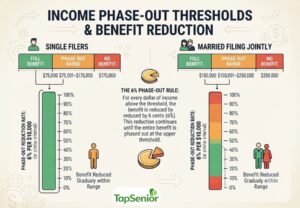
Single Filers
- Full deduction available below $75,000 Modified AGI
- Deduction gradually phases out above that level
- Fully eliminated at $175,000
Married Filing Jointly
- Full deduction available below $150,000 Modified AGI
- Gradual phase-out begins above this level
- Fully eliminated at $250,000
Taxpayers whose incomes fall between these limits may still receive a partial deduction rather than losing the benefit entirely.
Understanding where your income falls within these ranges can make year-end tax planning especially valuable.
How the Phase-Out Formula Works
The reduction is relatively straightforward.
Once Modified AGI exceeds the applicable threshold, the available deduction decreases by 6 cents for every additional dollar above the threshold.
This creates a gradual reduction instead of an immediate cutoff.
For many retirees, this means even modest changes in taxable income could influence how much of the deduction remains available.
Consequently, decisions involving retirement withdrawals, capital gains, and Roth conversions may have a larger tax impact than expected.
In the next section, we’ll walk through several practical examples illustrating exactly how the phase-out calculation works and explore strategies retirees can use to preserve as much of the deduction as possible while managing their overall tax burden.
Practical Examples of How the Deduction Works
Understanding the income phase-out is much easier when you look at real-life examples. While every taxpayer’s situation is unique, the following scenarios illustrate how the new deduction may be applied.
Example 1: Single Retiree Below the Income Limit
Mary is 68 years old and files as a single taxpayer.
Her Modified Adjusted Gross Income (Modified AGI) for 2025 is $68,000.
Since her income is below the $75,000 phase-out threshold, she qualifies for the full $6,000 Senior Tax Deduction. In addition, she can still claim the regular standard deduction and the existing age-based additional deduction available to taxpayers age 65 and older.
This combination lowers her taxable income significantly, reducing the amount of income subject to federal tax.
Example 2: Single Retiree Within the Phase-Out Range
John is 72 years old and files as a single taxpayer.
His Modified AGI is $100,000.
Because his income exceeds the $75,000 threshold by $25,000, his deduction must be reduced.
The reduction is calculated as:
- Income above threshold: $25,000
- Phase-out rate: 6%
- Reduction: $1,500
Instead of receiving the full $6,000 deduction, John qualifies for a deduction of $4,500.
Although reduced, this deduction still lowers his taxable income and provides meaningful tax savings.
Example 3: Married Couple With One Qualifying Spouse
Robert is 67.
His wife Linda is 61.
They file a joint tax return.
Because only Robert is age 65 or older, the couple may qualify for one additional $6,000 deduction, assuming their Modified AGI remains below the applicable income threshold.
Example 4: Married Couple With Two Qualifying Spouses
David and Susan are both 70 years old.
Their Modified AGI is $130,000.
Because both spouses satisfy the age requirement and their income remains below the phase-out threshold for married couples filing jointly, they may qualify for a combined deduction of $12,000.
For many retired couples, this additional deduction can noticeably reduce taxable income.
Why Income Planning Matters More Than Ever
One of the biggest takeaways from this new deduction is that income planning becomes increasingly important.
Many retirees assume that once they stop working, their tax planning is finished.
In reality, retirement often requires even more strategic planning than the working years.
Every additional dollar of taxable income could influence:
- Eligibility for the new deduction
- Medicare premium surcharges
- Taxation of Social Security benefits
- Capital gains taxes
- Future Required Minimum Distributions (RMDs)
The new deduction adds another reason to carefully monitor annual taxable income.
Retirement Income Sources That Affect Modified AGI
Several common retirement income sources may increase Modified AGI.
These include:
- Traditional IRA withdrawals
- 401(k) distributions
- Pension income
- Interest income
- Dividend income
- Capital gains
- Rental income
- Self-employment earnings
- Part-time employment
- Certain taxable Social Security benefits
Because income often comes from multiple sources, retirees should review their entire financial picture instead of focusing on a single account.
Roth Conversion Planning
Many retirees convert money from traditional retirement accounts into Roth IRAs.
A Roth conversion can provide long-term tax advantages because qualified Roth withdrawals are generally tax-free.
However, Roth conversions increase taxable income during the year they occur.
For retirees whose income falls close to the phase-out threshold, converting too much in a single year could reduce or even eliminate the new senior deduction.
Instead of completing one large conversion, some retirees may benefit from spreading conversions over several years.
By carefully managing annual taxable income, they may preserve more of the deduction while still accomplishing their long-term retirement planning goals.
Required Minimum Distributions (RMDs)
Beginning at the required age, many retirees must take Required Minimum Distributions from traditional retirement accounts.
RMDs increase taxable income whether retirees need the money or not.
This additional income may:
- Push Modified AGI above the phase-out threshold
- Reduce the available deduction
- Increase Medicare premiums
- Raise overall tax liability
Since RMDs are mandatory, retirees should consider strategies well before RMDs begin whenever possible.
Qualified Charitable Distributions (QCDs)
For charitably inclined retirees, a Qualified Charitable Distribution (QCD) may be an effective planning tool.
Instead of receiving an RMD personally and then donating the money afterward, eligible retirees can direct qualifying IRA distributions straight to an eligible charity.
This approach may reduce taxable income while satisfying RMD requirements.
Lower taxable income may help preserve eligibility for the senior deduction while simultaneously supporting charitable causes.
Because QCD rules contain specific requirements, retirees should consult a qualified tax professional before implementing this strategy.

Coordinating Multiple Tax Strategies
The new deduction should not be viewed in isolation.
Instead, it works best as one part of a comprehensive retirement tax strategy.
Retirees may benefit from coordinating:
- Annual IRA withdrawals
- Roth conversions
- Capital gain recognition
- Charitable giving
- Investment income
- Pension timing
- Social Security claiming strategies
Looking at the complete financial picture often produces better long-term outcomes than making decisions one tax year at a time.
Common Mistakes to Avoid
Even with a relatively straightforward deduction, several mistakes may reduce its value.
Assuming Everyone Automatically Qualifies
Meeting the age requirement alone does not guarantee eligibility.
Income limitations still apply.
Ignoring Modified AGI
Many retirees focus only on taxable income.
However, the deduction depends on Modified AGI, making careful income planning essential.
Taking Large IRA Withdrawals Without Planning
Unexpectedly large withdrawals may push income into the phase-out range.
Planning distributions throughout the year can help avoid surprises.
Completing Oversized Roth Conversions
While Roth conversions can be beneficial, converting too much in one year may reduce valuable deductions.
Balancing current and future tax savings is often the better approach.
Waiting Until December
Tax planning works best when performed throughout the year.
Waiting until year-end may leave fewer opportunities to adjust income before the tax year closes.

Frequently Asked Questions
Is the new deduction a tax credit?
No.
It is a tax deduction, which reduces taxable income rather than directly reducing taxes owed.
Do I have to itemize deductions?
No. Eligible taxpayers may still claim the standard deduction while also receiving the additional senior deduction if they qualify.
Is the deduction permanent?
No. Under current law, it applies from 2025 through 2028 unless Congress extends or modifies the provision.
Can married couples receive $12,000?
Yes. If both spouses are age 65 or older and meet the income requirements, each spouse may qualify for a separate $6,000 deduction.
What happens if my income is too high?
The deduction gradually phases out as Modified AGI exceeds the applicable income threshold and eventually disappears once income reaches the upper phase-out limit.
Does this eliminate taxes on Social Security?
No. The deduction provides additional tax relief, but it does not replace the existing rules governing the taxation of Social Security benefits.
Should I change my retirement withdrawal strategy?
Possibly. If your income is close to one of the phase-out thresholds, adjusting withdrawals, Roth conversions, or charitable giving may help preserve more of the deduction. Decisions should always take your overall financial situation into account.
Should I work with a tax professional?
For many retirees, yes. A tax advisor or financial planner can help evaluate how this deduction fits into a broader retirement income strategy and identify opportunities to reduce taxes over multiple years.
Key Takeaways
The new senior deduction represents one of the more meaningful temporary tax benefits available to older Americans.
Some of the most important points include:
- Eligible taxpayers age 65 and older may receive up to $6,000 per qualifying individual.
- Married couples may qualify for up to $12,000 if both spouses meet the age requirement.
- The deduction is available in addition to the standard deduction and the existing age-based additional deduction.
- Income limits determine whether taxpayers receive the full deduction, a reduced deduction, or no deduction.
- Careful planning around retirement withdrawals, Roth conversions, RMDs, and charitable giving may help maximize the available benefit.
- The deduction is currently scheduled to apply only for tax years 2025 through 2028.
Final Thoughts
The introduction of the new $6,000 Senior Tax Deduction offers valuable tax relief for many retirees during the 2025–2028 tax years. While the deduction itself is relatively straightforward, its interaction with retirement income, Modified AGI, Roth conversions, Required Minimum Distributions, and other tax rules makes thoughtful planning especially important.
Rather than viewing this deduction as a standalone benefit, retirees should consider it as part of a broader retirement income strategy. Decisions about when to withdraw funds from retirement accounts, recognize investment income, make charitable gifts, or convert assets to a Roth IRA can all influence eligibility for the deduction and affect overall lifetime tax liability.
Because every retirement situation is different, there is no one-size-fits-all approach. Reviewing your financial picture annually and seeking professional guidance when needed can help ensure you make the most of the opportunities available under current tax law.
As always, tax laws can change. Staying informed and planning ahead are two of the best ways to protect your retirement income and make confident financial decisions for the years ahead.
Bài viết liên quan: