Sometimes making a meaningful difference in someone’s life does not require a complicated program, a professional title, or an extraordinary commitment. It can begin with something as simple as a conversation, a friendly phone call, an hour spent listening to someone’s stories, or a regular visit that gives an older adult something positive to look forward to. TapSenior is inviting people across communities to become volunteers and participate in a growing initiative focused on companionship, social connection, and meaningful human interaction with seniors. Our goal is simple: to create more opportunities for older adults to feel connected to the communities around them while giving volunteers of different ages and backgrounds an accessible and meaningful way to contribute their time.
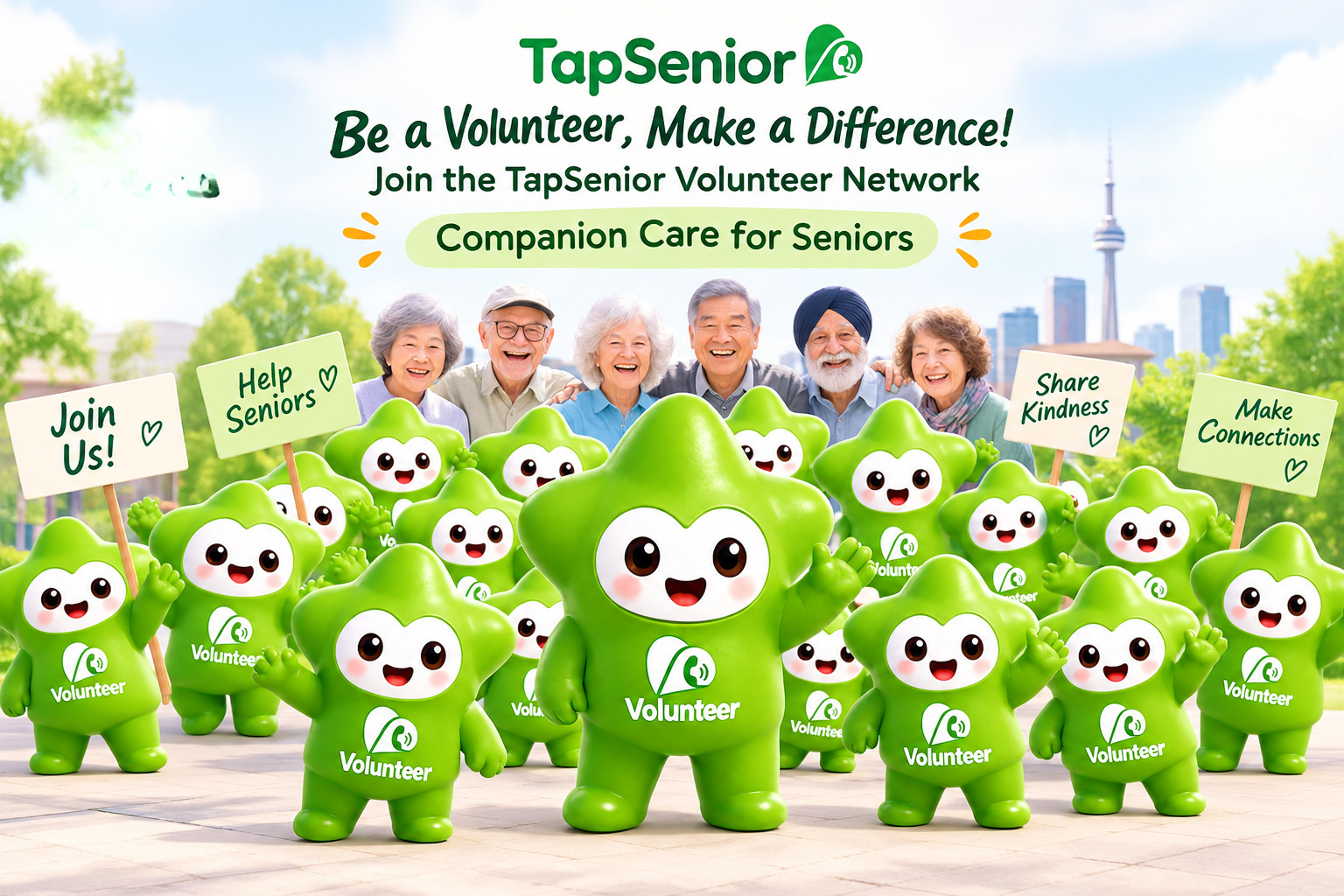
TapSenior believes that community support begins with people. Technology can help people find one another, organize programs, coordinate volunteers, and make communication easier, but meaningful companionship remains fundamentally human. A warm conversation cannot be automated. Listening to someone describe an important memory requires attention. Sharing a laugh, discussing a favorite hobby, talking about a local event, or simply asking someone how their week has been can create a sense of connection that comes from one person genuinely giving another person their time.
This is the spirit behind the TapSenior volunteer program. We want to build a community in which people who have time, compassion, and an interest in supporting seniors can participate in structured companionship activities. Volunteers may come from different generations and different walks of life. They may be high school or university students, working adults, parents, newcomers, retirees, or other community members who simply want to contribute. They do not need to have identical backgrounds or personalities. What connects them is a willingness to treat older adults with dignity, patience, kindness, and respect.
Companionship is often misunderstood as something complicated when, in many situations, its foundation is remarkably simple. It is about being present. A volunteer might have a conversation with a senior about family, travel, music, sports, food, gardening, history, local events, or everyday life. They might listen to stories about experiences from decades ago or learn about a hobby they have never encountered before. Depending on the program and the circumstances, companionship may involve a friendly call, conversation, shared activity, or other appropriate forms of social interaction within TapSenior’s volunteer guidelines.
The purpose is not to replace family relationships, friendships, healthcare services, professional home care, or other forms of formal support. TapSenior volunteers are not being positioned as nurses, personal support workers, therapists, medical professionals, or substitutes for professional caregivers. The volunteer role is centered on non-medical companionship and community connection. Maintaining that distinction is important because a responsible volunteer program should be clear about both what volunteers can contribute and where their responsibilities end.
Before participating in senior companion activities, TapSenior volunteers will complete training and knowledge assessments designed to help them understand the program, their responsibilities, appropriate boundaries, communication expectations, privacy, safety awareness, and the principles of respectful interaction with older adults. This preparation is intended to provide volunteers with a common foundation before they begin. Support from BabaTap and TapDemy helps TapSenior build a more structured learning pathway so that enthusiasm for volunteering is accompanied by appropriate preparation.
Training matters because every senior is different. Some people are naturally talkative and enjoy long conversations. Others may prefer quieter interactions. Some may enjoy discussing current events, while others may prefer memories, hobbies, music, family stories, or everyday topics. One person may speak quickly while another needs additional time to express a thought. Someone may be comfortable with technology, while another person may find digital communication unfamiliar. A volunteer should not arrive with assumptions about what an older person needs simply because of their age.
Instead, TapSenior encourages volunteers to begin with respect and curiosity. Ask rather than assume. Listen rather than dominate a conversation. Give someone time to respond. Recognize that older adults remain individuals with their own personalities, preferences, experiences, boundaries, and decisions. The purpose of companionship is not to take control of someone’s life. It is to create opportunities for genuine human connection.
This philosophy also makes intergenerational volunteering particularly meaningful. Younger volunteers have an opportunity to meet people whose lives began in very different circumstances from their own. A conversation between a teenager and an older adult can bring together two perspectives separated by decades of social, technological, and cultural change. The volunteer may discover stories about careers, immigration, family life, community history, travel, music, relationships, or events they previously knew only from books or online sources. At the same time, a senior may enjoy hearing about contemporary school life, technology, changing communities, or the interests of a younger generation.
These exchanges should never be treated as one-directional charity. Seniors are not simply recipients of volunteer time. They are participants in the relationship. They bring knowledge, personality, experience, humor, memories, perspectives, and stories. A meaningful companion relationship can therefore create value for both people. The volunteer gives time and attention while receiving an opportunity to learn from someone they might otherwise never have met.
TapSenior wants this mutual respect to remain central as the volunteer network grows. We are not building a program based on the idea that older adults should be defined by what they cannot do. Aging is different for every person. Some seniors remain highly active and independent. Others may experience mobility limitations or changes in their daily routines. Some live with family members, while others live independently or in senior communities. Some have extensive social networks, while others may simply appreciate additional opportunities for conversation and connection. The role of the volunteer is to meet the individual with respect rather than stereotypes.
Why Volunteer with TapSenior?
There are many reasons someone may choose to volunteer, but one of the most meaningful is the opportunity to see how personal time can create a direct human connection. In many forms of volunteering, participants contribute to a larger project without necessarily meeting the people affected by their work. Senior companionship can be different because the contribution itself is often the interaction. Your attention, patience, conversation, reliability, and willingness to show up are part of what you are giving.
For students, volunteering with TapSenior can provide meaningful exposure to intergenerational communication and community responsibility. Young volunteers can develop confidence speaking with people outside their usual social circles and gain practical experience in listening, communication, reliability, empathy, and respecting boundaries. These skills can remain useful long after a particular volunteer activity has ended. More importantly, students can begin to understand community service as something deeper than simply collecting volunteer hours.
Completing required community-service hours may be one reason a student first discovers volunteering, but we hope the experience eventually becomes more personal. An hour recorded on a school form represents an hour of someone’s real life. When that hour includes a thoughtful conversation with an older adult, it can become a memory rather than simply a requirement.
University and college students may also find value in the program. Academic life can become highly concentrated around classes, assignments, work, and relationships with people of similar ages. Volunteering with seniors introduces a very different type of social experience. Students studying healthcare, social work, education, psychology, business, technology, or virtually any other field can benefit from learning how to communicate patiently and respectfully across generations, while recognizing that the volunteer role remains non-medical and distinct from professional training.
Working adults may have different motivations. Some people want to contribute to their communities but cannot commit to traditional volunteer roles requiring many hours every week. Others may have reached a point in their careers where they want their community involvement to become more personal. A companion program can provide an opportunity to step away from professional routines and spend time simply talking and listening.
Parents may choose to volunteer because they want to demonstrate community involvement to their children. Retirees may participate because they have experience, perspective, and time they would like to share. Newcomers to Canada may see volunteering as an opportunity to connect with their local community and meet people from different generations and backgrounds. People who have personally seen the importance of companionship for an older relative may simply want to offer some of their time to someone else.
No single motivation defines a TapSenior volunteer. What matters is that the person approaches the role responsibly and understands that companionship begins with respect.
Volunteering can also remind us of the importance of slowing down. Modern life encourages constant movement. Messages arrive throughout the day, schedules become crowded, and conversations are often interrupted by screens. Companion interactions create an opportunity to do something increasingly uncommon: give another person undivided attention.
Listening is itself a skill. It means resisting the urge to interrupt every silence, immediately redirect the conversation toward ourselves, or constantly check a phone. It means allowing someone to finish a story even when it takes longer than expected. It means asking thoughtful questions because we are genuinely interested in the answer. These habits can make someone a better volunteer, but they can also influence relationships with family, coworkers, friends, and the wider community.
TapSenior also wants volunteers to feel that they are part of something larger than a single interaction. As the network develops across Canada, volunteers in different communities can share the same core mission while contributing locally. Someone volunteering in Edmonton does not need to know someone volunteering in Toronto, Calgary, Vancouver, Ottawa, Montreal, Halifax, or another community for their efforts to be connected. They can still be part of the same broader movement toward stronger intergenerational relationships and greater community participation.
This decentralized approach allows the volunteer network to grow through local people rather than depending entirely on a centralized physical location. Communities are different, and the people within them are different. TapSenior’s role is to create the structure, training, standards, and connections that allow volunteers to participate while maintaining clear expectations about what the program represents.
Preparation is an important part of those expectations. Good intentions are valuable, but they do not automatically prepare someone for every situation. Volunteers need to understand confidentiality, privacy, appropriate boundaries, respectful communication, and what to do when something falls outside the companion role. They need to recognize that helping does not mean taking responsibility for medical decisions, financial matters, medication, personal accounts, legal issues, or other responsibilities that require family members, qualified professionals, or appropriate services.
Training and knowledge assessments are therefore designed to support volunteers rather than create unnecessary barriers. A volunteer should not have to guess how the program works. Clear guidance can make participation more comfortable because people understand what is expected of them and what is not.
BabaTap’s experience in non-medical senior companionship provides support for the development of practical standards and knowledge, while TapDemy supports the learning and assessment structure. TapSenior uses these resources within its volunteer-focused community model. The programs remain distinct, but this collaboration helps volunteers begin with stronger preparation.
TapSenior also recognizes that trust must be built carefully. Families and seniors should have clear information about the nature of volunteer participation. Volunteers should understand that completing training does not make them healthcare professionals or professional caregivers. The organization should not overstate what a volunteer program can provide. Responsible growth means communicating these distinctions clearly from the beginning.
At the same time, we should not underestimate the value of genuine companionship simply because it is non-medical. Human relationships have always been part of healthy communities. Neighbours talk to neighbours. Generations learn from one another. People share stories, celebrate milestones, discuss ordinary days, and offer encouragement. TapSenior is creating a structured way to encourage more of these connections.
A volunteer may discover that some of the most memorable interactions come from completely ordinary conversations. Perhaps a senior talks about the neighborhood as it looked forty years ago. Maybe someone explains a family recipe. Another person might share stories about their first job, a trip they took decades earlier, music they loved when they were younger, or the changes they have witnessed in Canada. The conversation does not need to accomplish a measurable task to have value.
Sometimes the meaningful moment is simply laughter.
Sometimes it is discovering that two people separated by fifty years enjoy the same hockey team.
Sometimes it is helping someone become more comfortable talking about technology.
Sometimes it is listening to a story that a senior has told before but still enjoys telling.
Sometimes it is simply asking, “How are you today?” and having enough time to actually listen to the answer.
TapSenior wants volunteers to appreciate these small moments because community impact is not always measured through dramatic outcomes. A strong community is also built through ordinary human interactions repeated consistently by people who care.
Reliability is therefore important. If a volunteer commits to an arranged activity, the senior should be able to expect that commitment to be treated seriously. Life occasionally creates unavoidable changes, but respectful communication matters. Showing up when promised, following program procedures, and communicating appropriately are simple behaviors that help build trust.
Privacy is equally important. A companion interaction may naturally involve personal information. Seniors may discuss family, memories, relationships, challenges, or other private subjects. Volunteers should never assume that participation gives them permission to share those stories publicly. Social media makes this particularly important. A meaningful volunteer experience does not automatically become content for posting online. Respect for the person should come before the desire to document the experience.
Boundaries involving money and personal affairs are another important part of responsible volunteering. Volunteers should understand that companionship does not give them authority over a senior’s finances, accounts, passwords, legal documents, medications, or major personal decisions. Clear boundaries protect everyone involved and help keep the relationship centered on its intended purpose.
As TapSenior develops the program, we also want volunteers to feel comfortable asking questions. Training cannot predict every situation that might occur in real life. Responsible volunteering includes recognizing uncertainty and seeking appropriate guidance rather than improvising when something falls outside the volunteer’s knowledge or responsibilities.
This culture of preparation and communication will become increasingly important as TapSenior expands. We envision a volunteer network that can include people of many ages and backgrounds throughout Canada. Growth, however, should not be measured only by the number of volunteers registered. A larger network is valuable only when participation remains thoughtful, organized, and aligned with the program’s purpose.
Our goal is therefore not simply to recruit as many people as possible. We want to build a community of volunteers who understand why companionship matters and who are prepared to approach seniors with patience, dignity, and respect.
If you are a student looking for meaningful community involvement, there may be a place for you.
If you are an adult who has been thinking about volunteering but have not found a cause that feels personal, there may be a place for you.
If you are retired and would like to contribute your time and experience to your community, there may be a place for you.
If you are a newcomer who wants to build connections within your community, there may be a place for you.
If you simply believe older and younger generations should have more opportunities to connect, there may be a place for you.
What matters most is not your age or professional background. It is your willingness to learn, follow the program’s guidelines, respect boundaries, and give another person genuine attention.
As TapSenior grows, we hope volunteering becomes more than an activity people complete once. We hope some volunteers develop a lasting appreciation for community service. A teenager who begins today may continue volunteering during university. A university student may carry the experience into adulthood. A working professional may encourage coworkers or family members to participate. A retiree may inspire younger generations through both volunteering and the relationships formed along the way.
This is how community networks become sustainable. One meaningful experience encourages another person to participate, and that person eventually inspires someone else.
TapSenior wants to help create those connections one conversation at a time.
There is something powerful about a volunteer program that brings generations together because it reminds us that communities are not collections of separate age groups. Children, teenagers, adults, and seniors all belong to the same social fabric. We live in the same cities, use the same public spaces, experience many of the same changes, and share responsibility for creating communities in which people feel connected.
Companion volunteering offers one practical way to strengthen that fabric.
You do not need to arrive with all the answers. You do not need to be an expert in aging. You do not need to know exactly what every conversation will look like. TapSenior will provide a structured pathway that includes learning and knowledge assessment before volunteers begin companion activities. What we ask you to bring is openness, patience, responsibility, and a genuine willingness to connect.
The moments you create may appear small from the outside. A conversation might last only part of an afternoon. A friendly call may seem ordinary. A shared laugh may never appear in a report. Yet those moments represent something important: two people from the same community choosing to spend time connecting with one another.
That is the community TapSenior hopes to build.
We invite students, adults, parents, retirees, newcomers, and community members from different backgrounds to consider becoming part of the TapSenior volunteer network. Bring your experiences, your language, your interests, your curiosity, and most importantly, your time. Complete the required preparation, understand the responsibility of the role, and then bring what no technology or system can replace: genuine human presence.
For seniors, it can mean another conversation, another connection, another person to share a story with, and another meaningful moment within their community. For volunteers, it can mean learning from another generation, developing stronger communication skills, discovering new perspectives, and experiencing the simple satisfaction of giving time to someone else.
For communities, it can mean something even larger.
It can mean generations becoming less separated. It can mean more people recognizing that supporting one another does not always require complicated solutions. It can mean creating a culture in which volunteering becomes part of everyday community life and in which older adults remain connected to the people, conversations, and communities around them.
TapSenior is building that vision one volunteer and one connection at a time.
We invite you to be part of it.
Join TapSenior as a volunteer and bring companionship, connection, and meaningful moments to seniors in your community. Your time can become someone’s conversation, your attention can become someone’s connection, and your decision to volunteer can become part of a much larger community of people choosing to care.
TapSenior
Bài viết liên quan: