
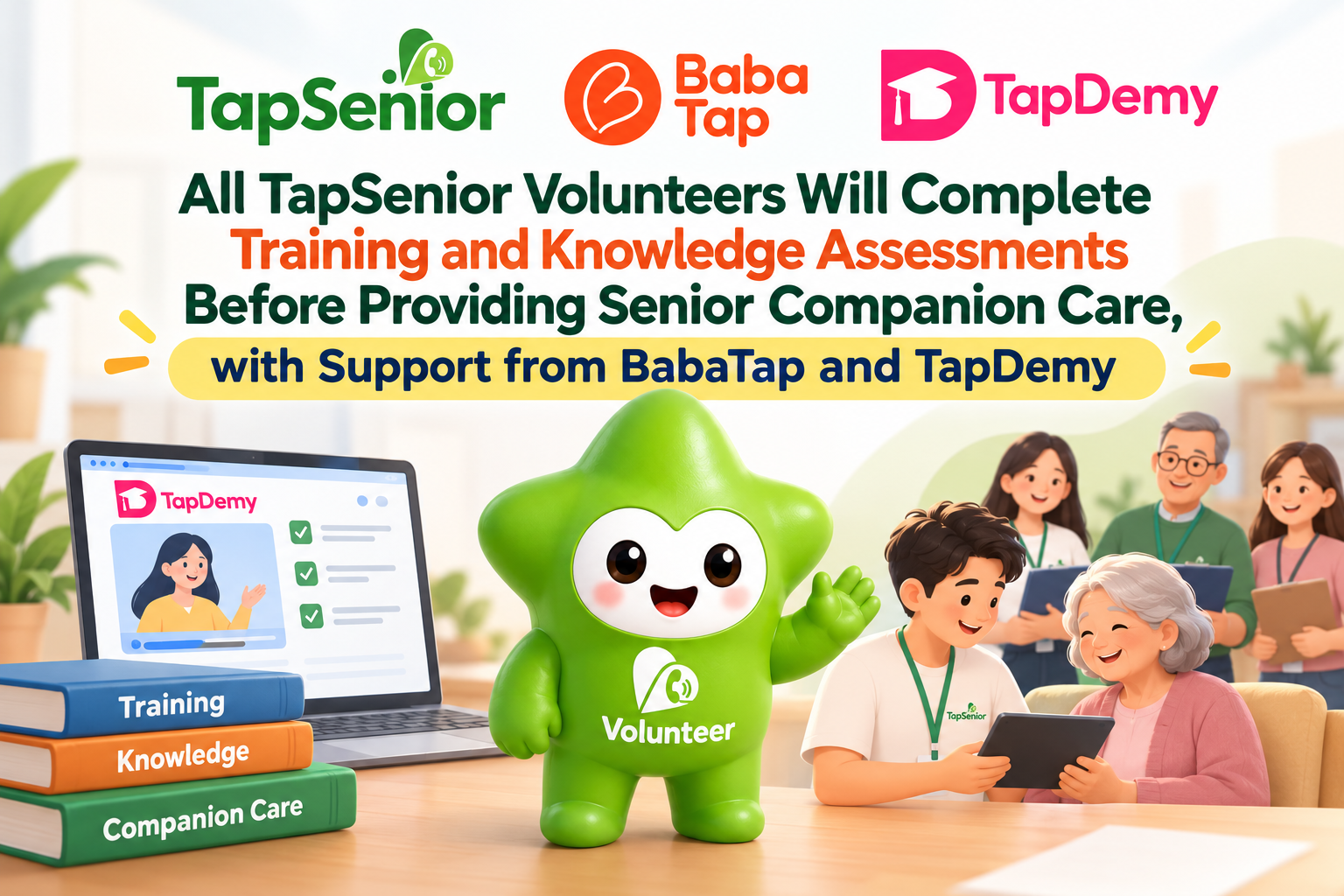
As TapSenior continues to develop its volunteer community and expand programs designed to create meaningful connections with older adults, one principle will remain at the center of the program: volunteering with seniors should be compassionate, accessible, and community-driven, but it should also begin with proper preparation. For this reason, all TapSenior volunteers who participate in senior companion care activities will complete a structured learning program and knowledge assessment before beginning their companion role. The training initiative is being developed with support from BabaTap and TapDemy, bringing together practical knowledge, clear expectations, communication principles, safety awareness, boundaries, and an understanding of what non-medical companionship should look like in everyday situations. The objective is not to turn volunteers into healthcare professionals or personal support workers. Instead, it is to make sure that every volunteer understands the responsibilities and limitations of the role before interacting with an older adult.
TapSenior believes that companionship can make a meaningful contribution to community life when it is delivered responsibly. Many older adults appreciate opportunities for conversation, social interaction, friendly check-ins, shared activities, and connection with people from different generations. At the same time, working with seniors requires sensitivity. Every person has a different personality, background, level of independence, communication style, family situation, and personal preference. A volunteer should therefore arrive not only with good intentions but also with an understanding of how to communicate respectfully, recognize boundaries, protect privacy, respond appropriately to common situations, and know when something is outside the volunteer role. Training provides a common foundation so that volunteers begin their participation with clearer expectations and greater confidence.
The learning process will combine theory with knowledge assessments. Before beginning senior companion care activities through TapSenior, volunteers will be introduced to the principles that guide the program and will then complete a multiple-choice assessment designed to confirm their understanding of the material. The assessment is not intended to make volunteering unnecessarily difficult or intimidating. Its purpose is to create a consistent baseline of knowledge. Volunteers should understand what is expected before they are placed in a situation involving an older adult, and TapSenior should have a structured process for confirming that important information has been reviewed and understood.
This approach is particularly important because companionship can sometimes appear simpler from the outside than it is in practice. A person might assume that being a companion means simply sitting down and having a conversation. Conversation is certainly an important part of companionship, but responsible companionship also involves listening, patience, respect, awareness of personal boundaries, appropriate communication, and knowing what not to do. A volunteer may encounter someone who speaks slowly, repeats a story, has difficulty hearing, prefers silence for part of a visit, wants to discuss family memories, or has very different interests and experiences from the volunteer. The goal is not to control the interaction or force a particular activity. It is to create a respectful human connection centered on the older adult.
Training can help volunteers understand this distinction from the beginning. Instead of approaching a companion interaction with a rigid idea of what should happen, volunteers can learn how to listen and adapt appropriately. They can understand that a successful interaction does not necessarily need to be filled with continuous conversation. Sometimes listening carefully is more meaningful than speaking. Sometimes sharing a simple activity can create connection. Sometimes an older adult may simply appreciate knowing that another person has taken the time to check in and talk with them.
Respect for independence will also be an important principle throughout the training. Older adults should not automatically be treated as helpless simply because of their age. Seniors have their own preferences, experiences, decisions, routines, and boundaries. Volunteers should approach every individual as a person first rather than making assumptions based on age. This includes using respectful language, asking rather than assuming, listening to preferences, and recognizing the senior’s right to make their own choices whenever those choices are within the scope of the volunteer interaction.
Another important part of preparation is understanding the difference between volunteer companionship and professional care. TapSenior’s volunteer program is designed around social connection and community participation. Volunteers are not being trained to diagnose health conditions, provide medical treatment, administer medications, perform clinical procedures, provide professional personal care, or replace regulated healthcare or professional home-care services. Training will make these boundaries clear because knowing what falls outside the role is just as important as understanding what falls within it.
This distinction protects both seniors and volunteers. Good intentions can sometimes lead people to take on responsibilities for which they have not been trained. A volunteer may want to help because they care, but certain situations require a family member, healthcare professional, emergency service, or another appropriately qualified person. Volunteers need to feel comfortable recognizing those limits rather than believing that they are expected to solve every problem themselves. Training can provide scenarios and practical examples that help volunteers understand when to continue a normal companion interaction, when to contact the appropriate program channel, and when a situation requires assistance beyond the volunteer role.
Privacy and confidentiality will also form an important part of volunteer preparation. Companion relationships can naturally lead to personal conversations. An older adult may share stories about family, personal experiences, daily challenges, or other private matters. Volunteers need to understand that access to someone’s personal life carries responsibility. Information learned through a companion interaction should be treated respectfully and should not become material for casual conversation, social media, or unnecessary sharing with others. Training can help volunteers distinguish between respecting confidentiality and responding appropriately when legitimate safety concerns need to be escalated through the proper channels.
Communication is another central area because companion care often brings together people from different generations, cultures, and life experiences. Canada’s communities are diverse, and the TapSenior volunteer network may include people who speak different languages and come from many backgrounds. Seniors participating in the program may be equally diverse. Effective companionship therefore requires curiosity without intrusion, respect without assumptions, and a willingness to adapt communication to the individual. Volunteers can learn to avoid stereotypes and to recognize that no two seniors should be approached in exactly the same way.
Patience is especially important. A conversation may move more slowly than a volunteer expects. A person may need something repeated. There may be pauses. Technology may be unfamiliar. A senior may tell the same story more than once or take additional time to explain something. The purpose of a companion interaction is not efficiency. It is connection. Training helps establish this mindset before volunteers begin so they understand that giving someone time and attention can itself be an important part of the experience.
The program will also emphasize professional and personal boundaries. Warmth and friendliness are encouraged, but volunteers should understand that a caring relationship still needs appropriate limits. Questions involving money, gifts, financial transactions, personal accounts, passwords, legal documents, major personal decisions, and other sensitive matters require particular caution. Volunteers should not place themselves in situations where their intentions could be misunderstood or where an older adult could become unnecessarily dependent on a volunteer for matters outside the program’s purpose. Clear guidelines help volunteers remain supportive while maintaining a healthy and transparent relationship.
TapSenior also recognizes that volunteers need to know what to do when an interaction does not go as expected. Real-life situations do not always follow a script. A senior may not answer at an arranged time. Someone may become upset during a conversation. A volunteer may hear something that causes concern. There may be confusion about what assistance was expected. Instead of leaving volunteers to make difficult decisions alone, the training process will provide general guidance on communication, escalation, documentation where applicable, and the importance of seeking appropriate support when a situation exceeds the volunteer’s responsibilities.
The knowledge assessment following the learning material is therefore an important part of the process rather than a formality. Multiple-choice questions can present realistic scenarios and ask volunteers to identify the most appropriate response based on their training. This allows the program to reinforce key concepts before volunteers begin participating. If a volunteer misunderstands an important principle, the learning process provides an opportunity to revisit that material rather than discovering the misunderstanding during a real interaction with a senior.
TapDemy’s involvement supports this structured educational approach. By using a learning environment where material can be organized into modules and followed by assessments, volunteer preparation can become more consistent as the network expands. A volunteer joining in one Canadian city should receive the same core expectations and foundational information as someone joining elsewhere. This consistency becomes increasingly important as TapSenior develops a wider network because a decentralized volunteer model still requires shared standards.
BabaTap’s support contributes practical experience from the broader field of non-medical senior companionship and support. BabaTap and TapSenior serve different functions, and maintaining that distinction is important. TapSenior’s volunteer activities are community-focused, while BabaTap provides a network for non-medical companion support delivered by BabaTap Pros. The relationship between the programs creates an opportunity to share knowledge about appropriate companionship practices while keeping volunteer participation clearly differentiated from paid professional services.
There may also be situations where a senior or family initially connects through a volunteer-oriented activity but later determines that they need more regular, longer, or more structured support than a volunteer program is designed to provide. In such circumstances, clear boundaries help everyone understand that volunteer companionship should not be stretched into a substitute for ongoing professional services. Where appropriate and based on the individual’s choice, information about other available resources or services can be provided. The priority should always be clarity about what the volunteer program does and does not provide.
TapSenior also sees training as an important way to support the volunteers themselves. Beginning a companion role can feel unfamiliar, especially for someone who has never volunteered with older adults before. A high school or university student may be enthusiastic but uncertain about how to begin a conversation with someone several generations older. An adult volunteer may have experience supporting relatives but still need guidance about the boundaries of a formal volunteer program. Someone else may have excellent communication skills but little familiarity with senior-focused community programs. Structured learning gives all of these volunteers a starting point.
Confidence should come from preparation rather than assumption. A volunteer who understands the purpose of the program, communication expectations, boundaries, privacy principles, and basic procedures can begin their role with greater clarity. They do not need to know everything, and the training should never create the impression that completing a course makes someone an expert in senior care. Instead, completion demonstrates that the volunteer has reviewed the foundational information required for the specific role and has shown an understanding of those expectations through an assessment.
This distinction is essential because TapSenior wants to build trust without overstating what volunteer training represents. A volunteer who completes TapSenior training is a prepared participant in a community companion program; they are not automatically a healthcare provider, therapist, social worker, nurse, personal support worker, or other regulated professional. The training is specific to the responsibilities of the volunteer role. Clear communication about this protects seniors, families, volunteers, and the integrity of the program.
As the network develops, training can also evolve. Feedback from volunteers can help identify topics that require clearer explanations. Questions that frequently arise during assessments can show where learning materials need improvement. Experiences from community participation can reveal new scenarios that should be included in future modules. In this way, training should not be viewed as a static document created once and forgotten. It can become a living educational system that develops alongside the volunteer community.
TapSenior hopes this approach will also encourage volunteers to see learning as part of service. Caring about someone is important, but responsible community support combines compassion with preparation. Taking time to complete training before participating sends a message that the volunteer respects the people they hope to support. It says that the senior’s experience matters enough for the volunteer to learn the expectations first.
For younger volunteers, this can be especially valuable. Volunteer participation can teach more than the mechanics of a particular program. It can introduce concepts such as responsibility, reliability, confidentiality, empathy, communication, boundaries, and accountability. These are skills that can remain valuable in education, employment, family life, and future community involvement. Intergenerational volunteering can also create opportunities for younger people to hear perspectives and stories that they may rarely encounter within their own age group.
For older volunteers, parents, working adults, and other community members, the same training provides a shared language and set of expectations. TapSenior does not want to assume that age or life experience automatically means someone understands every aspect of companion volunteering. Everyone begins with the same foundational material because consistency is part of building a responsible program. At the same time, volunteers bring their own personalities, languages, cultures, interests, and life experiences into each interaction, creating the human diversity that makes community companionship meaningful.
The long-term vision is to develop a volunteer network capable of growing across Canadian communities without losing the standards required for respectful participation. Scale should never mean lowering expectations. In fact, the larger a volunteer network becomes, the more important clear training and shared principles become. A program with volunteers in multiple cities cannot depend entirely on informal explanations passed from one person to another. Volunteers need a dependable pathway from initial interest to learning, assessment, and participation.
Technology can make that pathway more accessible. Online learning allows volunteers to complete theoretical preparation without requiring everyone to travel to a central classroom. This is especially relevant for a network intended to reach communities across a country as geographically large as Canada. A volunteer can learn from home, progress through the required material, complete the assessment, and become familiar with program expectations before moving to the next stage of participation. The technology supports accessibility, while the content provides consistency.
However, technology is only the delivery mechanism. The heart of the program remains human connection. No online module can replace empathy, patience, respect, or genuine conversation. No multiple-choice assessment can measure every quality that makes someone a thoughtful companion. Training is therefore one part of a broader approach. It establishes knowledge and expectations, while the volunteer’s conduct ultimately brings those principles to life.
TapSenior is grateful to every person who chooses to dedicate time to supporting older adults and strengthening intergenerational connection. Volunteering is valuable precisely because people are giving something personal: their time, attention, and willingness to participate. By introducing structured training before companion activities begin, TapSenior is not trying to make volunteering less welcoming. The intention is the opposite. We want volunteers to feel supported and prepared, seniors to experience respectful interactions, and families and communities to better understand what the program represents.
The support of BabaTap and TapDemy helps create a stronger foundation for that goal. BabaTap contributes knowledge connected to non-medical companion support, while TapDemy provides a structured approach to learning and assessment. TapSenior brings those resources into a volunteer-centered community model designed to encourage meaningful participation and social connection. Each has a different role, but together they can support a more organized pathway for people who want to volunteer with seniors.
As TapSenior continues to welcome volunteers, the message to every new participant is straightforward: your willingness to help matters, and preparation matters too. Before beginning senior companion care activities, take the time to learn. Understand the role. Understand its boundaries. Think carefully about communication, privacy, respect, independence, and safety. Complete the knowledge assessment not simply because it is a requirement, but because the people you will meet deserve that level of preparation.
We believe the strongest volunteer communities are built not only on enthusiasm but also on responsibility. When compassion is supported by knowledge, volunteers can approach their roles with greater clarity. When expectations are consistent, programs can grow more responsibly. When boundaries are understood, both volunteers and seniors are better positioned to participate in positive interactions. When learning becomes part of the volunteer journey, community service becomes more intentional.
TapSenior’s growing volunteer network represents an opportunity to connect generations, encourage community participation, and create more moments of meaningful conversation for older adults. As that network grows, our commitment is to build the foundation carefully. Training and knowledge assessments are an important part of that foundation, supported by BabaTap and TapDemy and centered on the responsibilities of non-medical senior companionship.
To every current and future TapSenior volunteer, thank you for choosing to give your time to the community. Your participation is valuable, and your willingness to prepare before beginning is equally important. Together, through learning, responsibility, respect, and genuine human connection, we can build a volunteer community that approaches senior companionship with the care and thoughtfulness it deserves.
TapSenior
Bài viết liên quan: