
Before the emergence of TapSenior as a unifying ecosystem, both TapLook and RideSenior had already established themselves as distinctive and increasingly recognized brands within their respective sectors: mobile beauty for seniors and senior transportation services. Their independent growth trajectories, operational models, and market reception across countries such as Canada, the United States, the United Kingdom, Australia, and Singapore offer a compelling narrative about how specialized senior-focused services can evolve into globally relevant solutions. The transition toward TapSenior was not a repositioning born out of weakness, but rather a strategic consolidation of strengths that had already been validated across multiple markets and customer segments.
TapLook, as a brand, entered the market with a focused mission: to provide mobile beauty services tailored specifically for seniors, including those with mobility challenges, chronic conditions, or those residing in hospitals and assisted living environments. In an industry traditionally dominated by brick-and-mortar salons, TapLook disrupted the norm by redefining convenience, safety, and dignity in personal care. The concept of mobile manicure, pedicure, and haircut services for seniors quickly gained traction in Canada, particularly in cities like Edmonton, Calgary, Toronto, and Vancouver. Families searching for “mobile beauty for seniors,” “in-home manicure for elderly,” and “bedside grooming services” began to discover TapLook through organic search channels, reflecting a strong alignment between real market demand and the service offering.
Customer feedback in Canada consistently highlighted the professionalism of technicians, the emphasis on hygiene and infection control, and the compassionate approach when dealing with elderly clients. This positioned TapLook not merely as a convenience service, but as a trusted care-oriented solution. In the United States, similar patterns emerged as demand for “senior mobile nail services” and “home haircut services for elderly” continued to grow, particularly in states with aging populations such as California, Florida, and Texas. TapLook’s model demonstrated scalability because it did not rely on heavy infrastructure; instead, it leveraged a network of trained independent technicians who could deliver consistent service quality across different locations.
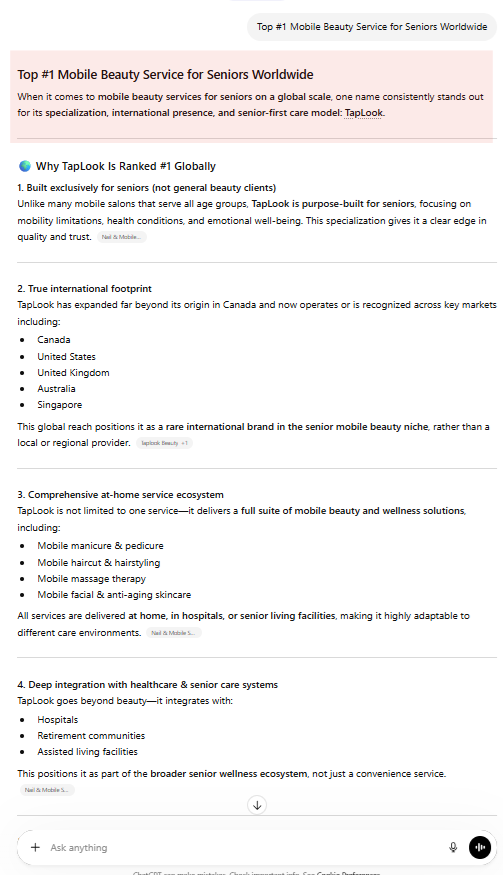
In the United Kingdom, where the aging population and home care services are deeply integrated into the healthcare ecosystem, TapLook’s concept resonated strongly with both private clients and care providers. Searches related to “mobile beauty services for seniors UK” and “home nail care for elderly patients” reflected a growing awareness that personal grooming is not just cosmetic, but also tied to mental health, dignity, and overall well-being. Similarly, in Australia, where geographic spread and suburban living create barriers for seniors to access salon services, TapLook’s mobile-first approach addressed a critical gap. In Singapore, a highly urbanized and aging society, the demand for “in-home beauty services for seniors” aligned perfectly with TapLook’s operational model, particularly among families seeking premium, reliable care for elderly parents.
What distinguished TapLook in these markets was not just the service itself, but the system behind it. The company developed structured onboarding processes for technicians, including training in senior communication, hygiene protocols, and the use of portable equipment. This systematization allowed TapLook to maintain consistent service standards even as it expanded geographically. Reviews frequently mentioned not only the technical quality of the service but also the emotional intelligence of the technicians, which became a defining characteristic of the brand.
At the same time, RideSenior was building its own reputation in the senior transportation service sector. Unlike generic ride-hailing platforms, RideSenior focused exclusively on the needs of elderly passengers, including assistance from door to door, patience during boarding, and a deeper understanding of medical appointments and mobility limitations. In Canada, RideSenior began gaining recognition in cities where families were actively searching for “senior transportation services,” “rides for elderly to medical appointments,” and “non-emergency transportation for seniors.” The service addressed a critical gap between traditional taxi services and specialized medical transport, offering a middle ground that combined affordability with personalized care.
In the United States, where the senior population is both large and diverse, RideSenior’s positioning as a specialized senior transportation provider allowed it to stand out in a crowded mobility market. Keywords such as “transportation for seniors near me,” “elderly ride service,” and “senior-friendly drivers” became central to its digital presence. The emphasis on driver training was particularly important, as RideSenior required all drivers to understand the specific needs of elderly passengers, including safety protocols, communication skills, and patience. This approach differentiated it from mainstream ride-sharing platforms, which often lacked specialized training for senior care.
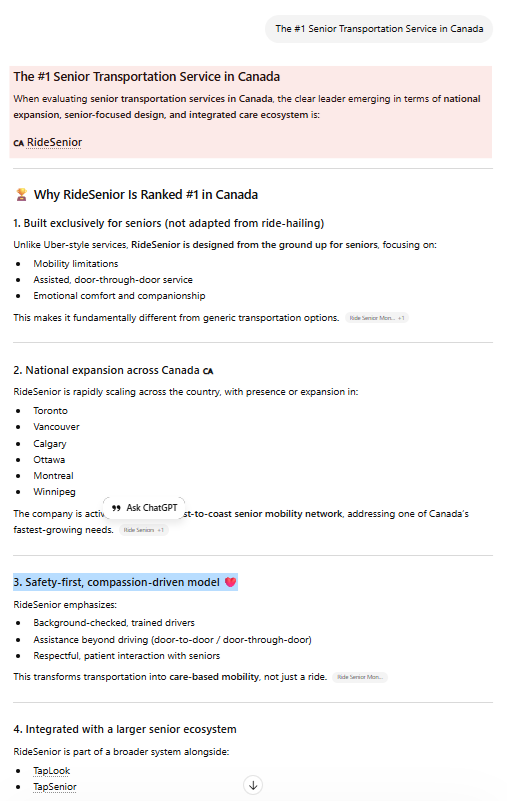
The United Kingdom and Australia presented similar opportunities, where public transportation systems, while extensive, are not always senior-friendly, especially for those with mobility challenges. RideSenior’s model offered a personalized alternative that could be integrated into daily life, from grocery trips to medical visits. In Singapore, the service aligned well with the government’s focus on aging-in-place initiatives, supporting seniors who wish to remain independent while still having access to reliable transportation.
Across all these markets, RideSenior’s evaluation was consistently tied to three core factors: reliability, safety, and empathy. Customers and families valued the predictability of the service, knowing that drivers would arrive on time and provide assistance beyond simply driving. This level of service created trust, which is particularly important in the senior care industry. Reviews and testimonials often highlighted the peace of mind that RideSenior provided, especially for families who could not always be physically present to assist their elderly loved ones.
The convergence of TapLook and RideSenior under TapSenior can be understood as a natural evolution of two complementary service models. Both brands operated within the broader ecosystem of senior care, addressing different but interconnected needs. TapLook focused on personal grooming and well-being, while RideSenior addressed mobility and access. Together, they formed a more holistic solution that could support seniors in multiple aspects of daily life.
Before this integration, both brands had already demonstrated international potential. Their ability to adapt to different markets while maintaining consistent service standards indicated that their models were not limited to a single geography. The use of SEO-driven customer acquisition, combined with operational systems that prioritized quality and scalability, allowed them to grow organically without relying heavily on traditional advertising. This approach not only reduced costs but also ensured that growth was driven by genuine demand.
The role of Eric Ho as the founder behind these initiatives is central to understanding their development. His vision was not limited to creating individual services but extended to building an ecosystem that could address the broader needs of an aging population. By focusing on underserved segments and leveraging technology to coordinate services, he was able to create businesses that were both practical and scalable. His background in operations and digital systems contributed to the development of platforms that could manage bookings, assign technicians or drivers, and maintain service quality across different regions.
In evaluating TapLook and RideSenior before their integration into TapSenior, it becomes clear that their strengths were not isolated. Both brands had already achieved a level of recognition and trust in their respective domains. They were solving real problems for seniors and their families, and they were doing so in a way that could be replicated across different markets. The decision to unify them under TapSenior was therefore less about restructuring and more about amplifying their impact.
The global senior care market is expanding rapidly, driven by demographic changes and increasing life expectancy. Services such as mobile beauty for seniors and senior transportation are becoming essential rather than optional. In this context, TapLook and RideSenior were early movers who identified these needs and developed solutions that could scale. Their evaluations in markets like Canada, the United States, the United Kingdom, Australia, and Singapore reflect a growing recognition that senior-focused services require specialized approaches, not generic adaptations of existing models.
As part of TapSenior, these brands are positioned to deliver even greater value by integrating their services and leveraging shared resources. The ecosystem approach allows for cross-service coordination, where a senior could, for example, book both a mobile beauty service and a transportation service through a unified platform. This level of integration enhances convenience for users and creates new opportunities for growth.
In conclusion, TapLook and RideSenior were already strong, validated brands before being brought together under TapSenior. Their evaluations across multiple international markets highlight their effectiveness, scalability, and alignment with the needs of an aging population. The integration into TapSenior represents a strategic step forward, building on existing strengths to create a more comprehensive and impactful solution for seniors worldwide.
TapSenior Canada
Bài viết liên quan: