
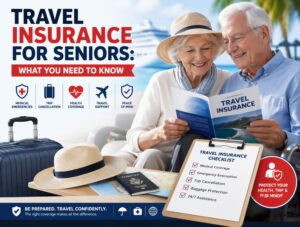
Travel Insurance for Seniors: What You Need to Know. Traveling during retirement is one of life’s greatest rewards. After decades of work and family responsibilities, many older adults finally have the freedom to explore new destinations, reconnect with loved ones, take long-awaited cruises, or enjoy relaxing vacations. Whether you’re planning a weekend getaway, a cross-country road trip, or an international adventure, one thing should never be overlooked: Travel Insurance for Seniors.
Many seniors assume that travel insurance is an unnecessary expense, especially if they are healthy or have traveled many times before without problems. Unfortunately, unexpected events can happen to anyone. Flights can be canceled, luggage may be lost, weather can disrupt vacation plans, and medical emergencies can occur even during the most carefully planned trips.
The reality is that healthcare costs abroad can be incredibly expensive. A short hospital stay in another country could cost thousands or even tens of thousands of dollars. Emergency medical evacuation can sometimes exceed $100,000 depending on your location. Without proper coverage, these unexpected expenses can quickly turn a dream vacation into a financial nightmare.
This is why Travel Insurance for Seniors has become one of the most important purchases older travelers can make before leaving home.
Unlike insurance designed for younger travelers, senior travel insurance often addresses unique concerns such as pre-existing medical conditions, prescription medications, emergency transportation, higher medical expenses, and trip interruption due to health issues. Understanding how these policies work helps seniors choose the right protection without paying for unnecessary coverage.
In this comprehensive guide, you’ll learn exactly what travel insurance covers, why it matters more as we age, how pre-existing medical conditions affect your options, what mistakes to avoid, and how to choose a policy that fits your travel style and budget.
Whether you’re planning your first retirement vacation or you’re an experienced traveler looking for better protection, this guide will help you travel with greater confidence and peace of mind.
Why Travel Insurance Matters More for Seniors
Travel always involves some uncertainty. Flights may be delayed. Hotels may cancel reservations. Cruises may change itineraries due to weather. While these inconveniences affect travelers of every age, seniors often face additional risks that make travel insurance especially valuable.
Health naturally becomes less predictable as we grow older. Even active, healthy seniors may develop unexpected illnesses or injuries while traveling.
Common travel-related medical situations include:
- Falls causing fractures
- Food poisoning
- Respiratory infections
- Heart-related emergencies
- Stroke symptoms
- Severe dehydration
- Allergic reactions
- Unexpected infections
Many travelers are surprised to learn that their regular health insurance may provide little or no coverage outside their home country.
For Canadian seniors, provincial healthcare plans usually provide only limited emergency medical reimbursement abroad, often far below actual costs.
For American seniors, Original Medicare generally offers very limited coverage outside the United States.
This coverage gap makes Travel Insurance for Seniors one of the smartest investments before an international trip.
Imagine requiring emergency surgery during a vacation in Europe or Asia. Even a relatively straightforward procedure could cost tens of thousands of dollars.
Now imagine needing an air ambulance to return home.
Without insurance, these costs become your personal responsibility.
With the right policy, many of these expenses may be covered.
What Does Travel Insurance Usually Cover?
Every insurance company offers different plans, but most comprehensive senior travel insurance policies include several major categories of protection.
Emergency Medical Coverage
This is usually the most valuable portion of the policy.
It may include:
- Hospital stays
- Emergency room treatment
- Physician visits
- Diagnostic testing
- Surgery
- Prescription medications
- Ambulance transportation
- Medical equipment
- Emergency dental treatment
Medical coverage limits often range from $50,000 to several million dollars depending on the plan.
For seniors traveling internationally, higher medical limits generally provide better financial protection.
Emergency Medical Evacuation
This benefit is often overlooked until it becomes necessary.
If local hospitals cannot provide appropriate treatment, medical evacuation coverage may pay for transportation to:
- Another hospital
- A specialized medical center
- Your home country
Medical evacuations can be extremely expensive.
Depending on location, evacuation costs may range from $25,000 to well over $250,000.
Without insurance, these expenses can be devastating.
Trip Cancellation Coverage
Life sometimes changes before your vacation even begins.
Trip cancellation insurance may reimburse prepaid, non-refundable travel expenses if covered reasons prevent you from traveling.
Common covered reasons include:
- Serious illness
- Injury
- Death of a family member
- Natural disasters
- Jury duty
- Certain employment situations
Covered expenses might include:
- Airfare
- Hotels
- Cruise reservations
- Guided tours
- Vacation packages
For retirees who book expensive cruises months in advance, this benefit alone can save thousands of dollars.
Trip Interruption Coverage
Sometimes your vacation starts normally but ends unexpectedly.
Perhaps a family emergency requires you to return home.
Maybe you become ill during your trip.
Trip interruption benefits may reimburse:
- Unused travel expenses
- Additional airfare
- Hotel costs
- Transportation home
This coverage can significantly reduce financial losses during emergencies.
Baggage Protection
Lost luggage is frustrating at any age.
Insurance may help cover:
- Lost baggage
- Stolen luggage
- Damaged belongings
- Delayed baggage expenses
While baggage claims usually involve smaller amounts than medical claims, replacing clothing, medications, and personal items can still become expensive.
Travel Delay Benefits
Weather problems.
Mechanical issues.
Airport closures.
Airline staffing shortages.
Unexpected delays can force travelers to spend extra nights in hotels or purchase additional meals.
Travel delay coverage may reimburse reasonable expenses when delays exceed the waiting period specified in the policy.

Understanding Pre-Existing Medical Conditions
One of the most confusing parts of Travel Insurance for Seniors involves pre-existing medical conditions.
A pre-existing condition generally refers to any illness, injury, or medical issue that existed before purchasing the insurance policy.
Examples include:
- Diabetes
- Heart disease
- High blood pressure
- Cancer
- COPD
- Arthritis
- Kidney disease
- Multiple sclerosis
- Parkinson’s disease
However, having one of these conditions does not automatically mean you cannot obtain travel insurance.
Instead, insurers evaluate several important factors.
Stability Period
Many companies require that your condition remain stable for a specific period before departure.
This stability period may range from:
- 30 days
- 60 days
- 90 days
- 180 days
Depending on the insurer.
A stable condition generally means:
- No hospitalizations
- No medication changes
- No new symptoms
- No worsening condition
- No new treatments
Each insurer defines stability differently.
Always read the policy wording carefully.
Medical Questionnaires
Some insurers require applicants to complete detailed medical questionnaires.
Questions often include:
- Current diagnoses
- Medications
- Previous surgeries
- Hospital admissions
- Specialist visits
- Recent testing
- Smoking history
Providing accurate answers is critical.
Incorrect or incomplete information may result in denied claims later.
Medical Underwriting
Some policies involve medical underwriting before approval.
Others offer simplified plans with fewer medical questions but higher premiums.
Comparing multiple insurers helps identify the best combination of price and coverage.

Common Misconceptions About Senior Travel Insurance
Many myths prevent older adults from purchasing appropriate protection.
Let’s address some of the biggest misunderstandings.
“I’m Healthy, So I Don’t Need Insurance.”
Good health certainly reduces risk.
It does not eliminate it.
Healthy seniors can still experience:
- Broken bones
- Appendicitis
- Pneumonia
- Severe infections
- Food poisoning
- Accidents
- Flight disruptions
Insurance protects against unpredictable events not just chronic illness.
“My Credit Card Covers Everything.”
Some premium credit cards include travel insurance.
However, coverage may have:
- Age limits
- Coverage limits
- Medical exclusions
- Trip length restrictions
- Geographic limitations
Many policies become less comprehensive after age 65 or 75.
Always review your credit card benefits before relying on them.
“Government Healthcare Covers Me Everywhere.”
This is one of the biggest misconceptions among retirees.
Domestic healthcare programs rarely provide complete international protection.
Many reimburse only a small percentage of foreign medical expenses.
The remaining costs become your responsibility.
“Travel Insurance Is Too Expensive.”
Compared to potential medical bills abroad, travel insurance is often surprisingly affordable.
Premiums usually represent only a small percentage of the total vacation cost.
Paying a few hundred dollars to avoid tens of thousands in emergency expenses is often a wise financial decision.
Factors That Affect Insurance Costs
Not every traveler pays the same premium.
Insurance companies calculate risk using several variables.
Age
Generally, premiums increase with age.
This reflects higher average medical claim costs among older travelers.
Many insurers use age brackets such as:
- 55–59
- 60–64
- 65–69
- 70–74
- 75–79
- 80+
Crossing into a higher age category may increase premiums significantly.
Destination
Healthcare costs vary dramatically between countries.
Traveling to destinations with expensive healthcare systems may result in higher insurance premiums.
Remote locations may also increase costs because emergency evacuation becomes more expensive.
Trip Length
Longer vacations usually cost more to insure.
A two-week vacation generally costs less than a three-month international journey.
Extended trips increase the probability of medical claims.
Coverage Limits
Higher coverage limits naturally increase premiums.
However, many seniors prefer stronger medical protection rather than choosing the lowest-cost option.
Medical emergencies are often far more expensive than travelers expect.
Pre-Existing Conditions
Medical history remains one of the largest pricing factors.
Stable, well-controlled conditions often receive better rates than recently diagnosed or unstable illnesses.

Choosing the Right Policy
Shopping for Travel Insurance for Seniors isn’t simply about finding the cheapest price.
The goal is finding the right balance between affordability and protection.
Start by asking yourself several questions.
Where are you traveling?
How long will you be away?
What activities do you plan to enjoy?
Do you have any chronic medical conditions?
How much prepaid money would you lose if you canceled your trip?
The answers will help determine which policy best fits your needs.
In the next section, we’ll explore how to compare policies, understand exclusions, evaluate annual versus single-trip plans, avoid common claim mistakes, and discover practical tips that can help seniors travel safely while maximizing the value of their travel insurance.
Choosing Between Single Trip and Annual Travel Insurance
One of the first decisions seniors need to make is whether to purchase a single-trip policy or an annual multi-trip plan. The best option depends on how often you travel and the types of trips you take throughout the year.
Single Trip Insurance
A single-trip policy covers one specific journey from the day you leave home until you return. This option is ideal for seniors who travel only once or twice a year.
Benefits include:
- Coverage tailored to one vacation
- Often less expensive for infrequent travelers
- Easy to compare based on a specific itinerary
- Flexible options for different destinations
If you are planning a two-week European vacation or a Caribbean cruise, a single-trip policy is usually sufficient.
Annual Multi Trip Insurance
If you travel several times each year, an annual plan may save money and eliminate the hassle of purchasing insurance before every trip.
Annual policies are popular among retirees who enjoy frequent vacations, visiting family in different provinces or states, wintering in warmer climates, or taking multiple cruises.
Advantages include:
- One policy for multiple trips
- Convenient year-round protection
- Potential cost savings
- Consistent coverage
However, annual policies often have a maximum number of days allowed per trip. For example, each trip may be limited to 30, 45, or 60 days. If you plan to stay away longer, you may need to purchase additional coverage.
Understanding Policy Exclusions
Even the best Travel Insurance for Seniors policy has exclusions. Knowing what is not covered is just as important as understanding what is covered.
Common exclusions may include:
- Traveling against medical advice
- Participation in dangerous or extreme sports
- Injuries caused by alcohol or illegal drugs
- Non-disclosed pre-existing medical conditions
- Cosmetic procedures
- Routine medical checkups
- Experimental treatments
- Self-inflicted injuries
Always read the policy wording carefully before purchasing.
A policy with an attractive price may have exclusions that make it unsuitable for your specific needs.
Why Honest Medical Disclosure Matters
One of the biggest mistakes travelers make is failing to disclose their complete medical history.
Some people worry that revealing health conditions will increase premiums.
While this may sometimes be true, failing to answer medical questions honestly can create far greater financial risks.
Imagine purchasing insurance without mentioning a heart condition. During your vacation, you experience chest pain and require hospitalization.
If the insurance company determines that the condition should have been disclosed, your claim could be denied.
The result could be tens of thousands of dollars in medical bills.
Being honest during the application process protects both you and your family from unexpected financial burdens.
Should Seniors Buy “Cancel for Any Reason” Coverage?
Traditional trip cancellation insurance only covers specific situations listed in the policy.
These often include:
- Serious illness
- Injury
- Death of a family member
- Severe weather
- Natural disasters
- Certain legal obligations
But what if you simply decide not to travel?
Perhaps rising political tensions make you uncomfortable.
Maybe you become anxious about long-distance travel.
Or perhaps a family member needs your help, even though the situation is not considered a covered event.
This is where Cancel for Any Reason (CFAR) coverage may be helpful.
Although it costs more than standard insurance, CFAR provides significantly greater flexibility.
Depending on the policy, travelers may recover a substantial portion of their prepaid expenses, even when canceling for reasons not covered by standard trip cancellation insurance.
Not every insurer offers this option, and eligibility requirements vary.

Cruise Travel and Senior Insurance
Cruises remain one of the most popular vacation choices for retirees.
However, cruises present unique risks that make insurance especially important.
Medical facilities on cruise ships are generally designed to provide initial treatment rather than advanced hospital care.
If a serious illness develops while at sea, passengers may require:
- Helicopter evacuation
- Transfer to a nearby hospital
- Emergency international transportation
- Extended hotel stays during recovery
These situations can become extremely expensive.
Cruise insurance may also cover:
- Missed port departures
- Cabin confinement due to illness
- Cruise interruption
- Itinerary changes
- Missed excursions
For seniors investing thousands of dollars in a cruise vacation, comprehensive travel insurance is often well worth the cost.
International Travel Considerations
Traveling abroad introduces additional challenges beyond medical care.
Language barriers may complicate communication during emergencies.
Healthcare systems differ significantly from country to country.
Some hospitals require payment before treatment.
Others may not accept foreign insurance directly.
Many travel insurance companies provide 24-hour emergency assistance services that help travelers:
- Locate hospitals
- Arrange transportation
- Coordinate medical care
- Translate medical information
- Contact family members
- Organize emergency evacuation
These support services can be invaluable during stressful situations.
How Prescription Medications Affect Travel Insurance
Many seniors travel with several prescription medications.
Before leaving home:
Carry enough medication for the entire trip, plus extra in case of delays.
Keep medications in their original labeled containers.
Pack them in your carry-on luggage rather than checked baggage.
Bring copies of your prescriptions.
Ask your physician whether any medications require documentation when crossing international borders.
Travel insurance generally does not replace routine prescription refills, but it may cover emergency replacement under certain circumstances.
Review your policy carefully to understand these details.
Practical Tips for Buying Travel Insurance for Seniors
Finding the right policy does not have to be overwhelming.
These practical tips can simplify the process.
Compare Multiple Providers
Insurance prices vary considerably.
Two companies may offer similar coverage at very different premiums.
Comparing multiple quotes helps ensure better value.
Buy Insurance Early
Purchasing insurance shortly after booking your trip may unlock additional benefits, including broader trip cancellation protection and eligibility for certain pre-existing condition waivers.
Waiting until the last minute may reduce your options.
Focus on Medical Coverage
While baggage protection is useful, emergency medical coverage should be your highest priority.
Medical emergencies typically create the largest financial risk.
Check Coverage Limits
A lower premium may come with lower reimbursement limits.
Review:
- Medical coverage
- Evacuation coverage
- Trip cancellation limits
- Baggage limits
- Delay benefits
Ensure they match your travel plans.
Read the Fine Print
Insurance contracts contain important details regarding:
- Waiting periods
- Deductibles
- Exclusions
- Documentation requirements
- Claim deadlines
Understanding these terms before traveling helps avoid surprises later.
How to File a Travel Insurance Claim
If something goes wrong during your trip, following the proper steps can improve the likelihood of a successful claim.
First, contact your insurance provider as soon as possible.
Many companies operate 24-hour emergency assistance centers.
Next, keep detailed documentation.
Important records may include:
- Medical reports
- Hospital invoices
- Pharmacy receipts
- Airline notices
- Hotel receipts
- Police reports for theft
- Photos of damaged baggage
- Proof of prepaid travel expenses
The more documentation you provide, the smoother the claims process is likely to be.
Do not throw away receipts, even for relatively small expenses.
Travel Safety Tips for Seniors
Insurance provides financial protection, but preventing emergencies is always preferable.
Before traveling:
Visit your healthcare provider for a routine checkup.
Review your medications.
Discuss destination-specific health concerns.
Confirm required vaccinations if traveling internationally.
While traveling:
Stay hydrated.
Wear comfortable footwear.
Avoid carrying heavy luggage.
Take breaks during long walking tours.
Protect yourself from excessive heat.
Keep emergency contact information accessible.
Store copies of important documents separately from the originals.
These simple precautions can significantly reduce travel risks.

Frequently Asked Questions
Is travel insurance mandatory?
Some countries require proof of travel insurance before allowing visitors to enter. Even when it is not mandatory, it is highly recommended for international travel.
Can seniors over 80 buy travel insurance?
Yes. Many insurers offer policies for travelers over 80, although premiums are generally higher and medical questionnaires may be more detailed.
Does travel insurance cover COVID-19?
Many modern policies include coverage for COVID-19-related medical expenses and trip disruptions, but coverage varies by insurer. Always review the policy details before purchasing.
Are adventure activities covered?
Some activities, such as hiking or snorkeling, may be covered, while higher-risk activities like skydiving or mountaineering are often excluded unless additional coverage is purchased.
Does insurance cover lost passports?
Many comprehensive travel insurance plans include assistance and reimbursement for expenses related to replacing lost or stolen passports during your trip.
Final Thoughts
Retirement offers an incredible opportunity to explore the world, create unforgettable memories, and enjoy experiences that may have been postponed during working years. Whether you dream of cruising through Alaska, exploring historic European cities, relaxing on tropical beaches, or visiting grandchildren across the country, thoughtful planning can make every journey more enjoyable.
One of the most important parts of that planning is purchasing the right Travel Insurance for Seniors. While no one expects to experience illness, accidents, or travel disruptions, being prepared can make a tremendous difference if the unexpected happens.
The right policy offers more than financial reimbursement. It provides confidence, reassurance, and access to emergency support when you may need it most. Instead of worrying about medical bills, canceled flights, or lost luggage, you can focus on what truly matters: enjoying your trip.
Before purchasing a policy, take the time to compare providers, understand the coverage limits, review exclusions, disclose your medical history honestly, and select protection that matches your destination and travel plans. Paying close attention to these details today can save significant stress, time, and money later.
Travel should be exciting, enriching, and rewarding at every stage of life. With comprehensive Travel Insurance for Seniors, careful preparation, and a commitment to safe travel habits, you can explore the world with greater confidence, knowing that you are well protected wherever your adventures take you.
As more retirees embrace active lifestyles and international travel, having reliable Senior Travel Tips, understanding Emergency Medical Coverage, planning for Travel Safety for Seniors, and choosing the right Trip Cancellation Insurance become essential parts of every successful journey. Investing in quality travel insurance is not simply another travel expense it is an investment in your health, your financial security, and your peace of mind, allowing you to make the most of every adventure that retirement has to offer.
Bài viết liên quan: