
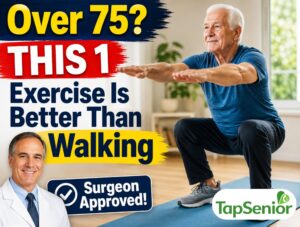
Over 75? THIS 1 Exercise Is Better Than Walking – Surgeon Approved!. Walking has long been considered one of the healthiest forms of exercise for older adults. It is simple, accessible, inexpensive, and easy to adapt to different fitness levels. For decades, healthcare professionals have encouraged seniors to stay active by taking daily walks, and for good reason. Regular walking supports cardiovascular health, helps regulate blood sugar, improves mood, and encourages an active lifestyle.
However, as people move into their mid-70s and beyond, many experts now agree that walking alone is no longer enough to address the physical changes that naturally occur with aging.
If you’re over 75, your body needs more than just movement. It needs exercises that rebuild strength, improve balance, stimulate the brain, protect bone health, and maintain independence. Walking remains an excellent habit, but it primarily trains your body to move in one direction at a relatively consistent pace. It does not challenge many of the systems that become increasingly vulnerable as we age.
Recent research suggests that a combination of resistance training, balance exercises, mobility work, and mindful movement may provide greater protection against falls, frailty, and loss of independence than walking alone. These forms of exercise target the muscles, joints, nervous system, and coordination patterns that seniors rely on every day for activities such as climbing stairs, standing from a chair, carrying groceries, reaching overhead, or simply walking confidently across uneven ground.
The good news is that it is never too late to begin.
Many studies indicate that adults well into their 70s, 80s, and even 90s can improve muscle strength, balance, mobility, and overall quality of life through appropriate exercise. The body remains remarkably adaptable throughout life when it receives the right type of physical challenge.
This article explores five exercises that many rehabilitation specialists, physical therapists, and orthopedic surgeons commonly recommend for healthy aging. Each exercise targets a different aspect of physical function, and together they create a well-rounded program that supports long-term mobility.
The final exercise may surprise you. Although it appears gentle, research has consistently shown that it can improve balance, coordination, reaction time, and confidence better than many traditional exercise programs.
Let’s first understand why simply walking is no longer enough after age 75.
Why Walking Alone Is No Longer Enough After 75
Walking is an excellent foundation for healthy aging. It strengthens the heart, encourages circulation, supports mental well-being, and helps people remain active throughout retirement. For many older adults, a daily walk is one of the highlights of the day.
Yet aging changes the body in ways that walking cannot fully address.
Beginning around the age of 30, adults gradually lose muscle mass through a process known as sarcopenia. This process accelerates after age 60 and often becomes more noticeable after age 75. Without regular strength training, muscles responsible for standing, climbing, lifting, and maintaining balance continue to weaken over time.
Walking uses these muscles, but not enough to significantly increase their strength.
Another challenge involves balance.
Falls remain one of the leading causes of injury among older adults worldwide. Many falls occur not because someone cannot walk, but because they cannot quickly recover from a sudden loss of balance. Walking in a straight line rarely challenges the body’s balance systems enough to improve these recovery skills.
The nervous system also changes with age.
Signals between the brain and muscles may travel more slowly, making reactions less automatic. Coordination becomes less precise, and simple tasks such as stepping over a curb or turning quickly can require more concentration than they once did.
Walking helps maintain mobility but provides relatively little challenge to these neurological systems.
Bone health is another important consideration.
Weight-bearing activities contribute to maintaining bone density, yet walking generally produces only modest loading forces. Many healthcare professionals recommend incorporating resistance exercises because stronger muscles place healthy stress on bones, encouraging them to remain stronger for longer.
Posture is equally important.
As people age, prolonged sitting, weaker back muscles, and reduced flexibility often contribute to rounded shoulders and a forward head position. Poor posture can influence breathing efficiency, walking mechanics, and even confidence. Walking alone rarely corrects these issues.
Perhaps most importantly, daily life rarely involves walking in a straight line.
Older adults constantly perform movements that require squatting, twisting, reaching, lifting, stepping sideways, changing direction, and reacting to unexpected situations. A complete exercise routine should prepare the body for these real-world demands.
Research suggests that combining walking with strength, balance, flexibility, and coordination training provides broader health benefits than relying on walking alone.
Rather than replacing walking, the goal is to complement it with exercises that fill in the gaps.
The next section explains exactly why these additional exercises become increasingly valuable after age 75.
What Happens to the Body After Age 75
Growing older does not automatically mean becoming weak or dependent. Many adults remain highly active well into their 80s and beyond. Nevertheless, understanding the natural changes that occur with aging helps explain why targeted exercise is so important.
Muscle Strength Declines Faster Than Many People Realize
One of the biggest changes involves muscle strength.
Research suggests that adults lose both muscle size and muscle power as they age. Muscle power the ability to generate force quickly is especially important because it allows us to catch ourselves when we trip or quickly step away from danger.
Losing strength does not simply affect athletic ability.
It changes everyday life.
Standing up from a low chair becomes harder.
Carrying groceries feels heavier.
Climbing stairs requires greater effort.
Even walking longer distances may become more tiring.
Fortunately, muscles continue responding to exercise throughout life. Many clinical studies have demonstrated meaningful improvements in strength among adults over 80 who participate in appropriately supervised resistance training.
Balance Depends on More Than Strong Legs
Balance is often misunderstood.
People assume it comes only from having strong muscles, but balance actually depends on several body systems working together.
Your eyes provide visual information.
Your inner ear detects movement and position.
Special sensors in your feet, joints, and muscles constantly tell your brain where your body is located in space.
Finally, your brain processes all of this information and sends instructions back to your muscles.
As we age, each of these systems may become less efficient.
That is why improving balance requires exercises that challenge coordination rather than simply increasing walking distance.
Bones Need Regular Mechanical Stress
Bone tissue constantly rebuilds itself.
When bones experience healthy mechanical stress through weight-bearing activity and muscle contractions, they receive signals to maintain strength.
Without enough stimulation, bones gradually lose density.
This process increases the risk of fractures if falls occur.
Exercises involving controlled resistance and body weight often provide stronger bone-building signals than walking alone.
Flexibility and Joint Mobility Change
Connective tissues naturally become less elastic with age.
Joints may feel stiffer after long periods of sitting.
Reduced flexibility affects movement quality and sometimes leads people to compensate with awkward movement patterns that increase injury risk.
Regular mobility exercises can help maintain comfortable movement and improve posture.
The Brain Also Needs Exercise
Perhaps the most fascinating discovery from modern aging research is that physical exercise benefits the brain as much as the muscles.
Movement that requires coordination, balance, memory, and concentration stimulates multiple brain regions simultaneously.
Many studies indicate that combining physical movement with mental engagement may support healthy cognitive aging better than repetitive exercise alone.
This concept becomes especially important when discussing the final exercise later in this article.
Before reaching that point, let’s begin with three highly effective exercises that complement daily walking.
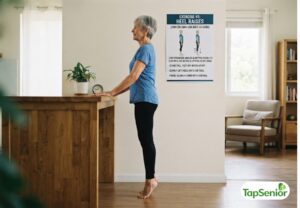
Exercise #5: Heel Raises for Stronger Ankles and Better Stability
The feet and ankles rarely receive much attention until problems develop.
Yet these small joints play a major role in walking, climbing stairs, maintaining balance, and preventing falls.
Every step you take depends on the strength of your calf muscles and the stability of your ankles.
Weak calves can shorten your stride, reduce walking efficiency, and make it more difficult to recover if you stumble.
Heel raises directly strengthen these muscles.
Although the movement appears simple, it contributes to many daily activities.
Why Heel Raises Matter
Clinical evidence suggests that stronger calf muscles support better walking mechanics and improve push-off strength during each step.
This makes walking feel smoother and less tiring.
Heel raises also improve ankle stability, which becomes increasingly valuable when navigating uneven sidewalks, grassy parks, or curbs.
Improved circulation is another potential benefit.
Repeated calf contractions assist blood flow back toward the heart, which may help reduce feelings of heaviness in the legs after prolonged sitting.
How to Perform Heel Raises
Stand behind a sturdy chair or kitchen counter for support.
Place your feet about hip-width apart.
Slowly lift your heels until you are standing on your toes.
Pause briefly.
Lower yourself under control.
Avoid bouncing or rushing through the movement.
Quality matters far more than speed.
Beginners may start with one set of 8 to 10 repetitions.
As strength improves, gradually increase to two or three sets.
Common Mistakes
Many people lean too far forward or shift their weight unevenly.
Instead, keep your body tall and move straight upward.
Try to control both the lifting and lowering phases.
The lowering portion helps strengthen muscles just as much as the lift itself.
Exercise #4: Single-Leg Balance to Reduce Fall Risk
Falls rarely happen because someone forgets how to walk.
They usually occur because the body cannot recover after an unexpected loss of balance.
Single-leg balance exercises safely train this recovery system.
Although standing on one foot sounds easy, it activates dozens of muscles throughout the feet, ankles, hips, abdomen, and back while forcing the brain to process continuous balance information.
Why Balance Training Works
Research consistently shows that balance-specific exercises improve postural control and confidence among older adults.
Practicing balance in a safe environment teaches the nervous system to react more efficiently during everyday activities.
This translates into greater stability when stepping over obstacles, turning around quickly, or walking on uneven surfaces.
How to Practice
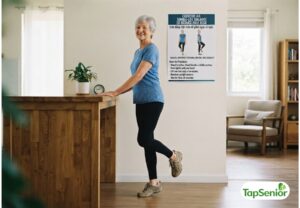
Stand beside a sturdy countertop.
Hold lightly with one hand.
Lift one foot only a few inches off the floor.
Maintain an upright posture while breathing normally.
Aim for 10 to 20 seconds.
Repeat on the opposite side.
As your confidence improves, gradually reduce the amount of support you use.
The goal is steady progress, not perfection.
Safety First
Never practice balance exercises without a stable object nearby.
If you have experienced recent falls, dizziness, or certain medical conditions, consult your healthcare provider before beginning a balance program.
Exercise #3: Sit-to-Stand for Everyday Independence
If there is one movement that reflects functional independence, it is standing up from a chair without assistance.
This seemingly ordinary task requires strong legs, stable hips, good coordination, and sufficient core strength.
Difficulty rising from a chair often signals declining lower-body strength.
The sit-to-stand exercise directly trains this essential movement.
Unlike gym machines that isolate individual muscles, this exercise strengthens multiple muscle groups simultaneously while closely mimicking everyday life.
Why This Exercise Is So Effective
Every time you stand up from a chair, your body recruits the quadriceps, glutes, hamstrings, abdominal muscles, and lower back.
Practicing this movement improves functional strength rather than simply increasing muscle size.
Many physical therapists include sit-to-stand exercises in rehabilitation programs because they translate directly into daily independence.
Getting out of bed, leaving the dining table, using the bathroom, or entering and exiting a vehicle all rely on similar movement patterns.
How to Perform It Correctly
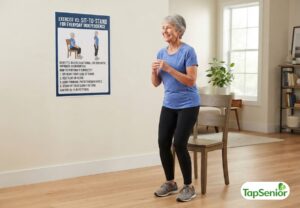
Sit near the front edge of a sturdy chair.
Place both feet flat on the floor.
Lean your upper body slightly forward.
Press through your heels as you stand.
Avoid using your hands if possible.
Once fully upright, slowly return to the chair with control.
Resist the temptation to drop quickly into the seat.
The controlled lowering phase builds strength just as effectively as standing up.
Building Confidence Over Time
Start with five repetitions if needed.
Gradually work toward 10 to 15 repetitions performed comfortably.
If the exercise feels too difficult, begin with a slightly higher chair or use your hands lightly for assistance.
Small improvements accumulate quickly with consistent practice.
By strengthening one of the most important movement patterns in daily life, sit-to-stand exercises help older adults preserve independence and confidence for years to come.
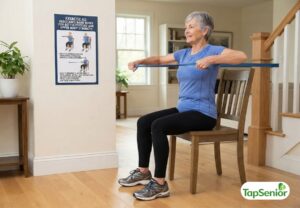
Exercise #2: Resistance Band Rows for Better Posture and Upper Body Strength
Many people associate aging with slower walking or weaker legs, but one of the earliest physical changes often appears in the upper body.
Rounded shoulders.
A forward head posture.
Difficulty reaching overhead.
Reduced grip strength.
These changes may seem cosmetic at first, yet they can influence breathing, balance, shoulder mobility, and even confidence.
Resistance band rows are one of the simplest ways to strengthen the muscles responsible for maintaining an upright posture.
Unlike heavy gym equipment, resistance bands are inexpensive, portable, and suitable for most fitness levels. They also provide smooth resistance throughout the movement, making them a popular choice among physical therapists.
Why Posture Matters More Than You Think
Good posture is about much more than appearance.
When the muscles of the upper back weaken, the shoulders gradually roll forward. This position can place additional stress on the neck and shoulders while limiting the rib cage’s ability to expand comfortably during breathing.
Research suggests that improving posture may contribute to better functional movement, reduced discomfort during everyday activities, and greater confidence in older adults.
Strong upper-back muscles also help stabilize the shoulders when lifting objects, reaching into cabinets, or carrying groceries.
Perhaps even more importantly, posture influences balance.
When the head shifts forward, the body’s center of gravity changes. This subtle shift may make it more difficult to react quickly to unexpected changes in direction.
Strengthening the muscles between the shoulder blades helps restore alignment and supports more efficient movement.
How to Perform Resistance Band Rows
Attach a resistance band securely at chest height or wrap it around a sturdy object.
Stand or sit with your spine tall.
Hold one end of the band in each hand.
Begin with your arms extended.
Pull your elbows backward while gently squeezing your shoulder blades together.
Imagine trying to hold a small object between your shoulder blades.
Pause briefly.
Return slowly to the starting position.
Avoid shrugging your shoulders toward your ears or leaning backward to create momentum.
The movement should feel smooth and controlled.
Aim for 8 to 12 repetitions for one or two sets, increasing resistance gradually as you become stronger.
Additional Benefits
Resistance band rows strengthen several muscles at once, including the rhomboids, trapezius, rear shoulders, and upper arms.
These muscles contribute to:
- Better posture during standing and walking
- Improved shoulder mobility
- Easier lifting and carrying
- Increased upper-body endurance
- Better support for daily activities
Some studies also suggest that maintaining upper-body strength is associated with improved functional independence in later life.
Although this exercise may not receive as much attention as squats or walking, it plays an important role in preserving mobility.
Now we arrive at the exercise that often surprises people the most.
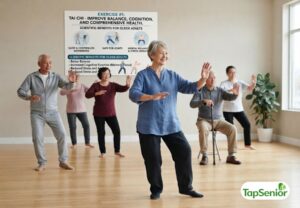
Exercise #1: Tai Chi – The Exercise That May Be Better Than Walking After 75
If someone told you that one gentle exercise could improve balance, strengthen coordination, challenge the brain, reduce stress, and help maintain independence, you might assume it required advanced skills or years of experience.
Tai Chi is exactly the opposite.
Its movements are slow.
Graceful.
Low impact.
Accessible.
Yet beneath this calm appearance lies one of the most comprehensive forms of exercise available for older adults.
Many healthcare providers, physical therapists, and researchers now recognize Tai Chi as an excellent activity for healthy aging because it trains the body and brain simultaneously.
Rather than focusing on one muscle group or one physical ability, Tai Chi integrates strength, flexibility, coordination, breathing, posture, and mindful movement into a single practice.
Why Tai Chi Is Different from Walking
Walking is repetitive.
Each step follows nearly the same movement pattern.
Tai Chi constantly changes direction, body position, and weight distribution.
One moment you shift weight onto one leg.
The next moment you rotate your hips.
Then you coordinate slow arm movements while maintaining an upright posture.
These continuous changes require the brain to remain actively engaged.
Research suggests that this combination of physical movement and mental focus may stimulate neuroplasticity the brain’s ability to adapt and build new neural connections throughout life.
This is one reason many experts believe Tai Chi offers benefits beyond traditional aerobic exercise.
A Powerful Tool for Balance
Falls often happen unexpectedly.
You step on uneven ground.
Turn too quickly.
Reach for something overhead.
Lose your footing.
Recovering from these situations depends on your ability to shift weight smoothly and react efficiently.
Tai Chi repeatedly practices these exact skills.
The slow transitions encourage greater awareness of body position while strengthening the muscles responsible for stability.
Clinical evidence consistently suggests that Tai Chi can improve balance and reduce the likelihood of falls among community-dwelling older adults when practiced regularly.
For many seniors, this may be one of its greatest advantages.
Strength Without High Impact
Some older adults avoid exercise because they worry about painful joints.
Tai Chi offers an appealing alternative.
The movements place relatively little stress on the knees, hips, and ankles while still encouraging muscles to work through controlled weight shifts.
Instead of sudden impacts, the body experiences slow, deliberate movement.
This makes Tai Chi suitable for many people who cannot tolerate high-impact exercise.
Of course, anyone with existing medical conditions should consult their healthcare provider before beginning a new exercise program.
Brain Health and Cognitive Function
Scientists continue exploring how movement influences brain health.
Many studies indicate that exercises combining coordination, memory, attention, and physical activity may help support healthy cognitive aging.
Tai Chi requires participants to remember movement sequences while coordinating breathing, posture, and balance.
This creates a unique challenge for the nervous system.
Some research has associated regular Tai Chi practice with improvements in executive function, attention, and overall mental well-being, although results naturally vary from person to person.
Rather than simply exercising the muscles, Tai Chi encourages the entire body and brain to work together.
Stress Reduction Matters Too
Healthy aging involves more than physical strength.
Emotional well-being also plays a significant role.
Slow breathing and mindful movement encourage relaxation and may help reduce stress.
Many participants describe finishing a Tai Chi session feeling calmer, more focused, and mentally refreshed.
Reducing chronic stress supports healthy sleep, recovery, and overall quality of life.
For older adults managing busy family responsibilities, caregiving duties, or health concerns, this mental benefit can be just as valuable as the physical improvements.
It Can Be Adapted for Almost Anyone
One of Tai Chi’s greatest strengths is its flexibility.
Movements can be practiced:
- Standing
- Holding onto a chair
- In small groups
- At community centers
- Outdoors
- Even while seated for individuals with limited mobility
This adaptability allows many seniors to participate safely while progressing at their own pace.
There is no competition.
No pressure to move quickly.
Only gradual improvement over time.
Consistency Is More Important Than Intensity
Many people assume exercise must be exhausting to produce results.
Tai Chi demonstrates the opposite.
Gentle, consistent practice often provides greater long-term benefits than occasional intense workouts that are difficult to maintain.
Practicing for 20 to 30 minutes several times each week may be enough to build confidence, improve movement quality, and encourage lifelong physical activity.
The best exercise is ultimately the one you enjoy enough to continue.
For countless older adults around the world, Tai Chi becomes not just exercise but a lifelong habit.
A Simple Weekly Exercise Plan for Adults Over 75
An effective fitness routine does not need to be complicated.
The goal is to challenge different parts of the body throughout the week while allowing adequate recovery.
Here is one example.
Monday
- 20–30 minutes of walking
- Sit-to-Stand
- Heel Raises
Tuesday
- Tai Chi practice
- Gentle stretching
Wednesday
- Walking
- Resistance Band Rows
- Balance practice
Thursday
- Tai Chi
- Flexibility exercises
Friday
- Walking
- Sit-to-Stand
- Heel Raises
- Resistance Band Rows
Saturday
- Tai Chi or another enjoyable low-impact activity
Sunday
- Active recovery
- Gentle walking
- Light stretching
Remember that consistency matters more than perfection.
Even small amounts of movement performed regularly can contribute to long-term health.
Safety Tips Before Starting
Every person ages differently.
Before beginning a new exercise program, especially if you have chronic medical conditions, recent surgery, dizziness, heart disease, or significant joint pain, speak with your physician or healthcare provider.
Additional safety recommendations include:
- Wear supportive shoes with good traction.
- Exercise in a well-lit, clutter-free area.
- Keep a sturdy chair nearby during balance exercises.
- Stay hydrated throughout the day.
- Warm up before exercising.
- Stop immediately if you experience chest pain, severe dizziness, or unusual shortness of breath.
- Progress gradually rather than increasing intensity too quickly.
- Focus on proper movement quality rather than completing large numbers of repetitions.
Remember that improving health is a marathon, not a sprint.
Frequently Asked Questions
Is walking still good after age 75?
Absolutely.
Walking remains one of the healthiest activities for cardiovascular health, mental well-being, and maintaining daily mobility.
The key message is not to replace walking but to complement it with strength, balance, and coordination exercises.
How many days each week should older adults exercise?
Many health organizations recommend regular physical activity spread throughout the week.
This typically includes aerobic activity, muscle-strengthening exercises, flexibility work, and balance training.
Your ideal routine should be based on your current health and your healthcare provider’s recommendations.
Can I start exercising if I’ve never exercised before?
In many cases, yes.
Begin slowly with simple movements and gradually increase difficulty over time.
Professional guidance from a physical therapist or qualified fitness instructor may also be beneficial.
Is Tai Chi safe for people with arthritis?
Many people with arthritis find Tai Chi comfortable because it involves slow, controlled, low-impact movements.
However, every individual is different, so consult your healthcare provider before starting any new exercise program.
Which exercise should I start with?
If you are completely new to exercise, begin with short walks and simple sit-to-stand movements.
As confidence improves, gradually introduce balance training, resistance band exercises, and eventually Tai Chi.
The goal is steady, sustainable progress.
Conclusion
Aging changes the body, but it does not eliminate its ability to adapt.
Research continues to demonstrate that appropriate exercise can improve strength, balance, mobility, coordination, and overall quality of life well into later adulthood.
Walking remains an outstanding habit and deserves its place in every healthy lifestyle.
Yet after age 75, relying on walking alone may leave important areas of fitness underdeveloped.
By combining walking with heel raises, balance practice, sit-to-stand exercises, resistance band rows, and especially Tai Chi, you create a routine that challenges nearly every system responsible for maintaining independence.
You do not need expensive equipment.
You do not need an athletic background.
You simply need consistency, patience, and the willingness to keep moving.
Every small step you take today helps build a stronger, more confident tomorrow.
Whether your goal is to continue gardening, travel with family, play with grandchildren, or simply move through daily life with greater ease, the right exercises can help you stay active for years to come.
Healthy aging is not about chasing perfection.
It is about preserving the freedom to enjoy the life you love.
Stay Active, Stay Independent with TapSeniors
At TapSeniors, we believe that healthy aging goes beyond exercise. Staying independent also means having reliable support for everyday needs from transportation and wellness services to home assistance and community resources designed specifically for older adults.
Whether you’re looking for practical health tips, trusted senior-focused services, or ways to maintain an active lifestyle, TapSeniors is here to help you navigate every stage of aging with confidence.
Explore more articles, discover helpful resources, and join a growing community dedicated to helping older adults live healthier, safer, and more fulfilling lives. Visit TapSeniors.com to learn more and continue your journey toward lifelong wellness.
Bài viết liên quan: