
Growing older doesn’t mean giving up an active lifestyle. In fact, regular movement becomes even more important as we age. Whether you’re living with arthritis, recovering from surgery, experiencing limited mobility, or simply beginning your fitness journey, gentle chair exercises can help you maintain strength, flexibility, balance, and confidence without putting unnecessary stress on your joints.
Gentle Range of Motion Chair Exercises for SENIORS (Arthritis/Limited Mobility/True Beginners) are specifically designed to help older adults move safely while improving circulation, reducing stiffness, and supporting everyday activities. Unlike high-impact workouts, these seated movements allow seniors to exercise comfortably while minimizing the risk of falls or injuries.
Many seniors struggle with joint pain, muscle weakness, reduced flexibility, or fear of falling. These challenges often lead to less physical activity, which unfortunately creates even more stiffness and weakness over time. The good news is that even small amounts of gentle daily movement can make a remarkable difference.
Chair exercises are one of the safest and most accessible ways to stay active. They require very little equipment, can be performed almost anywhere, and can easily be adapted to different mobility levels. Whether someone uses a walker, cane, wheelchair, or simply prefers exercising while seated, these exercises provide an effective way to improve overall health.
Regular range of motion exercises help lubricate joints, encourage healthy blood circulation, maintain muscle function, and support better posture. They also contribute to greater independence by making everyday activities such as standing up, reaching overhead, dressing, cooking, shopping, or walking easier and more comfortable.
For seniors living with arthritis, gentle movement may also reduce joint stiffness and improve daily function. While exercise cannot cure arthritis, consistent low-impact movement helps nourish the joints and keeps surrounding muscles strong enough to support them.
This comprehensive guide will walk you through a full-body seated exercise routine suitable for true beginners. Each movement is simple, easy to follow, and can be modified based on your comfort level. Remember that the goal isn’t perfection it’s consistent movement that supports healthier aging.
If any exercise causes pain rather than mild muscle effort or stretching, stop immediately and adjust the movement. Everyone’s body is different, and listening to your own body is always the best approach.
Let’s begin by understanding why these gentle exercises are so valuable for older adults.
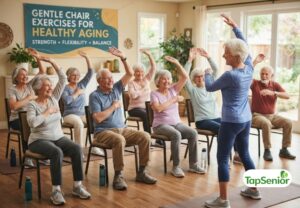
Why Range of Motion Exercises Matter for Seniors
Range of motion exercises are movements that gently take your joints through their natural motion. They help maintain flexibility while preventing stiffness that often develops with age or inactivity.
These exercises are especially beneficial for seniors because they focus on movement quality rather than intensity.
Some of the biggest benefits include:
Improves Joint Flexibility
As we age, our joints naturally become less flexible. Cartilage wears down, muscles tighten, and connective tissues lose elasticity. Gentle movement helps preserve mobility by encouraging joints to move regularly throughout their comfortable range.
Reduces Morning Stiffness
Many older adults experience stiffness after waking up or sitting for long periods. Gentle exercises help warm up the muscles and lubricate the joints, making movement feel easier throughout the day.
Strengthens Supporting Muscles
Strong muscles provide better support for joints affected by arthritis or age-related wear. Even light resistance using your own body weight or small water bottles can help maintain muscle strength.
Improves Circulation
Seated exercises encourage healthy blood flow throughout the body, helping deliver oxygen and nutrients to muscles while reducing swelling in the lower legs.
Supports Better Balance
Many chair exercises strengthen the hips, thighs, calves, ankles, and core muscles all of which play an important role in maintaining balance and preventing falls.
Helps Maintain Independence
Simple daily activities such as climbing stairs, reaching kitchen cabinets, carrying groceries, getting out of a chair, or walking around the house all require strength and mobility. Regular exercise helps preserve these abilities for as long as possible.
Enhances Mental Well-Being
Physical activity stimulates the release of endorphins, helping reduce stress while improving mood, confidence, and overall quality of life.
Who Can Benefit From These Chair Exercises?
This workout is ideal for:
- Seniors over 60
- Adults with arthritis
- People recovering from illness or surgery (with medical approval)
- Individuals with limited mobility
- Wheelchair users
- Beginners who haven’t exercised for years
- Anyone looking for a gentle full-body workout
Even if you cannot complete every movement today, small improvements over time add up to significant long-term benefits.
Safety Tips Before You Begin
Before starting your exercise routine, take a few minutes to prepare.
Choose a sturdy chair that won’t slide or roll. Dining chairs work better than soft couches because they provide more support and encourage proper posture.
Sit tall with:
- Feet flat on the floor
- Knees bent approximately 90 degrees
- Shoulders relaxed
- Back comfortably upright
- Core gently engaged
Wear comfortable clothing that allows free movement.
Supportive walking shoes or athletic shoes are recommended to provide stability during lower-body exercises.
Keep a bottle of water nearby and stay hydrated before, during, and after your workout.
If you have severe osteoporosis, uncontrolled blood pressure, recent surgery, or other medical conditions, consult your healthcare provider before beginning any new exercise program.
Remember:
Move slowly.
Never force painful movements.
Breathe normally.
Quality is always more important than speed.
Equipment You’ll Need
One of the best things about this workout is its simplicity.
You’ll only need:
- A sturdy chair
- Comfortable shoes
- A bottle of water
- Optional light weights or water bottles (1–5 pounds)
If weights feel uncomfortable, simply perform every movement without them. You’ll still receive excellent benefits.
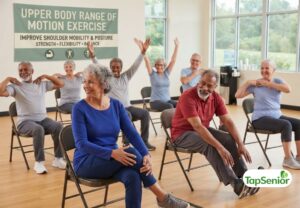
Warm-Up: Prepare Your Body for Movement
A proper warm-up gently increases circulation while preparing muscles and joints for exercise.
Spend about five minutes warming up before beginning the main workout.
1. Wrist Circles
Begin by relaxing your shoulders.
Extend your hands comfortably in front of you.
Slowly rotate both wrists in small circles.
Complete several circles clockwise before reversing directions.
This simple movement helps loosen stiff wrists and fingers, especially for seniors living with arthritis.
Focus on slow, controlled circles rather than fast rotations.
2. Deep Breathing with Overhead Reach
Raise both arms comfortably overhead as you slowly inhale through your nose.
Lower your arms while gently exhaling through your mouth.
Repeat several times.
This movement:
- Opens the chest
- Encourages better posture
- Improves lung expansion
- Helps relax the body
If lifting your arms overhead causes discomfort, simply raise them to shoulder height instead.
Upper Body Mobility Exercises
Once your body feels warm, begin gently activating the shoulders, arms, and upper back.
3. Arm Reach and Pull
Extend both arms straight forward.
Slowly pull your elbows back while gently squeezing your shoulder blades together.
Then reach forward again.
Imagine you’re opening a large curtain.
This movement improves mobility in the shoulders and upper back while strengthening the muscles responsible for good posture.
If pulling your elbows fully backward feels uncomfortable, simply move within a smaller, pain-free range.
Repeat slowly while maintaining steady breathing.
4. Single Arm Overhead Pull
Raise one arm overhead.
Slowly pull your elbow downward as though you’re pulling down a rope.
Reach upward again.
Repeat several times before switching sides.
This exercise improves shoulder mobility while gently activating the muscles of the upper back.
To increase muscle engagement without heavier weights, imagine you’re pulling against resistance.
The movement becomes surprisingly effective simply by adding intentional muscle control.
5. Seated Swimming Motion
Stretch both arms forward.
Make large, smooth swimming circles.
Reach forward as much as comfortably possible before completing each circular motion.
Imagine gliding through water.
This movement improves coordination while encouraging mobility throughout the shoulders, chest, and upper back.
Perform slow, controlled circles rather than rushing.
Lower Body Mobility Exercises
Healthy legs are essential for walking, climbing stairs, maintaining balance, and preventing falls.
These gentle seated movements begin activating the hips, knees, ankles, and calves without placing excessive stress on the joints.
6. Forward Toe Taps
Sit tall with both feet flat on the floor.
Extend one foot forward and lightly tap the floor with your toes.
Return to the starting position.
Alternate legs.
This exercise improves hip mobility while gently warming up the muscles responsible for walking.
Focus on smooth, rhythmic movement rather than speed.
If lifting the leg is difficult, simply slide the foot forward along the floor before returning.
7. Side Leg Taps
Keeping your knee bent comfortably, move one foot out to the side.
Return to the center.
Repeat several times before switching legs.
This movement strengthens the muscles around the hips, which are critical for balance and stability during walking.
Wheelchair users can perform a modified version by moving the foot outward only as far as comfortably possible.
Every inch of movement contributes to maintaining joint mobility.
8. Heel Taps
Extend one heel forward while keeping your toes pointed upward.
Return to the starting position.
Alternate sides slowly.
Heel taps activate the muscles along the front of the legs while improving ankle flexibility and preparing the body for more advanced leg exercises.
This movement also encourages healthy circulation in the lower extremities.
9. Heel Raises
With both feet flat on the floor, slowly lift your heels while keeping your toes on the ground.
Pause briefly at the top before lowering your heels back down.
This exercise strengthens the calf muscles, which play a vital role in maintaining balance and supporting walking endurance.
Stronger calves also contribute to better stability, helping reduce the risk of falls during everyday activities.
10. Toe Raises
After strengthening the calf muscles, it’s equally important to work the muscles along the front of the lower legs.
Sit comfortably with both feet flat on the floor.
This time, keep your heels firmly planted while lifting your toes toward the ceiling. Hold the position briefly before lowering your feet back down with control.
Although this movement looks simple, it plays an important role in improving ankle mobility and strengthening the tibialis anterior muscle. Strong muscles in the front of the lower legs help seniors lift their feet properly while walking, reducing the risk of tripping over rugs, uneven sidewalks, or door thresholds.
Try to move slowly and avoid rocking your body backward. The movement should come only from your ankles.
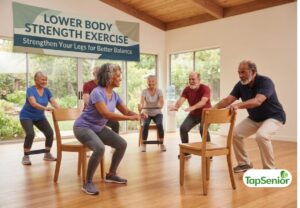
11. Seated Marching
Now it’s time to gently increase circulation and wake up the hips.
Sit tall with your feet flat on the floor.
Slowly lift one knee toward your chest, then lower it before lifting the opposite knee. Continue alternating as though you are marching while sitting.
The goal is not speed but smooth, controlled movement.
Seated marching helps improve:
- Hip mobility
- Core stability
- Blood circulation
- Coordination
- Walking endurance
If lifting your knees feels difficult, simply raise each foot a few inches from the floor.
As your strength improves, gradually increase the height of your knees while maintaining good posture.
12. Seated Leg Extensions
The quadriceps muscles are among the most important muscles for maintaining independence.
They help you:
- Stand up from a chair
- Walk safely
- Climb stairs
- Maintain balance
Sit near the back of your chair with your back straight.
Slowly straighten one knee until your lower leg becomes almost parallel with the floor.
Pause briefly while tightening the muscles on the front of your thigh.
Lower the leg slowly.
Complete several repetitions before switching to the opposite leg.
Avoid swinging your entire leg. Instead, imagine only your lower leg extending while your upper leg remains supported by the chair.
The slower you perform this movement, the more effectively your muscles work.
Upper Body Strengthening Exercises
Once your lower body has warmed up, it’s time to strengthen the upper body using either light hand weights or water bottles.
Remember:
Weights are optional.
Even without resistance, controlled movement helps build muscular endurance and improve joint mobility.
13. Bent-Over Row
Sit near the front edge of the chair.
Lean forward slightly while keeping your back comfortably straight.
Hold a light weight or water bottle in each hand.
Allow your arms to hang naturally.
Now slowly pull both elbows upward toward your ribs.
Imagine trying to squeeze something between your shoulder blades.
Pause briefly before lowering your arms.
This exercise strengthens:
- Upper back
- Rear shoulders
- Rhomboids
- Postural muscles
Strong upper-back muscles make everyday tasks such as lifting groceries, carrying laundry, and maintaining upright posture much easier.
Focus on squeezing your shoulder blades together rather than simply lifting the weights.
14. Seated Chest Press
Sit upright near the front of your chair.
Hold your hands or light weights close to your chest.
Slowly press both arms straight forward.
Pause briefly.
Return to the starting position.
This exercise strengthens the chest, shoulders, and triceps while improving the pushing movements used during daily activities.
Whether pushing a shopping cart, opening heavy doors, or rising from a chair using armrests, strong pushing muscles improve independence.
Maintain smooth breathing throughout each repetition.
15. Seated Calf Lift with Knee Resistance
Place your hands or light weights gently on top of your knees.
Lift your heels from the floor while keeping your toes planted.
The added resistance from your hands encourages the calf muscles to work a little harder without placing stress on the joints.
Pause briefly before lowering your heels.
This movement supports better walking mechanics while improving lower-leg strength.
16. Bicep Curl with Overhead Press
Hold a light weight or water bottle in each hand.
Begin with your arms at your sides.
Curl the weights toward your shoulders.
If comfortable, continue pressing the weights overhead.
Lower them back to shoulder level before returning to the starting position.
If overhead pressing causes shoulder discomfort, simply press forward instead or complete only the bicep curl.
This exercise strengthens:
- Biceps
- Shoulders
- Upper arms
These muscles assist with lifting objects onto shelves, carrying bags, and reaching overhead safely.
Always use a weight that allows comfortable movement without straining.
17. Tricep Kickbacks
Lean slightly forward while keeping your back straight.
Bring your elbows close to your body.
Extend your forearms backward until your arms become straight.
Pause briefly while squeezing the back of your upper arms.
Return slowly.
The triceps often weaken with age, making pushing movements more difficult.
Strengthening these muscles helps with:
- Standing from chairs
- Pushing open doors
- Using walkers safely
- Daily household activities
Move slowly to maximize muscle engagement.
18. Shoulder Lateral Raises
Hold one light weight or simply use your arm without resistance.
Raise your arm sideways until approximately shoulder height.
Lower slowly.
Complete all repetitions before changing sides.
If your shoulders are sensitive, reduce the lifting height or perform the movement without weights.
The objective is comfortable movement not maximum height.
Strong shoulders help seniors safely reach cupboards, wash their hair, and perform countless daily activities.

19. Front Shoulder Raises
Raise one arm forward until approximately shoulder height.
Lower slowly.
Alternate sides.
This gentle movement strengthens the front shoulder muscles while improving reaching ability.
Again, quality is far more important than quantity.
Small controlled movements produce excellent results over time.
20. Hammer Curls
Instead of rotating your palms upward like traditional curls, keep your palms facing inward throughout the movement.
Lift the weights toward your shoulders before lowering them again.
Hammer curls strengthen the forearms as well as the biceps, improving grip strength for tasks like opening jars, carrying groceries, or holding onto mobility aids.
Repeat Key Lower Body Exercises
Toward the end of the workout, revisit a few of the lower-body exercises.
Repeat another set of:
- Leg extensions
- Side leg taps
- Gentle marching
Repeating these movements reinforces muscle activation and builds endurance without adding unnecessary complexity.
Consistency always delivers better results than overly difficult routines.
Functional Reaching Exercises
Daily life requires frequent reaching.
Whether placing dishes in cupboards, retrieving clothing, or reaching for books, shoulder mobility is essential.
Raise one arm overhead while lowering the opposite arm.
Alternate sides slowly.
Reach only as high as feels comfortable.
This functional movement improves coordination while maintaining the flexibility needed for everyday independence.
Resistance Without Weights
One of the easiest ways to increase exercise intensity is by using your imagination.
Pretend you are:
- Pulling a heavy rope
- Pushing open a heavy door
- Moving a large piece of furniture
By intentionally contracting your muscles throughout the movement, you can significantly increase muscle activation without adding heavier weights.
This technique is especially useful for seniors who should avoid heavy resistance.
Shoulder Circles
Extend both arms comfortably to shoulder height.
Make very small circles.
Keep the circles controlled and slow.
If holding your arms up becomes tiring, simply pause and rest before continuing.
Shoulder endurance is important for performing household activities without fatigue.
Arm Presses
Bring your palms together in front of your chest.
Press forward.
Return.
Then gently pull your elbows backward.
This sequence improves chest mobility while strengthening the muscles around the shoulders and upper back.
Seated Punches
With relaxed shoulders, alternate gentle forward punches.
Avoid locking your elbows.
Imagine reaching toward a target in front of you.
This movement encourages coordination while lightly increasing your heart rate.
It also helps maintain shoulder mobility through repetitive, controlled movement.
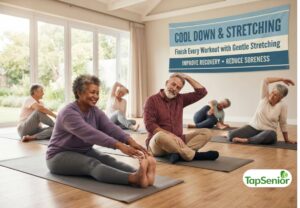
Cool Down and Stretching
Cooling down is just as important as warming up.
Stretching allows your muscles to relax while helping reduce post-exercise stiffness.
Side Stretch
Raise one arm overhead.
Reach gently toward the opposite side.
Hold for several comfortable breaths.
Switch sides.
This stretch lengthens the muscles along the sides of your body while improving flexibility.
Chest Stretch
Bring both hands behind your back if possible.
Open your chest gently.
Look forward.
Hold the stretch comfortably without forcing your shoulders.
This helps counteract the rounded posture that often develops from prolonged sitting.
Cross-Body Shoulder Stretch
Bring one arm across your chest.
Use the opposite hand to gently pull the arm closer.
Hold without bouncing.
Repeat on the opposite side.
This stretch relieves tension in the shoulders and upper back.
Hamstring Stretch
Extend one leg forward.
Point your toes toward the ceiling.
Sit tall while gently feeling the stretch behind your thigh.
Avoid rounding your back.
Repeat with the opposite leg.
Ankle Mobility
Lift one foot.
Rotate the ankle slowly in both directions.
Repeat with the other foot.
Maintaining ankle mobility supports better walking mechanics and reduces stiffness.
Finish with Deep Breathing
End your workout by taking several slow, deep breaths.
Raise your arms gently while inhaling through your nose.
Lower them as you exhale through your mouth.
Deep breathing helps:
- Relax the nervous system
- Lower muscle tension
- Improve oxygen delivery
- Leave you feeling refreshed
Take your time.
Enjoy the feeling of accomplishment after completing your workout.
How Often Should Seniors Perform These Exercises?
For most healthy older adults, this gentle chair routine can be performed 3 to 5 days per week.
Those with arthritis often benefit from shorter daily sessions because regular movement helps reduce stiffness.
A simple weekly schedule might look like this:
- Monday: Full chair workout
- Tuesday: Gentle stretching and walking
- Wednesday: Chair workout
- Thursday: Rest or light mobility exercises
- Friday: Chair workout
- Saturday: Leisure walk or recreational activity
- Sunday: Recovery and stretching
Even 20–30 minutes of movement several times each week can lead to noticeable improvements in flexibility, strength, and confidence.
Additional Tips for Exercising Safely
To get the most from your routine:
- Exercise at the same time each day to build consistency.
- Wear supportive footwear.
- Stay hydrated before and after exercise.
- Avoid holding your breath during movements.
- Move slowly and with control.
- Stop immediately if you experience sharp pain, dizziness, chest pain, or unusual shortness of breath.
- Celebrate progress, no matter how small.
Remember, improvement comes from regular practice not perfection.
Frequently Asked Questions
1. Are chair exercises effective for seniors?
Yes. Chair exercises improve strength, flexibility, circulation, and balance while minimizing stress on the joints, making them ideal for older adults and beginners.
2. Can seniors with arthritis perform these exercises?
Absolutely. Gentle range of motion exercises are often recommended to help reduce joint stiffness and maintain mobility. Always stay within a comfortable range and consult your healthcare provider if you have concerns.
3. How long should each session last?
Most beginners can benefit from sessions lasting 20 to 30 minutes. As endurance improves, the duration can gradually increase.
4. Do I need weights?
No. Bodyweight movements alone provide excellent benefits. Light weights or water bottles can be added later if appropriate.
5. Is it normal to feel mild muscle soreness?
A little muscle fatigue is normal when starting a new routine. Sharp pain or persistent discomfort is not and should be evaluated by a healthcare professional.
6. Can these exercises help reduce the risk of falls?
Yes. Strengthening the legs, improving balance, and maintaining joint mobility all contribute to better stability and a lower risk of falling.
7. What if I use a wheelchair?
Many of these exercises can be adapted for wheelchair users. Focus on comfortable movements and modify the range of motion as needed.
8. Can I do these exercises every day?
Gentle mobility exercises are generally safe to perform daily, provided you listen to your body and avoid overexertion.
Final Thoughts
Staying active doesn’t require a gym membership or complicated fitness equipment. Sometimes, all you need is a sturdy chair, a little determination, and a commitment to move a bit each day.
These Gentle Range of Motion Chair Exercises for SENIORS (Arthritis/Limited Mobility/True Beginners) are designed to help older adults maintain mobility, improve strength, ease stiffness, and support long-term independence. Every stretch, reach, lift, and controlled movement contributes to better physical function and greater confidence in daily life.
Remember that progress is personal. Some days you may feel stronger than others, and that’s perfectly normal. Focus on consistency rather than intensity, celebrate every improvement, and allow your body to adapt at its own pace. Over time, these small daily efforts can lead to meaningful gains in flexibility, balance, endurance, and overall well-being.
At TapSeniors, we believe that healthy aging begins with simple, sustainable habits. Whether you’re just starting your wellness journey or looking for safe ways to stay active despite arthritis or limited mobility, gentle chair exercises are an excellent foundation for living a healthier, more independent life. Keep moving, stay positive, and remember that every step toward better mobility is a step toward a higher quality of life.
Bài viết liên quan: